Nobel scientist calls Trump 'senile felon' and spots a troubling flaw
REUTERS/Umit Bektas
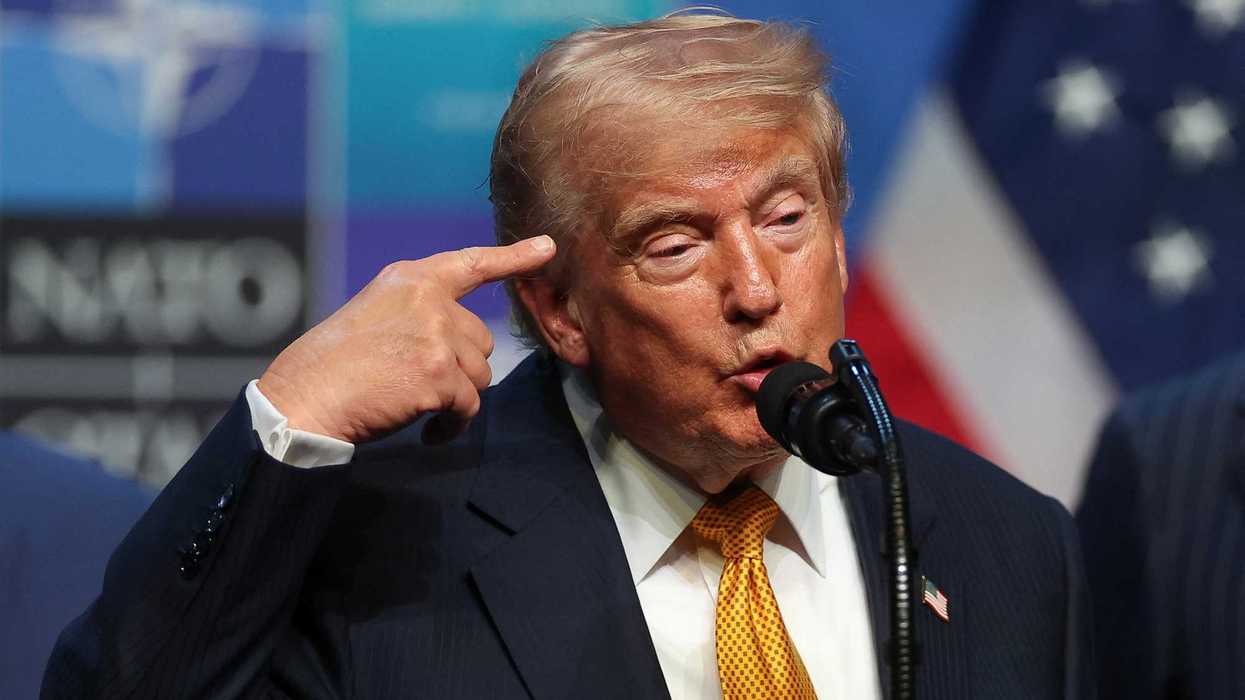
U.S. President Donald Trump gestures as he speaks to the media on the day of a NATO leaders' summit in Ankara, Turkey, July 8, 2026.

U.S. President Donald Trump gestures as he speaks to the media on the day of a NATO leaders' summit in Ankara, Turkey, July 8, 2026.
A Nobel Prize-winning scientist took a big swipe at President Donald Trump, calling him a "corrupt, senile felon" and saying he spotted another problem regarding a subject he has fully embraced.
Geoffrey Hinton, who is a pioneering computer scientist and one of the world's most influential researchers, discussed the president’s mental acuity in an interview with The Guardian published Tuesday.
Hinton, who won the 2024 Nobel Prize in Physics, criticized not only Trump but also his Silicon Valley allies, accusing them of ambition beyond raking in billions. He pointed the finger at billionaire investors Marc Andreessen, Elon Musk and Peter Thiel, saying the trio “don’t believe in democracy.”
He also believes that they see themselves as superior individuals who should "control society” and suggested they view Trump as a useful instrument for achieving those ambitions.
He directed some of his harshest criticism at the president himself, arguing that he shows a basic lack of understanding of a rapidly evolving technology capable of transforming society.
The scientist was referring to artificial intelligence and Trump's recent insistence on replacing that term with "superintelligence."
Hinton, widely regarded as the godfather of AI, said the president understands "almost nothing" about the technology.
He said superintelligence has a definite scientific meaning: systems that exceed human intelligence, and merely changing the name, he said, doesn't make existing systems any smarter.
Trump recently declared on Truth Social that anyone refusing to adopt his preferred terminology was "THE ENEMY."
Hinton also challenged the president's opposition to government safeguards, particularly his apparent willingness to let technology companies regulate themselves.
He compared that approach to letting tobacco companies, stating: “Do we think tobacco companies should have been allowed to design the warnings on the packets? So that they could print them in a six-point font, in dark grey on black?”
Hilton’s comment came after he received criticism from power players in the industry.
Nvidia CEO Jensen Huang recently pushed back on Hinton's predictions about the dangers of advanced AI, arguing that his estimates lacked sufficient scientific evidence. Hinton previously predicted a 10% to 20% chance that the technology could cause human extinction in the coming decades. He defended his dystopian warning by explaining that the precise probability matters less than recognizing the possibility of catastrophe.
The scientist also warned that humanity has only a few years in which to get used to sharing the world with machines that are becoming more and more intelligent at a rapid pace.
Hinton, having left Google in 2023 to speak openly about the dangers of the technology, maintained that failing to prioritize safety when developing more powerful systems could lead to irreversible consequences.