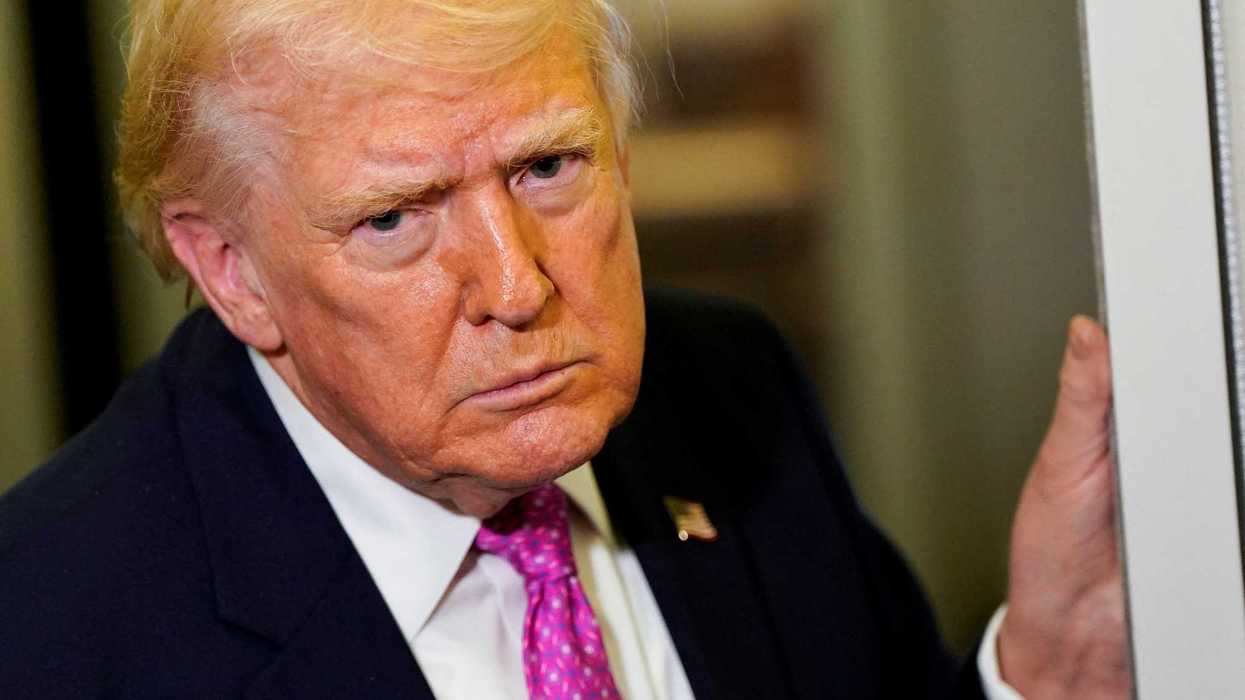
As Slate contributor Christina Cauterucci explains, though President Donald Trump “is a man of specific tastes, his aesthetic thrust is neither complicated nor refined. A maximalist to the end, he likes things ornate. He likes them newly constructed but grounded in centuries-old design. And above all else, he likes them gold.” That obsession with gold, Cauterucci argues, is not only derived from Trump’s desire to portray an image of wealth, but speaks to his pharonic dreams of immortality.
Cauterucci catalogs no shortage of examples of Trump’s gold fixation. It’s long been a “trademark of Trumpworld,” and he has brought it into the White House, decorating the so-called People’s House with as much gold trim as possible. And recently at the Trump National Doral Miami golf club, a group of clergy members dedicated a 22-foot-tall golden statue of the president, an idol that is “everything Trump wants to be: larger than life, fit to be worshipped, an embodiment of excess that thumbs its nose at notions of democratic propriety.”
“As far as design fetishes go,” explains Cauterucci, “gold is a logical one. In ancient civilizations as in ours, it was status made manifest. Societies across the world valued gold as a symbol of divinity, immortality, and authority; its rarity made it a special privilege to behold and possess. In recent eras, as power became increasingly synonymous with wealth, gold turned into shorthand for prosperity itself.”
For Trump, gold projects the “supremacy and luxury enjoyed by monarchical figures of the past, who built the likes of Egyptian temples and Versailles.” This is why it often goes hand in hand with his vanity projects. His D.C. arch, for example, will be extensively trimmed with gold.
But “to critical observers,” writes Cauterucci, “Trump’s lifelong attempt to project superiority through gold has had the exact opposite effect. Fran Lebowitz had Trump’s number when she called him ‘a poor person’s idea of a rich person’...Gold is garish, obvious, a rejection of respectability — the decor equivalent of Mar-a-Lago face…It reveals not just an absence of original taste but deep insecurity.”
What’s more, says Cauterucci, Trump’s obsession with the fancy metal and vanity projects implies a fixation with life everlasting.
“Even mortality can be staved off by enough gold, Trump seems to believe,” writes Cauterucci. “At this point in his public arc, his affinity for the material is more like a colonizing claim. As with red baseball caps, it is a calling card that evokes his presence without explanation. Trump loves to plaster his name on things, but barring that, gold leaves his imprint just the same. Long after Trump is gone, Americans will look on his works — the gilded White House ballroom that will be considered, if not named, the Trump Room — and despair.”
As Cauterucci points out, there is no shortage of literature and legend to suggest the folly of Trump’s golden mindset.
“Like Ozymandias, and like all the monarchs whose reigns and empires ultimately ended, Trump cannot buy his way out of death, nor can he take his riches with him when he goes,” Cauterucci concludes. “Human civilizations across the ages have understood this to be an important lesson, which is how gold became the go-to cautionary symbol for greed, vanity, and the hollow existence to which they lead. From King Midas to Chaucer’s ‘Pardoner’s Tale,’ from Goldfinger and Smaug to the crab obsessed with all things ‘shiny’ in Moana, gold has provided the simplest illustration of how wealth can distract a fool from what really matters, often at his own eventual expense.”