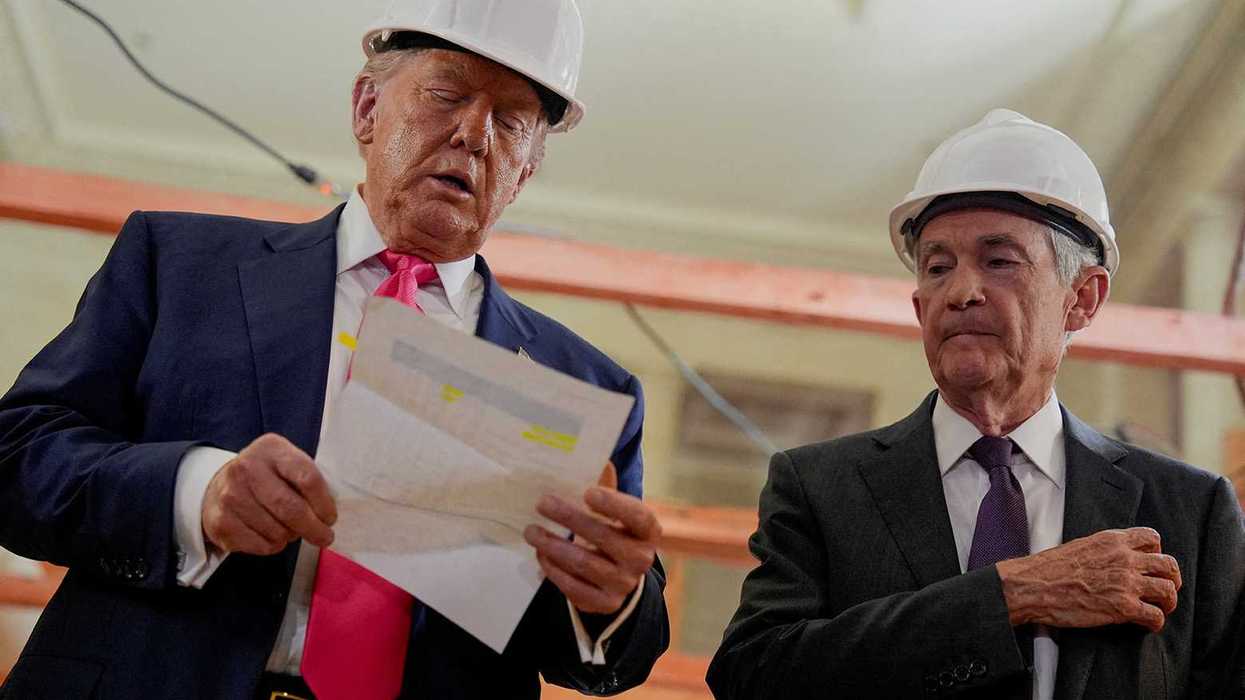
President Donald Trump insists the US economy has never done better than under his second term, but a right-leaning magazine just published an article claiming the opposite is true — indisputably so.
“Tariffs implemented last year by President Donald Trump's administration are entirely to blame for the recent surge in prices for consumer and household goods,” wrote Reason's economic policy reporter Eric Boehm on Monday. ”Those tariffs have raised core goods prices by 3.1 percent, according to a new study by a trio of economists at the Federal Reserve. Those higher consumer prices were the result of retailers passing the cost of tariffs along the supply chain.”
As of two months ago, Trump’s tariffs entirely account for the excess inflation of core goods that Americans have felt since the start of his second term.
"Our estimates indicate that tariff effects on prices gradually build over time, with cumulative effects seven months after implementation consistent with our theoretical measures of full dollar-for-dollar pass-through,” the economists wrote. Boehm added that “the study used the personal consumption expenditures price index (PCE), which is published quarterly by the federal Bureau of Economic Analysis and differs in some small ways from the monthly consumer price index published by the Department of Labor.”
“High prices causes real wages to fall, reversing the gains made since last summer in 2025,” former Special Assistant to President Joe Biden on the National Economic Council Mike Konczal wrote earlier this month regarding prices and tariffs under Trump. A former adviser to President Barack Obama, Betsey Stevenson, similarly wrote that "wars mean declining living standards for everyone,” referencing Trump's unprovoked conflicts against Venezuela and Iran.
Trump’s “tariff shock” has especially hit America’s auto industry, with car magazine WardsAuto reporting last month that “General Motors projects a tariff hit of $3.5 to $4.5 billion in 2025. Ford absorbed an $800 million second-quarter blow. Volkswagen is bracing for a €5 billion impact. Cox Automotive estimates the industry has collectively accumulated more than $25 billion in tariff obligations through just the first seven months of the year — roughly $5,200 per imported vehicle. For vehicles built in Mexico, a critical manufacturing hub, the added cost runs to approximately $4,800 per unit, effectively turning the build-in-Mexico business model upside down.”
As Americans continue to struggle economically because of Trump’s tariffs conservatives like Mona Charen of The Bulwark worry that Republicans will lose in future elections because of the economy.
“Voters are rarely able to connect policy to outcomes, but they have done so in the case of tariffs,” Charen wrote in February. “Back in 2024, Americans were about equally divided on the question of trade, with some favoring higher tariffs and roughly similar numbers opting for lower tariffs. Experience has changed their views.”
She concluded Democrats could win if they embrace as their campaign message, "Tariffs bad—full stop.”