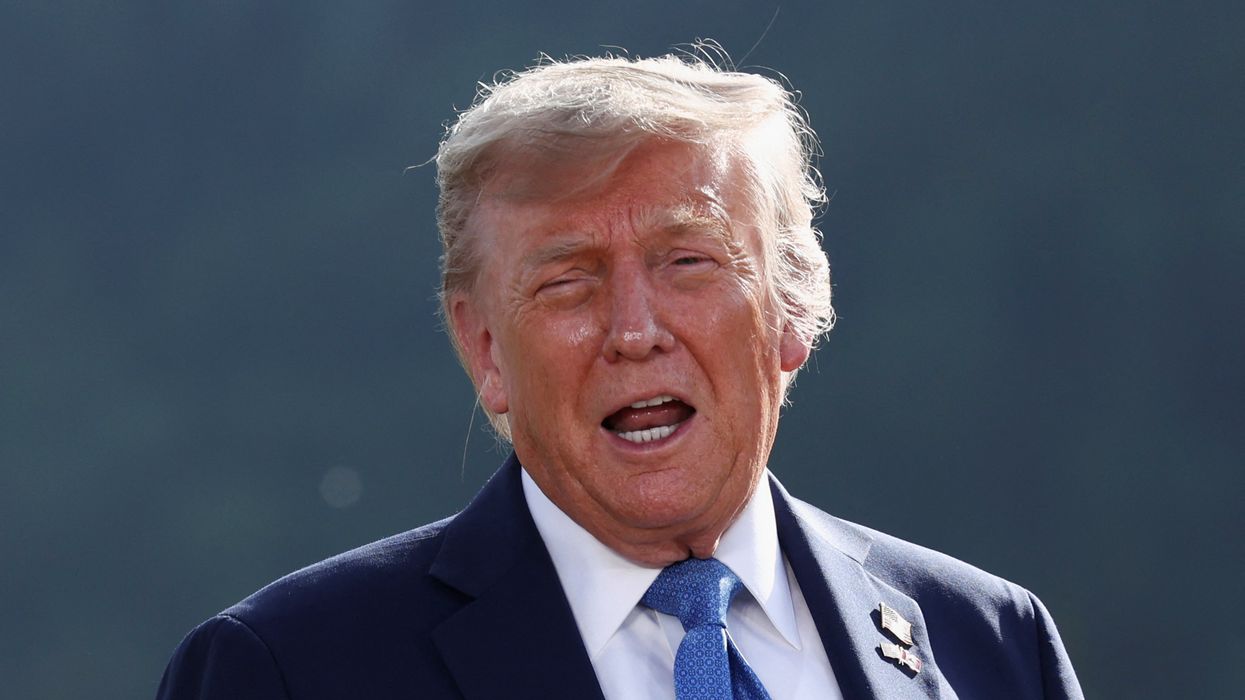
President Donald Trump has repeatedly hinted that he plans on invading Cuba, and claims that he has the right to do so based on the 1823 foreign policy principle known as the “Monroe Doctrine.” Yet a constitutional law and foreign policy expert just explained that his portmanteau “Donroe Doctrine” is in fact a massive mangling of President James Monroe’s seminal achievement.
“In Trump’s view, and that of the Monroe Doctrine’s detractors on the progressive left, the long-standing policy supports U.S. dominance over Latin America and the use of military force to achieve political and economic goals,” wrote Katherine Yon Ebright, a counsel in the Brennan Center’s Liberty and National Security Program, in an article for Lawfare. “That view, however, misreads the Monroe Doctrine’s purpose and ignores its history. The historical record instead supplies strong precedents for war powers constraints, not presidential aggrandizement in matters of war.”
Ebright went on to describe how Monroe announced the Monroe Doctrine during an 1823 message to Congress because Americans wanted to protect Western Hemisphere nations from European imperialist powers like Austria, Prussia and Russia.
Later in its history, the Monroe Doctrine was asserted to liberate Cuba from Spain and keep Venezuela out of the clutches of the United Kingdom. It was never intended, she pointed out, to validate America’s own imperialist overtures. Even when American presidents like William McKinley declared war to liberate nations like Cuba and the Philippines, more often than not they then sought to put those lands on a path to self-government. It also did not commit America to declare war on Western Hemisphere nations simply because its leaders wanted them to do so.
“Those who seek to aggrandize presidential power or to critique the Monroe Doctrine often note that the message does not foreclose U.S. intervention, as opposed to European intervention, in Latin America,” Ebright wrote. “But this glosses over the message’s disavowal of U.S. adventurism and its recognition of Latin American independence based ‘on just principles.’ It also overlooks the well-established position of Monroe’s secretary of state and the architect of the Monroe Doctrine, John Quincy Adams. Two years earlier, Adams had famously proclaimed that the United States ‘goes not abroad in search of monsters to destroy.’ He lauded the U.S. policy of nonintervention, crediting it with keeping the nation out of wars that would ‘usurp the standard of freedom,’ ‘insensibly change [U.S. policy] from liberty to force,” and transform America into ‘the dictatress of the world.’”
Ebright added, “Moreover, the Monroe Doctrine had no bearing on the distribution of war powers between Congress and the president. Nowhere in his message did Monroe cast doubt on Congress’s constitutional primacy in matters of war or on the founders’ concern that the president was ‘not safely to be trusted’ with the power of war.”
After reviewing the history of the Monroe Doctrine and unpacking its legal implications for US foreign policy, she concluded that the Donroe Doctrine is in fact achieving the opposite result of what the Monroe Doctrine sought to achieve.
“Trump’s contrary approach has led to half a dozen War Powers Resolution votes; dissent among military lawyers; the unprecedented departure of a top military commander; regional condemnation of U.S. military operations; and allies’ withdrawal from long-standing intelligence-sharing and military cooperation arrangements,” Ebright wrote. “Far from reviving Monroe’s ‘Era of Good Feelings,’ Trump’s uses of military force have strained relations with Congress and U.S. allies alike—the very outcomes the Monroe Doctrine’s framers, and a century of practice under it, were designed to avoid.”