
Trump readies new flip-flop on top ally
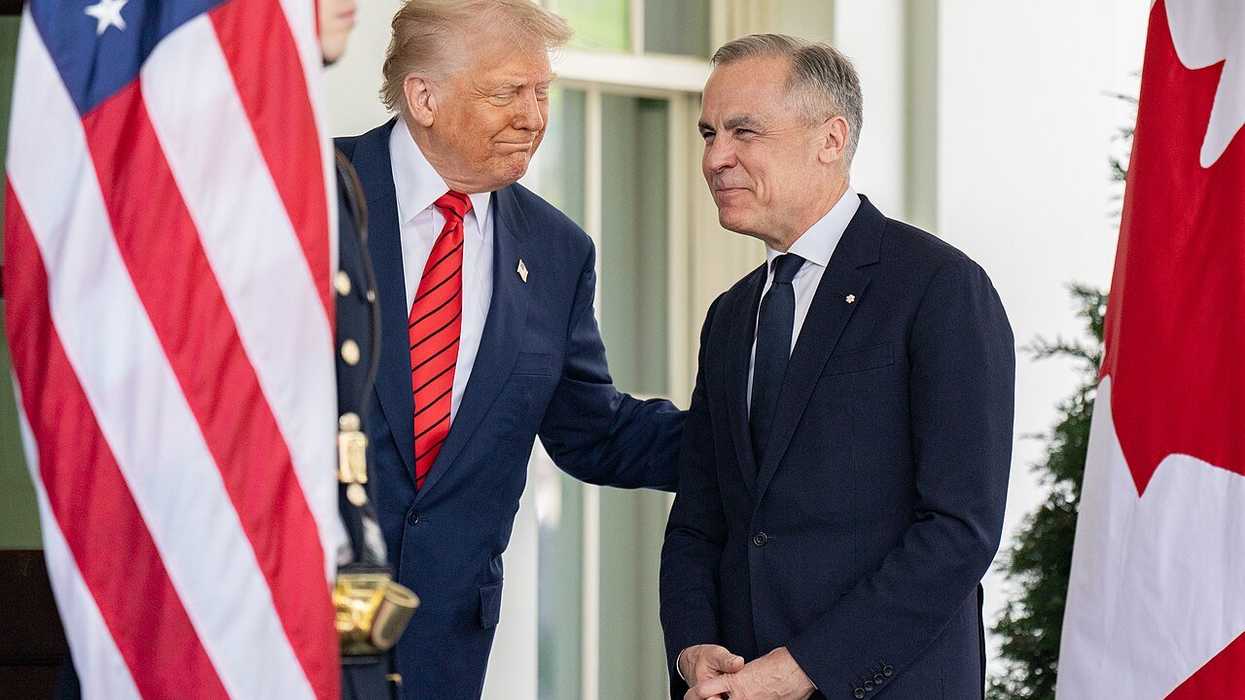
(Official White House Photo by Gabriel B Kotico/Flickr)
U.S. President Donald Trump meeting with Canadian Prime Minister Mark Carney in the White House on May 6, 2025

U.S. President Donald Trump meeting with Canadian Prime Minister Mark Carney in the White House on May 6, 2025
President Donald Trump has alienated Canada, once one of America's closest allies, from referring to the nation as "America's 51st state" to meddling with a fringe far right movement's effort to help its province Alberta secede. Canadians are so upset that more than 70,000 recently signed a petition to expel the US ambassador from the country. Now the president may be taking a more conciliatory approach toward Canada on one key issue — his tariffs.
"A deal between the U.S. and Canada to stave off new tariffs on Canadian goods is now on President Donald Trump’s desk, according to three people familiar with the discussions who were granted anonymity because of the sensitivity of the talks," reported Politico's Daniel Desrochers, Oliver Ward and Ari Hawkins on Tuesday. "Now it’s up to Trump whether the 50 percent duty goes into effect, as scheduled, at midnight."
They continued, "U.S. and Canadian officials have been in wall-to-wall talks for several days, with the administration pressing Canada to drop retaliatory measures it took against Trump’s tariffs last year — including provincial bans on U.S. liquor and tariffs on U.S. automobiles — and Ottawa looking to lower U.S. duties on autos, among other goods. The potential deal taking shape also includes Canadian concessions on its tariff-rate quota on dairy — an issue that has frequently come up in Trump’s missives against Canadian trade policy, according to two of the three people."
Speaking to AlterNet in July, one expert economist broke down how Trump's Canada tariffs are hurting the US economy as well as that of our northern neighbor.
“It's about uncertainty,” Dr. Robert Shapiro — undersecretary of commerce for economic affairs in the administration of President Bill Clinton and principal economic adviser to Clinton's 1992 campaign — told AlterNet at the time. “Every investment is based on an assessment of the likely future demand for whatever you're investing in, and how much it's going to cost to produce it. So there are assumptions about labor costs, material costs and other input costs — and again, about demand. If you have a set of arrangements that give you some confidence about the price of your inputs coming from Mexico or Canada, or about demand for goods in Canada — and don't forget, we have virtually no trade deficit with Canada; we have enormous trade, and it goes in both directions — so it's certainly right, and it's not just about investments based on these probabilities that the trade agreement can help reduce uncertainty about.”

