Psychologist exposes Trump's 'broken' brain as his speech becomes a mess
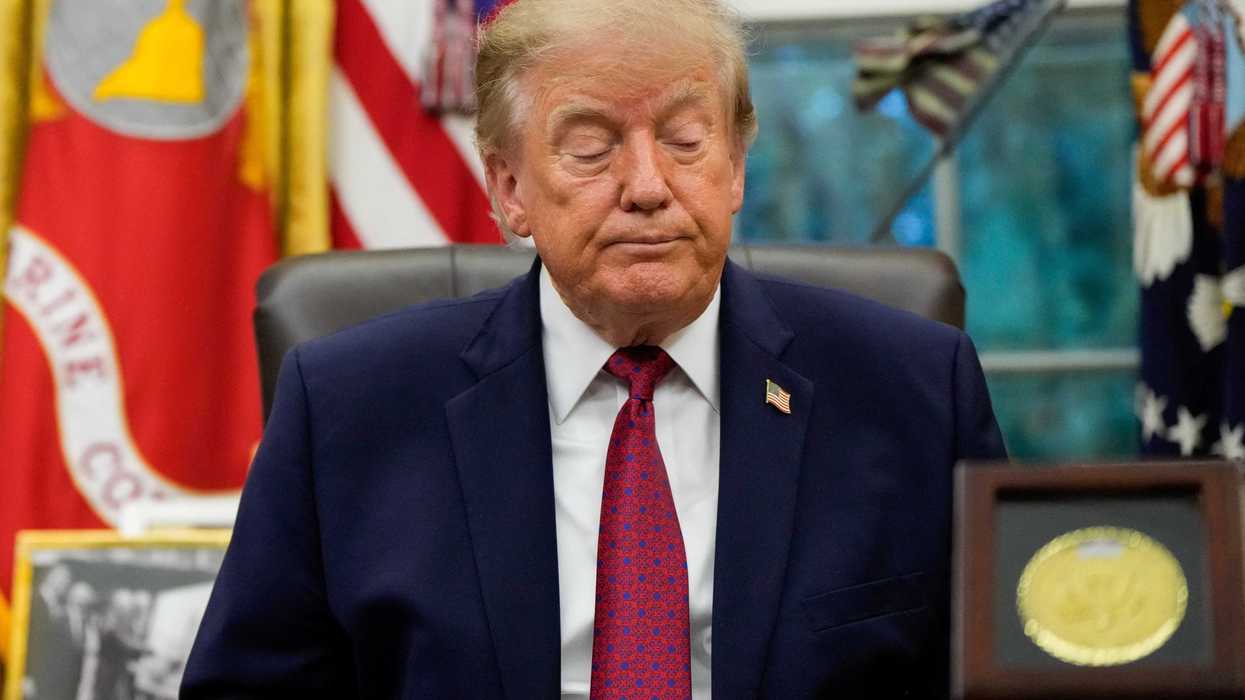
President Donald Trump sits after signing a proclamation on the 'Establishment of the Oval Office National Monument' at the White House in Washington, DC, on November 5, 2026. REUTERS/Elizabeth Frantz
President Donald Trump sits after signing a proclamation on the 'Establishment of the Oval Office National Monument' at the White House in Washington, DC, on November 5, 2026. REUTERS/Elizabeth Frantz
Dr. John Paul Garrison is a clinical and forensic psychologist with a specialty in body language, who also makes a series of YouTube videos in which he uses his professional insights to examine the behavior of public figures. Many of his recent videos have concerned Trump, with Garrison suggesting that the president is suffering a severe decline, possibly accelerated by a stroke.
In his latest video, Garrison examined Trump's recent Oval Office address after the midterms, in which he signed an executive order designating the office as a landmark, meaning future administrations could not undo his redecoration efforts without congressional approval or another order reversing his own. Garrison noted that Trump continued to show "apparent neurological dysfunction" while struggling to communicate clearly, highlighting an "incoherent" attempt at sharing a "meaningless anecdote" about Chinese and British leaders supposedly complimenting the Oval Office during recent visits.
"As you could probably tell from his very brief and meaningless anecdote right there, President Trump struggles to get his points across and to communicate clearly if it's not written down for him," Garrison said.
Garrison further noted one sentence in particular where Trump was "entirely unable to articulate himself," with his coming out as a mumbled jumble, another potential sign that he is grappling with dementia.
"So, if you really listen to what he just said, those were fragments of ideas that truly do not belong together," Garrison explained. "What he's saying is basically incoherent. And this is something that we sometimes observe when people have dementia — as I've talked about before — someone has a stroke, and there's different types of lesions or scarring in the brain or something like that. There are a wide variety of reasons that people can struggle with something like this. But what we're observing is problems producing language, and we're also finding problems with him forming coherent thoughts and ideas. So we're seeing multiple layers of issues right here... We typically associate that with stress or anxiety. So it's very interesting to see right now, as he's talking about this, the blink rate is unusually high."
He added further: "Now he's been doing that at times when he was not actually reading off the page, and this goes back to the idea that he's struggling with eye contact, something else that we see as dementia progresses for a wide variety of reasons related to attention, poor social communication. There's a wide variety of reasons that eye contact becomes worse, but we're seeing his eye contact get dramatically worse."