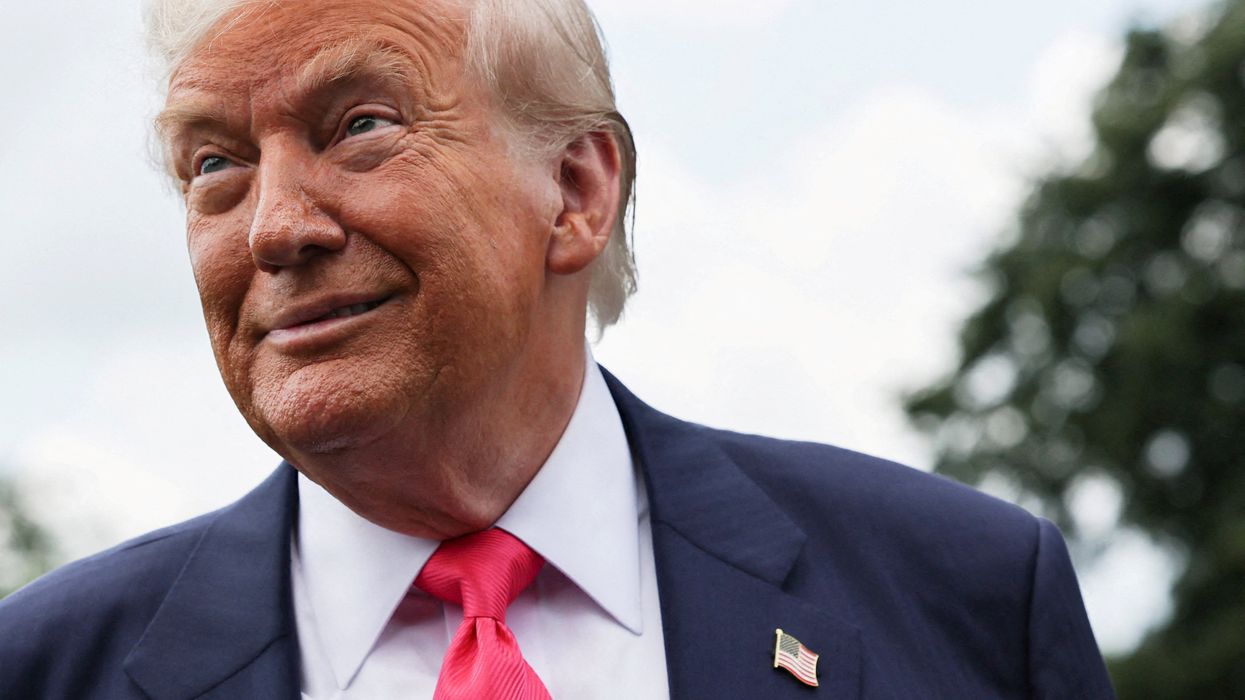
President Donald Trump recently told the New York Times in a lengthy interview that his "own mind" is "the only thing that can stop" him. One contributor to the Times is now theorizing that Trump may in fact be addicted to power and is constantly seeking more of it to chase a "high."
In a recent Times analysis, columnist Thomas B. Edsall argued that Trump is "showing symptoms of an addiction to power" in his recent foreign policy foray into Venezuela and his entertaining of a military occupation of Greenland. The president recently told Iranian protesters that "help is on the way" after thousands were killed by the Iranian regime, and Trump has also hinted at taking action against Cuba and Colombia.
Professor Manfred Kets de Vries, who teaches leadership development and organizational change at the Insead international business school, told Edsall that it is indeed "possible to become addicted to power." He noted that "individuals with pronounced narcissistic, paranoid or psychopathic tendencies are especially vulnerable," and theorized that Trump's fixation on praise is part of that same pattern.
"Donald Trump is an extreme illustration of this dynamic. From a psychoanalytic perspective, his narcissism is malignant in the sense that it is organized around a profound inner emptiness," he said. "Malignant narcissism is a combination of narcissism and psychopathology. Because there is little internal capacity for self-soothing or self-valuation, he requires continuous external affirmation to feel real and intact. Power supplies that affirmation."
Edsall also cited a 2014 study entitled "The Neurochemistry of Power: Implications for Political Change," by Nayef Al-Rodhan, who is the director of the geopolitics and global features department at the Geneva Center for Security Policy. Al-Rodhan asserted that the effects of power "occur at the cellular and neurochemical level."
"The primary neurochemical involved in the reward of power that is known today is dopamine, the same chemical transmitter responsible for producing a sense of pleasure," Al-Rodhan wrote. "Power activates the very same reward circuitry in the brain and creates an addictive 'high' in much the same way as drug addiction."
"Like addicts, most people in positions of power will seek to maintain the high they get from power, sometimes at all costs," he added.
Ian Robertson, who is a professor emeritus of psychology at Trinity College in Dublin, Ireland, agreed with that hypothesis, telling Edsall: "Power is a very strong stimulant of the dopamine reward system of the brain — which is the seat of addiction."
"People (men more than women) with a high need for control and dominance over other people (and a corresponding fear of loss of control)," he continued. "The need for control is one of three basic motivational needs — the others being affiliation and achievement. Having power over other people satisfies this deep need."
Click here to read Edsall's full analysis in the New York Times (subscription required).