
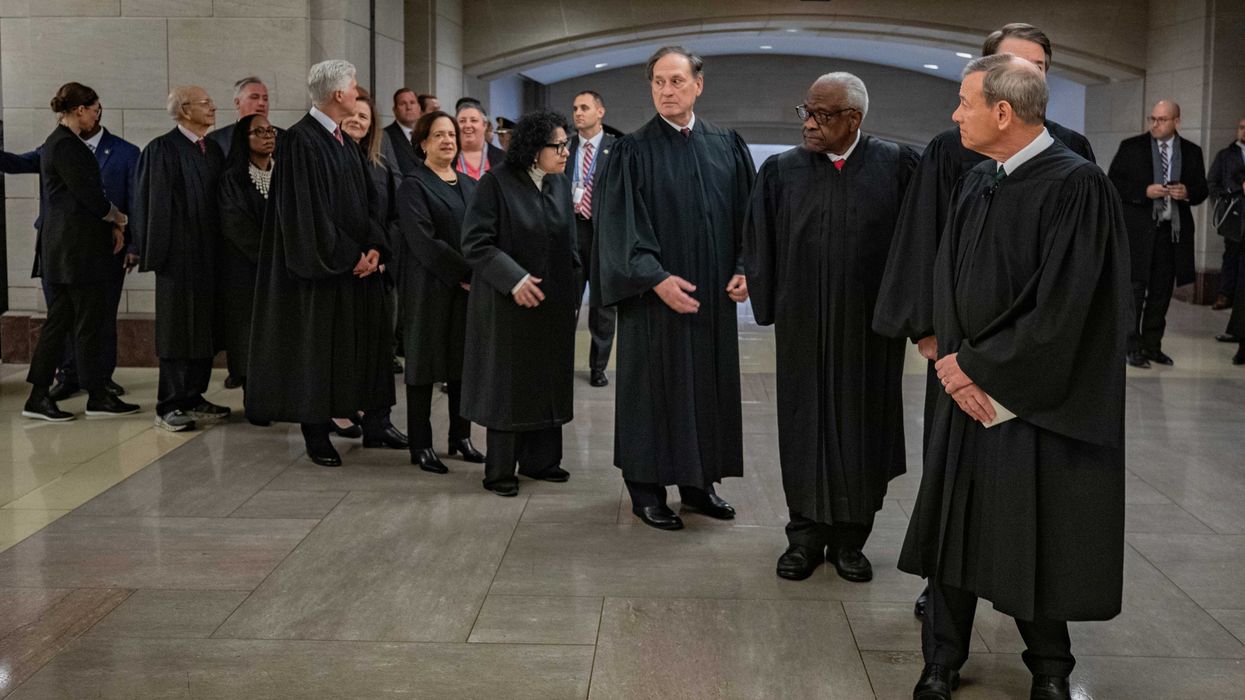


Typically, when the U.S. Supreme Court hears a case, it’s because it has worked its way up from local courts through appeals. That’s not enough for President Donald Trump’s administration.
In a Friday report, CNN's John Fritze wrote that under the leadership of Solicitor General D. John Sauer, however, the DOJ has filed at least five unsolicited briefs demanding action from the Supreme Court on culture-war issues.
Guns, religion and regulation are top of mind for an administration that wants huge changes to U.S. law immediately. One of those is a challenge to Colorado’s rules on funding religious preschools and a Second Amendment case over Hawaii’s limits on carrying guns onto private property.
Traditionally, the Justice Department can contribute its own opinions on the high court, and the solicitor general can make his own recommendations. The post has "long carried a special weight at the Supreme Court," the report explained.
“It’s using the solicitor general’s unique position as a way to push not just the policy and political agenda of the current president, but the broader ideological agenda of the Republican Party,” said Georgetown University Law Center professor Steve Vladeck, when speaking to CNN.
While earlier solicitor general offices tended to avoid overtly political battles, Trump’s DOJ is seeking them out. Sauer serves at the pleasure of the president, but he also occupies a special role as a kind of “10th justice,” with a distinct responsibility to the Court itself. So far, Sauer has largely managed to balance those sometimes competing demands: the 6–3 conservative Court repeatedly sided with Trump last year, backing the administration about 80% of the time on its emergency docket. Attorney General Pam Bondi even bragged about that record before a contentious House hearing this week.
Seeing Sauer pivot away from past practices to political territory, however, could mean higher scrutiny, CNN said.
When there is an appeal from a lower court, the high court spends weeks debating over whether it should move forward. There are third parties that submit letters and their own official "friend-of-the-court" briefs on the matter.
Over the last year, however, at least five times, the Trump administration sent its own demand for intervention.
There were no similar briefs submitted by President Joe Biden's administration over his four years in office. Former President Bill Clinton served for eight years, SCOTUSblog said.
CNN cited a source familiar with the DOJ's approach, saying that, so far, the court has been open to Trump's demands, granting three of five cases.
“Only infrequently does the solicitor general file unsolicited amicus briefs at the certiorari stage,” said former solicitor general assistant Patricia Millett in a 2009 academic journal. “After all, if the court believes that the government’s views would be helpful to its decision, it will ask for them.”
The department’s credibility “depends, in large part, on consistently applying extremely selective and exacting criteria before asking the court to exercise its jurisdiction," the now-judge added.
Appellate attorney William Jay, who worked in the solicitor general's office and clerked for far-right Justice Antonin Scalia, claimed that Biden likely didn't use the tactic because they were being more selective. Trump's administration is generally less strategic.
“In absolute terms, the numbers remain small,” appellate lawyer John Elwood wrote on SCOTUSblog. “But relative to historical practice, the increase is meaningful. A mechanism once used sparingly is now being deployed with some regularity.”
Report typos and corrections to: feedback@alternet.org.

#story_page_sidebar
MOST POPULAR
{{ post.roar_specific_data.api_data.analytics }}
MOST POPULAR
ContactAdvertise with AlterNetPrivacy PolicyWriter GuidelinesPress InformationAbout AlterNetMeet the AlterNet StaffDebug Logs
@2026 - AlterNet Media Inc. All Rights Reserved. - "Poynter" fonts provided by fontsempire.com.