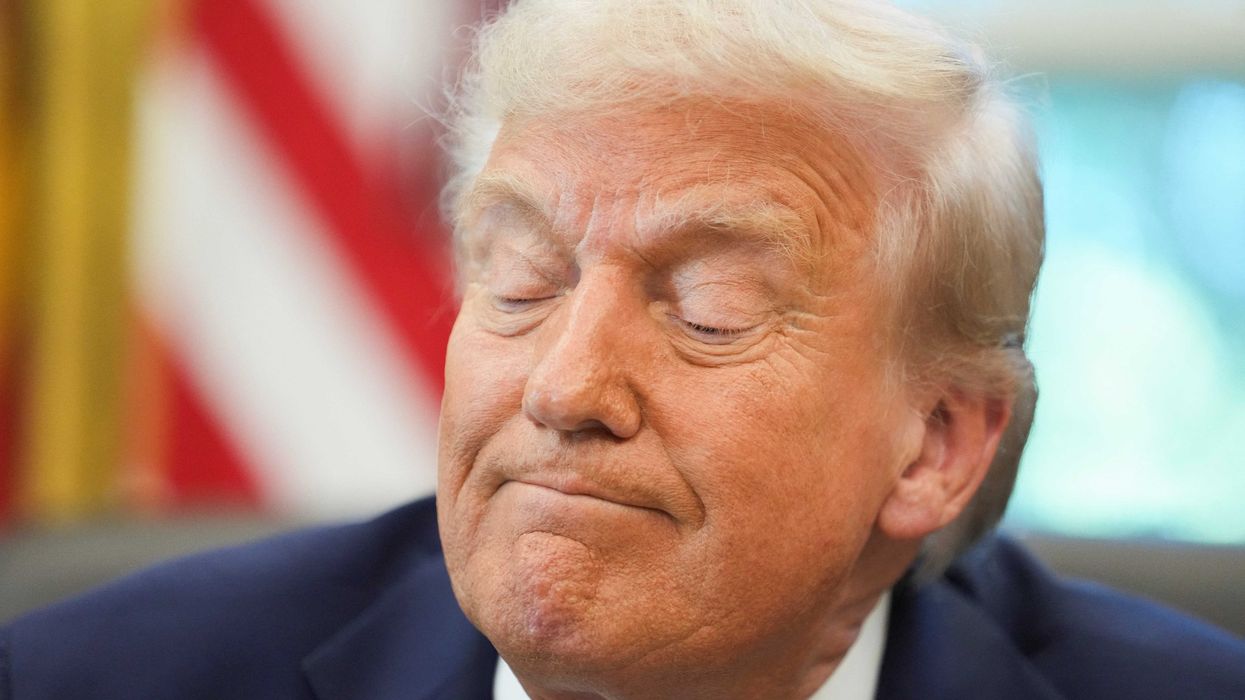
One of President Donald Trump's executive orders was just overturned by the House of Representatives — with plenty of Republicans voting with Democrats to do so.
The AFL-CIO labor union announced Thursday that a bipartisan majority in the House voted to pass the Protect America’s Workforce Act (H.R. 2550), with all 211 Democrats and 20 Republicans voting in favor of the legislation. H.R. 2550 would restore collective bargaining rights for more than one million federal workers, overturning Trump's March executive order that stripped them.
"President Trump betrayed workers when he tried to rip away our collective bargaining rights. In these increasingly polarized times, working people delivered a rare bipartisan majority to stop the administration’s unprecedented attacks on our freedoms," AFL-CiO president Liz Shuler stated. "We commend the Republicans and Democrats who stood with workers and voted to reverse the single largest act of union-busting in American history."
The Republicans who voted for the bill largely come from states with significant numbers of unionized workers, like Illinois, New Jersey, New York, Ohio and Pennsylvania. Rep. Don Bacon (R-Neb.), who is a frequent Trump critic, also voted for the bill's passage. The legislation now heads to the Senate, which has a 53-47 Republican majority. However, Shuler remained optimistic and observed that there is already "bipartisan support" for H.R. 2550 in the U.S. Senate.
"Americans trust unions more than either political party," Shuler stated. "... [W]orking people are calling on the politicians we elected to stand with us, even if it means standing up to the union-busting boss in the White House."
It's unlikely that Trump would sign the legislation into law even if the bill passed the Senate. However, the House and Senate would potentially be able to override a presidential veto with a two-thirds majority vote.
Trump made significant inroads with unionized workers in 2024, though Democratic nominee Kamala Harris still won a majority of voters who belong to labor unions. Trump was particular popular among blue-collar union workers who didn't have a college degree, whereas Harris prevailed among unionized workers with college degrees.
Click here to read the AFL-CIO's full statement.