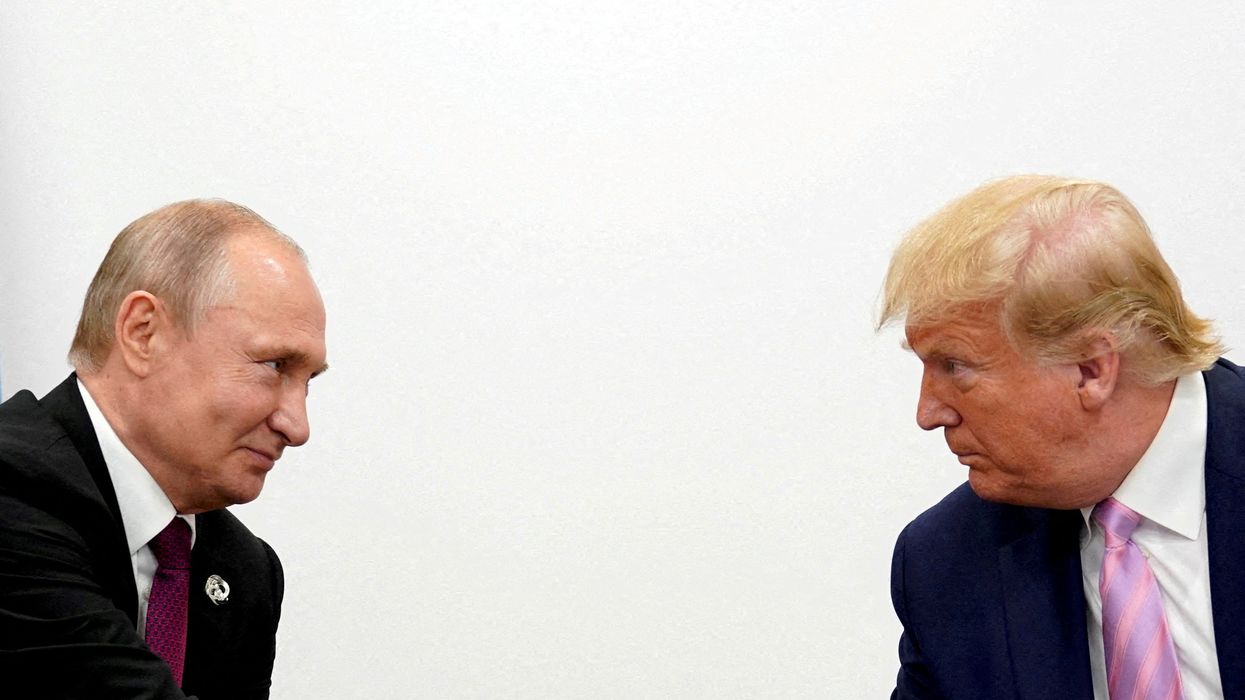
The North Atlantic Treaty Organization (NATO) was initially formed as a collective defense against the former Soviet Union (now Russia). European leaders are concerned that, in an era of President Donald Trump, the alliance can no longer be counted on to protect against Russia.
Speaking in early April, Trump called NATO a "paper tiger" and alleged it was "useless." Answering questions from the press, Trump let it slip that "Putin knows that too.” Indeed, Putin has trashed NATO for years and has welcomed the idea of the alliance becoming less effective.
In a piece for The Guardian, Paul Taylor, senior visiting fellow at the European Policy Centre, wrote that Europe is finally beginning to strategize for "the unthinkable."
Congress passed a law that was signed by former President Joe Biden, saying, “the president shall not suspend, terminate, denounce, or withdraw the United States from the North Atlantic Treaty … except by and with the advice and consent of the Senate, provided that two-thirds of the Senators present concur, or pursuant to an Act of Congress.”
But Trump has already made some steps to do exactly that when he withdrew 5,000 U.S. soldiers from Germany. There is now a question about whether Trump is in violation of the law that also includes a provision prohibiting any president from "using any federal funds to support such a unilateral withdrawal without Senate approval (2/3 vote) or a separate Act of Congress." The co-author of the bill is now Trump's Secretary of State, Marco Rubio.
Europe must now craft a "Plan B" for life in a world in which the US is no longer willing to help defend its allies against a Russian invasion.
Countries have already begun to step up on their financial and political responsibility, Taylor explained. They've also begun doing more to help Ukraine as it continues to fight back against the Russian invasion there.
"After four years of war in Europe, most leaders have come to recognize Ukraine as a military and technological asset for European defense rather than a burden or a risk factor," said Taylor.
It's clear that Europe is taking the first steps to prepare for the day Russia tests the waters of a new conflict with the broader collection of countries. Germany issued its first military strategy since the Second World War and aims to build its army into the strongest in Europe by 2039.
"On Monday, EU ambassadors held a first tabletop exercise to test how they would implement in practice their own hitherto largely declaratory mutual assistance pact," said Taylor. The EU treaty known as Article 42.7 mandates “an obligation of aid and assistance by all the means in their power." He added that it's more binding than NATO's Article 5.
The exercise made no mention of NATO. The move prompted concern among the Baltic states that it might anger Trump enough to disengage from European security entirely.
The prime minister of Poland has already openly questioned whether Trump would be there for NATO if Russia attacked. Speaking to the Financial Times, he said, Europe’s “biggest, most important question is if the United States is ready to be as loyal as it is described in our treaties."
It should be a topic of conversation at the next NATO summit in July, but Taylor said that he doubts anyone will bring it up with Trump face-to-face.
Taylor thinks that the "strongest option" for Europe if the U.S. stays on the sidelines is using "a European defense union led by France, Germany and the UK, backed by NATO and EU resources and with key roles for Poland and Ukraine."