
Mitch McConnell 'one of the greatest villains' in US history: Republican analysis
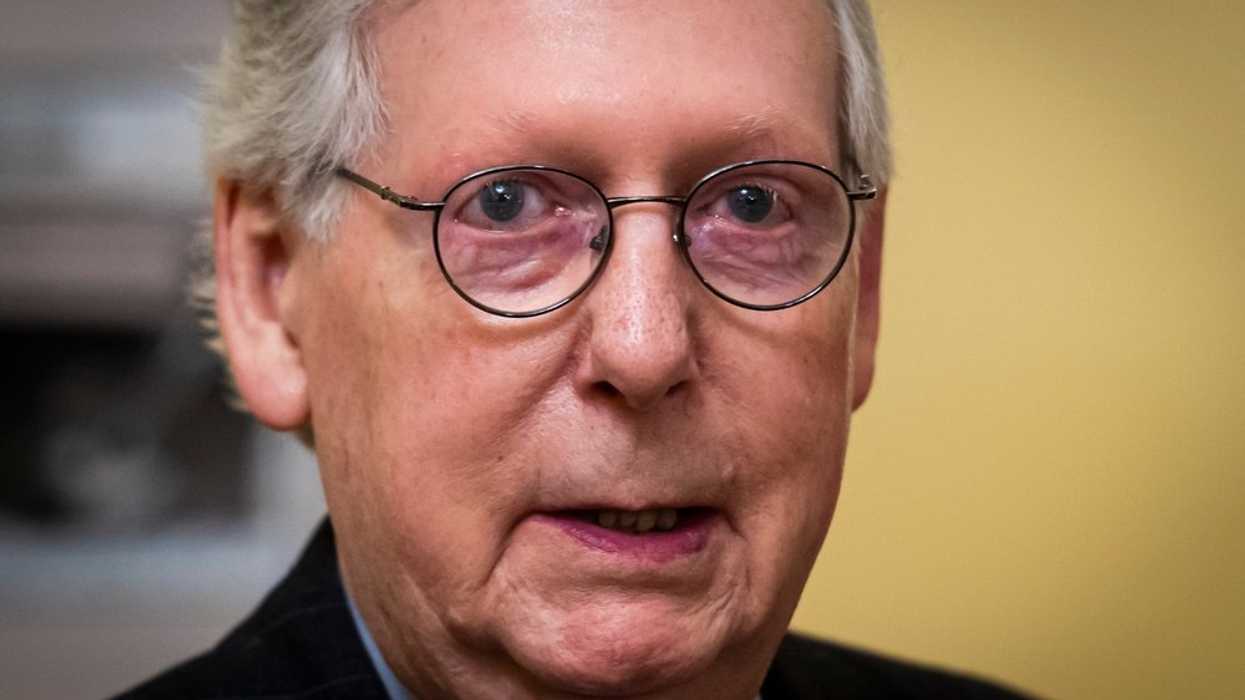
Image via Consolidated News Photos/Shutterstock.
Senator Mitch McConnell (R-KY)

Senator Mitch McConnell (R-KY)
On Friday, a prominent Republican declared Senator Mitch McConnell (R-KY) “one of the greatest villains across America’s 250-year history.” His legacy, it was asserted, will be tied to his role in breaking the Senate’s ability to function.
This is according to Lincoln Project co-founder Steve Schmidt, a longtime GOP insider who has served as a political strategist for the likes of George W. Bush and John McCain. Amid rumors and speculation about the condition of McConnell’s health — who has reportedly been in the hospital for some weeks after being discovered unconscious and receiving CPR, with some saying he may be “brain dead” — Schmidt argues, “The American people are owed candor when one of the most powerful elected officials in the country suffers a grave medical emergency.”
According to Schmidt, Americans cannot trust “carefully curated assurances from political allies whose first instinct is to protect an institution, a party, or a reputation — particularly when those assurances come from people who have no credibility whatsoever. Scott Jennings doesn’t have credibility, and neither do Senate Majority Leader John Thune and his number two John Barrasso from Wyoming,” the three of whom claimed to have spoken with hospitalized McConnell for “20 minutes.”
As Schmidt explains, not only is it highly unlikely that McConnell was capable of having such a conversation, noting that “an 84-year-old who had CPR performed on him before being put in an ambulance has a roughly six percent chance of ever walking out of a hospital,” but Americans have no reason to believe leaders who are unwilling to give a straight answer to who won the 2020 election.
And in this context, writes Schmidt, “the historical verdict on Mitch McConnell’s career is already taking shape. The high court of history is convening. The judgement will be appropriately brutal for service so unpatriotic and selfish. He’s one of the greatest villains across America’s 250-year history. Mitch McConnell destroyed the functioning and integrity of the US Senate, which was once known as the world’s greatest deliberative body. Today, it’s a joke.”
According to Schmidt, “Mitch McConnell was precisely the type of man George Washington warned about in his farewell. He’s done incredible damage to the American republic. He lived his life as a partisan cancer, and here at the end, he’s earned his looming two-word obituary: good riddance. He leaves behind a Senate that’s become a battlefield where power eclipses principle, and procedural warfare has replaced persuasion.”
The turning point, writes Schmidt, came with McConnell’s “refusal to allow Merrick Garland’s nomination even to receive a hearing ... Four years later, his determination to confirm Amy Coney Barrett weeks before a presidential election established a second rule that directly contradicted the first. Many Americans concluded that there were no rules at all. Only power.”
And what’s more, argues Schmidt, “The damage extended beyond the Senate chamber. Public confidence in the Supreme Court suffered enormously as millions came to see the institution not as an independent branch of government, but as another arena for raw political combat. History will remember that, and so will history remember his relationship with Donald Trump. No Republican leader understood Trump’s character more clearly. Few warned more eloquently about it. Yet when confronted with the defining challenge of his political life, Mitch McConnell repeatedly chose accommodation over confrontation.”
“That cowardice will be his epithet, and when he meets the supreme judge of the universe the grace he will need is something he didn’t practice in this life,” Schmidt concludes. “McConnell leaves behind a Senate that is weaker than the one he inherited, a judiciary viewed by millions with deeper suspicion than before, and a political culture in which power too often became an end unto itself. He lived his life as a constitutional vandal who lifted a fascist he despised into a position to wreck the institutions McConnell professed to revere, but really didn’t.”

