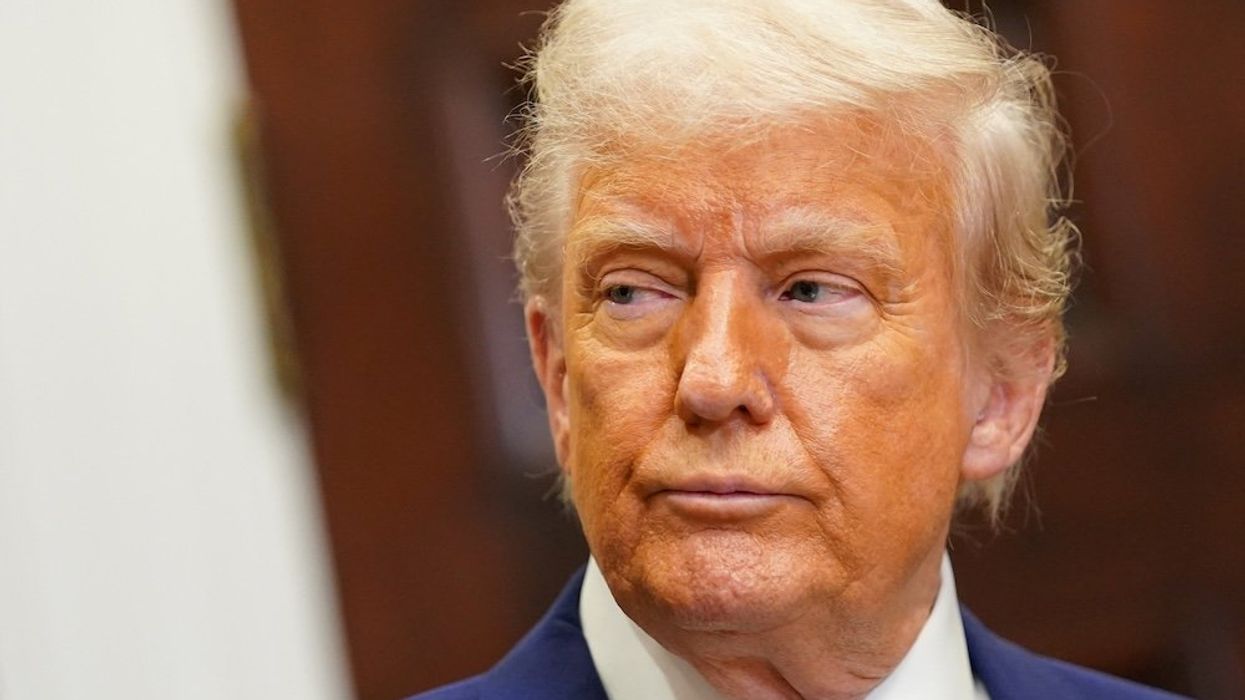
One federal judge recently struck down a move by President Donald Trump's administration to compel states to hand over sensitive data on registered voters, and criticized it as "unprecedented and illegal."
In a Thursday ruling, U.S. District Judge David O. Carter (an appointee of former President Bill Clinton) granted a motion by California Secretary of State Shirley Weber to dismiss a lawsuit from the Trump administration over California's voter list. The administration had sued in an effort to sift through a list of more than 20 million voters in the most populous state in the U.S., aiming to find reasons to remove people it deemed ineligible to cast ballots.
The New York Times reported that the administration had aimed to obtain highly sensitive personal information, like Social Security numbers and driver's license numbers. According to the Times, officials in California and elsewhere have argued that handing over that information to the administration "would have a chilling effect on elections."
"The foundation upon which American democracy has been built is the right to vote. Brave Americans have given their lives for more than two hundred years to protect this right. Now it seems the Executive Branch of the United States government wants to abridge the right of many Americans to cast their ballots," Carter wrote in the decision.
"The United States Department of Justice (DOJ) seeks an unprecedented amount of personal information related to California voters from California’s unredacted voting rolls," he continued. "... The issue presented to this court is animated by a well-established principle, long recognized by the Supreme Court: the right to vote is 'a fundamental political right, because [it is] preservative of all rights.' ... The government's request is unprecedented and illegal."
Politico legal correspondent Kyle Cheney pointed out in a post to X that Carter is the same federal judge "who said in 2022 that Trump had likely committed crimes in his quest to subvert the 2020 election." In that 2022 ruling, Carter remarked that it was "more likely than not that President Trump corruptly attempted to obstruct the Joint Session of Congress on January 6, 2021," preceding the first-ever federal indictment of a former U.S. president.
Click here to read Carter's full ruling in its entirety.