
Farmers are bleeding money under Trump —but are doubling down on their support anyway
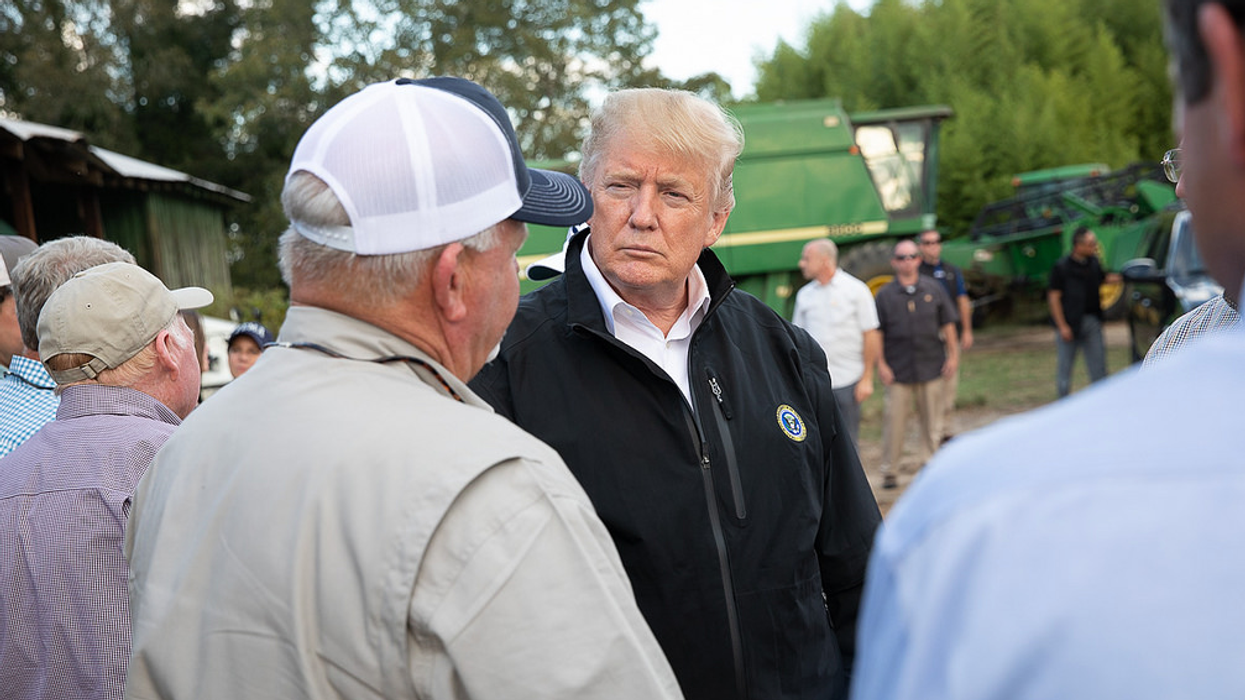
Official White House Photo by Shealah Craighead
Official White House Photo by Shealah Craighead

Official White House Photo by Shealah Craighead
President Donald Trump’s tariffs and Iran war are raising prices on farmers, eliminating key markets from them and making scarce materials on which they rely to survive. Despite these facts, most farmers still refuse to retract their support for the Republican leader.
“A recent Economist/YouGov poll suggests such troubles are now commonplace,” wrote The Economist on Monday, referring to farmers who struggle to make ends meet thanks to Trump’s policies. “27 percent of rural respondents said it would be ‘impossible’ to cover an unexpected $1,000 bill. It would be easy to blame Mr Trump for the downturn. After all, he campaigned on promises to bring down prices and revive the heartland. But rural America does not.”
The article added, “The president’s favourability rating is higher among rural voters than among any other group in our survey. Most still think he is doing a good job. In interview after interview with The Economist, farmers said they trust the administration—but that they need help to recoup the losses its foreign policy is causing them.”
Despite the fact that Trump does not seem to plan on major modifications to his tariffs, his Iran war or his antagonism of countries on which farmers rely for markets, The Economist reported that Trump remains more popular in rural America than elsewhere in the country — even though these same farmers demand sympathy and support for the hardships they are suffering as a direct result of Trump’s policies.
“Donald Trump has waged various literal and metaphorical wars in his second term, but two have been especially bad for Americans: his trade war with the world and his actual war with Iran,” The Economist wrote. “Every American industry that makes things—from chemicals to cars to crops—suffered at least a little when Mr Trump slapped tariffs on other countries and some of them retaliated. Now, with the conflict in Iran unresolved and the Strait of Hormuz still blocked, those same businesses face higher costs. Few have suffered more than American farmers.”
While farmers’ problems existed even before Trump’s second term, they have been significantly exacerbated since he imposed his tariffs, alienated trade partners like China and provoked Iran into closing the Strait of Hormuz.
“In a February earnings call, John Deere, the world’s largest maker of farm equipment, said it absorbed $600m in tariff-related costs in 2025 and expected that to double this year,” The Economist relayed. “Dave Peters, a semi-retired corn farmer near Harlan, Iowa, reckons farmers now need four times as many acres to make the same profit. Watching his son and granddaughter ride a tractor across his field, he reflects on how much it takes to get a farm going: ‘It’s costing half a million just out the door.’”
Another farmer bemoaned how the Iran war has hurt his ability to successfully plant crops.
“Preston Jimmerson, a cotton and pecan farmer in Georgia, reckons chemicals account for about 30% of his input costs,” The Economist wrote. “He plans to cut back by 15%, but fears this will hurt yields. ‘Taking the fertiliser away from a crop is like taking oxygen from a human,’ he says.”
On an even darker note, the owner of Illinois used-equipment house Kerr Auction “says in tough years more tractors come in from families of farmers who have taken their own lives. He now expects to see more.” Meanwhile Breauna Coody, a 17-year-old waitress at a rural diner with only four occupied tables, admitted “her family no longer has spare cash for ‘normal teenage girl things’ such as movie tickets and lip gloss. She works six nights a week and spends 75% of her pay on petrol.”
In an NPR report last week, Mississippi Delta corn grower Sledge Taylor — who described himself as a lifelong Trump supporter — complained that Trump’s policies have pushed farmers “to the brink,” even though Trump gave a one-time payment to offset farmers’ losses with his $12 billion Farmer Bridge Assistance Program.
“If somebody took $100 out of my pocket and then turned around and gave me $20 back, patted me on the back and said they were my friend, I'm not really sure I would agree," Taylor said. Indeed, because China has mostly stopped buying US soybeans while other staple export crops like rice, corn and cotton have similarly suffered, Taylor worries that there are no longer enough markets for his products.
"Everybody picks on the thing that's one of our bigger exports," Taylor told NPR. "They quit buying all of our crops. We have lost customers forever. They will never come back. Because we're deemed an unreliable supplier."
Earlier this month, Democratic strategist Max Burns observed that for most of the farmers who believe Trump’s promises, they have been left empty-handed.
"Like so many Trump promises, the help never arrived," Burns explained. "The suicide rate in rural communities is now 3.5 times the national average and climbing. Farmers buckle under the financial strain of crippling agricultural tariffs, rising input costs and a president who didn’t bother to mention them once in his most recent State of the Union address."
Despite this, as The Economist reported, most farmers still believe they should and ultimately will receive support from Trump.

