'Drummer Boy' is a fun family film about speaking your mind under tyranny
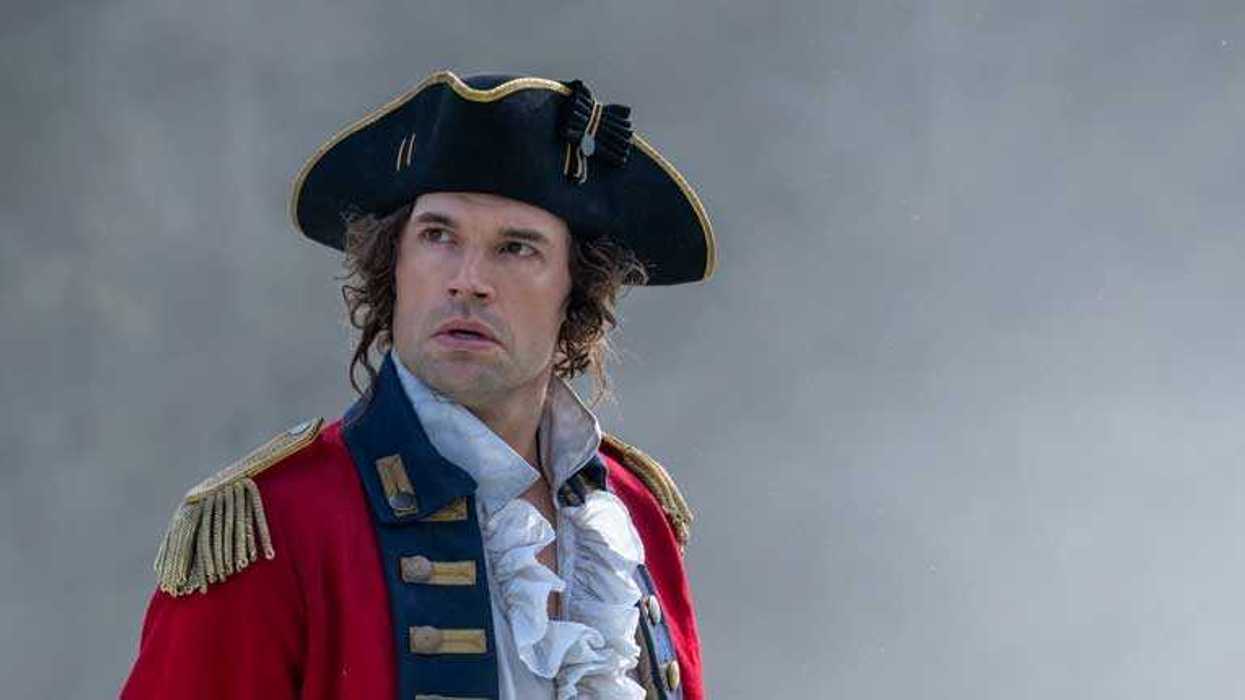
(Angel Studios)
Press still from Angel Studios' Drummer Boy
November 07, 2026 | 03:54PM ETBank
Why I vibed with "Drummer Boy."
There is a scene in "Drummer Boy" with which I strongly identified. Benjamin Clem (Lucas Leach) is criticizing King George III's administration and offending the customers at a business he co-owns with his mother Rachel (Melora Hardin) and the film's protagonist, big brother Jeremiah (Joel David Smallbone, who co-directed with his real life brother Ben). Jeremiah orders Benjamin to hold his tongue, but Benjamin cannot stop himself. While I won't spoil the details, suffice to say that his boldness (some might call it pigheadedness) sets the subsequent main plot in motion.
It's worth noting that Benjamin is at a disadvantage when he decides to take his stand, as he has a disabled leg. I am physically disabled myself — I have a hand-eye coordination disability that means I can't drive, a balance disorder that makes it hard to walk straight and a body that feels like a bag of rocks I drag around — and also like Benjamin, I'm prone to expressing my political views even when others tell me to be quiet. You don't need to share those traits to enjoy "Drummer Boy," though; all you need to be is an idealist with a taste for American history and catchy, uplifting Christian pop.
Set during the American Revolutionary War, "Drummer Boy" tells the story of two brothers whose professional and personal lives are caught up in the early phases of America's founding conflict. It was released by Angel Studios, the company that has pushed other subtly right-leaning movies into the marketplace like"The Brink of War" (which was about President Ronald Reagan during the Reykjavík Summit) and "Young Washington" (which was about President George Washington's early military career). In the case of "Drummer Boy," the conservatism mostly manifests in the protagonists' full throated Christianity, which at times seems to imply that American ideas about liberty cannot be separated from Christian theology.
The filmmakers, however, disavow any such intention.
"Look, the separation of church and state is a part of the government, and I believe that is an essential part of that," Ben Smallbone told AlterNet. "For the story of the film, no, we don't make a direct statement about that, and we don't plan to make a direct statement about that in the film. This was the founding of the United States 250 years ago. There was no acknowledgement of really what was gonna happen, who was gonna win. Were the British gonna take over? Were they gonna free the slaves? Were the United States gonna free the slaves if the patriots won? And so this is a story truly trying to discover what unites us instead of what divides us."
Smallbone reiterated, "And so, look, I don't know exactly where that would be stated in the film, but it is not in there presently."
Why I recommend "Drummer Boy."
Taking Smallbone at his word, I can recommend "Drummer Boy" as wholesome family entertainment not only on its surface level, but also beneath the skin, where insidious agendas sometimes lurk. Like the best Angel Studios fare, it is a straightforward story rather than a propagandistic one, and it includes the nuanced characterizations one expects in high art rather than the melodramas often churned out by Christian-leading studios.
Perhaps the movie's most important virtue is its world-building. In many movies set during the American Revolutionary War, especially those intended for families, the late 18th century is presented not as an inhabited era of history but as a style, a patois, an aesthetic, a collection of fashion and architectural choices. By contrast, the Smallbones and co-writer Ramsey L. Ramsey allow their version of colonial America to get its hands dirty. Between the expected period touches, "Drummer Boy" is stuffed with characters and corner-of-the-screen details that massage our minds into suspending disbelief. Before long, "Drummer Boy" no longer feels like a story set in history, but one whose characters could very easily be grappling with modern concerns.
As such, when characters like the Clem brothers quarrel over politics, the fact that we are being educated and provoked to think is secondary to the fact that we are being entertained. The filmmakers, I know, very much hoped this would be the case.
"There's an old saying: We make our plans, but God orders our steps," Joel David Smallbone told AlterNet. "And I'm so proud of the fact that this film is coming out three days after midterm elections, and that as people are grappling with exactly the question you just asked. Is this a reflection of history? Are we repeating ourselves? All of these questions, those are the questions we were asking ourselves as we wrote it. You know, what is freedom? What is forgiveness? Who are we? What is our identity? And I like asking questions, Matthew. That's my heart, is to ask questions. And so I love that you're pulling all of these pieces. My job is to provoke them."
Smallbone then laughed.
"Your job is to ask the question as well," he added.
The question I had asked, incidentally, was whether the Smallbones realized their conservative-leaning audience would soon hear criticisms of King George III that are awfully similar to how people today blast President Donald Trump.
"At one point in the film, the British remind me of, dare I say, President Trump," AlterNet told Smallbone. "They defend King George III by citing the divine right of kings, much as Trump says he was put here by God to lead America; that we must fight a war against France, as opposed to Iran, to protect our way of life; and they confiscate grain like Trump levying tariffs willy-nilly."
None of this was intentional, of course, but it still says a lot about "Drummer Boy" as a deeper narrative that it provoked these thoughts in me. Like the younger Clem brother refusing to be quiet, "Drummer Boy" is a determinedly positive celebration of American history that refuses to shut its mouth. Indeed, it is a tribute to this distinctly American trait, a Valentine to American obstreperousness toward tyranny.
In a year when Americans are debating existential issues, thanks in no small part to Trump's attempts to steal the midterm elections, the message of "Drummer Boy" is particularly appropriate to the year 2026, even as it is also timeless.