

'A Communism of Pelf': How Trump betrayed American workers
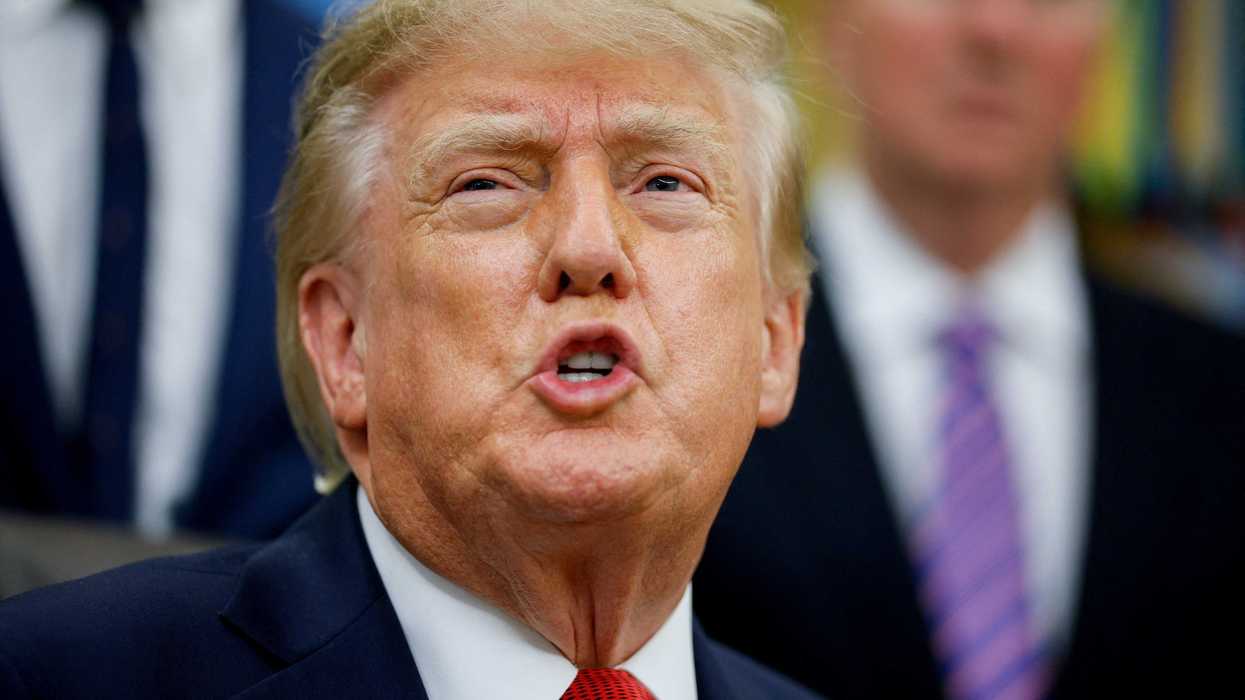
US President Donald J. Trump makes an announcement on healthcare in the Oval Office at the White House in Washington, D.C., US, September 18, 2026.
President Donald Trump's trade wars with Canada and Europe — who have traditionally been American allies — are more than merely "weird' (to quote economist Dr. Ed Gresser), although they are most certainly that. They have simultaneously done three things, all of them profoundly negative for both Americans and the rest of the world: First, they have raised prices for American workers while making their jobs less secure; second, they have hurt the United States' standing in the global community; and third, they have created a political culture rife with corruption.
Or, to quote President Grover Cleveland: Instead of creating a communism of the proletariat, they have instead established a "communism of pelf."
These ideas are not always easy to communicate to the general public, which is why AlterNet was grateful to speak with Dr. Elizabeth McKillen, professor emerita of history at the University of Maine. McKillen specializes in US history, labor history and foreign policy history, and has written two well-received monographs, "Making the World Safe for Workers: Labor, the Left, and Wilsonian Internationalism" and "Chicago Labor and the Quest for a Democratic Diplomacy: 1914-1924." In the subsequent conversation, McKillen illuminates how Trump's trade policies are fundamentally changing the world as we have known it for generations.
This interview has been lightly edited for accuracy, clarity, context and length.
How Trump hurts America's positive influence in the world.
ROZSA: You've written about President Woodrow Wilson, who, through the philosophy known as Wilsonianism, promoted liberal democratic internationalism to create a world order defined by national sovereignty, a rule of law, and the promotion of peace. How did Wilsonianism alter America's standing worldwide, and how has Trumpism changed that?
McKILLEN: Well, that's an interesting historical question. I noticed you had a background in history. I think there's a large gap of time there, but initially, of course, Wilsonian internationalism was not that influential, because the Senate rejected the treaty and, therefore, the League of Nations... There was, of course, that isolationist sentiment during the '30s, so we were slow to enter World War II. But in the aftermath of World War II, we did see a period of free trade and a period in which the U.S. assumed a kind of hegemonic mantle and worked with international organizations for a period of time.
And so I think that Trump has rejected that role on many levels. I shouldn't say he's rejected hegemony, or that role of the United States being influential in affairs; it's just that he wants to play more the bully, as opposed to engaging in international cooperation. So that's one thing that's different. And then he has, of course, rejected free trade and moved us back to protectionism, which flourished in the '30s and arguably made the Depression much worse. For that reason, there were many of us who were always skeptical about tariffs as a way to renew American prosperity, and of course that's proven to be true. It's alienated our allies throughout the world, including Canada, perhaps previously one of our closest trade partners.
So those are the things that come to me off the top of my head. I do think he's rejected elements of that. He's also rejected elements of closing the gap between rich and poor, both domestically and internationally, which there was some interest in during the post-World War II period, at least in the U.S. helping out struggling economies. That happened in Europe first, through the Marshall Plan, because we were concerned that Europe revive. And then it happened later in underdeveloped countries through USAID. Of course, that was not entirely altruistic on the part of the United States, because what it realized is that its own economic well-being, to some degree, now depended upon a global market for its goods. And so the United States increasingly came during the Cold War, ironically, to see that kind of outreach to struggling economies as necessary to maintaining its own economic growth.
But Trump has largely rejected that as a kind of charity and has argued that the United States needs to give less of its funds to international uplift, so to speak. And so that has been another element of contest between him and European allies. It's also applied even to issues of international health, of course, as things like Ebola have surfaced in Africa, and how much do you help African countries to overcome that? We slashed some of those funds, so that's problematic as well. So, in essence, yes, Trump said he was returning to an America First strategy, although you could argue that an America First strategy has not served America very well because of the rise of a global economy.
The other thing that happened by the '70s, of course, was that the rest of the world caught up with us, or part of the world caught up with us, and we had rivalry in economic terms between the United States and Japan and the United States and Europe. So then the question was how you deal with that. A lot of American companies tended to want to go find the lowest-wage markets around the world, whereas labor and other groups started to argue that, no, you needed to emphasize the home market and pay workers enough money so that they could afford American products. And so there was a kind of anti-Japanese revolt, if you will, among labor even in the '70s, because they objected to everybody buying Japanese cars and wanted the American automobile industry to remain very strong.
So those are a few things that come to me off the top of my head.
How Trump hurts American workers.
ROZSA: Can you explain how President Donald Trump's trade wars, particularly with Canada and the European Union, are hurting American workers? I am asking this question in two ways. First, how is it hurting American workers in terms of raising prices? And second, how is the trade war hurting American workers in terms of their labor rights?
McKILLEN: Well, in terms of what it costs American workers, it's pretty clear that those kinds of tariffs ultimately cause higher prices for workers when they go to buy something. That's, of course, because Trump really lied in his election campaign about how foreign countries paid for tariffs, and that's not true. It tends to be, first, the businesses in America that buy foreign goods, and then, secondly, they tend to pass that on to consumers. So that part of Donald Trump's argument was always untrue, and I had published some stuff in the local press about that. But the other element of it, I think, was more convincing to American workers initially, which is that you wanted to bring American industry back home if it had moved away.
There was that runaway-plant phenomenon in the '70s and '80s, and so people initially tended to buy that. That was true even, for example, of Shawn Fain of the United Auto Workers. Despite the fact that he had initially given a campaign speech for Kamala Harris, he then turned over and liked the tariff approach of Trump. But as we've seen, that also didn't work, because, of course, factory jobs have actually declined because of the tariffs. Part of that is because even American factories that are making goods rely on foreign products to make them. And then it tended to raise the prices of their goods, too. So those things hurt workers. And if you're talking about Canada, for example, there are really good examples of how the auto industries in the United States and Canada were very much intertwined, and so those hurt workers too.
Now, I argue that the other way in which Trump's policies have hurt American workers is that, clearly, he's engaged in some kinds of union busting in terms of federal workers, and that's a big proportion of the population. And then also, he's done terrible things with the National Labor Relations Board, as he did with a lot of independent agencies. He fired the person who was in charge of that board. Those federal agencies, all of them, I think, really need to remain independent, but he has compromised their independence. In the case of the National Labor Relations Board, it's been largely disempowered, because he has not replaced that person that he fired, and so it hasn't been able to do anything because it doesn't have a quorum. And the National Labor Relations Board has, since the 1930s, clearly been quite important in guaranteeing workers' rights to unions on the job.
So I would say that those are some of the ways in which Donald Trump has really hurt the rights of workers.
ROZSA: The Supreme Court has repeatedly ruled Trump's tariffs to be illegal, yet he keeps imposing them. How does this undermine America's economic standing in the global community?
McKILLEN: Well, I think it makes the global community, needless to say, feel insecure about its future relations with the United States. And economists of course, say that that's the worst thing that can happen; even steady high tariffs are better than not knowing what the future will bring. So I think that's problematic. And then I think also that many in the international community have recognized that tariffs are hurting all workers. They hurt workers in the United States, and they hurt workers in other countries.Now, there are periods in the history of each country where there's a need for a certain level of protectionism. The best case for that in the United States is probably the era immediately after the American Revolution, because American industry was behind British industry, and so we really needed a few protective tariffs. I'm not arguing there should never be protective tariffs, but they need to be focused, and they do need to be reciprocal, and they really have not been in Trump's case, whatever he argues. He instead tends to play this role of world bully, and I think everyone resents it.
And also, his economic knowledge just seems so poor that foreign countries often make fun of him. This is certainly true of Canada, for example, where they named a washroom after him, or even Ireland, where they have a statue of him sitting in a garbage can. So he displays this kind of astounding lack of knowledge of basic economic principles, or people either believe that or they believe that he's just lying. And so he's really viewed as kind of a farce, and I don't think people abroad terribly understand him, or understand why Americans would vote for him, actually.
How Trump created a "communism of pelf."
ROZSA: I'd now like to quote another Democratic president from over a century ago. Grover Cleveland warned against high tariffs. In 1894, he wrote that they are a "communism of pelf," and in 1887, he described excess tariffs as an "indefensible extortion" and a "culpable betrayal of American fairness and justice." Do you think those characterizations still hold up today? Why or why not?
McKILLEN: Well, I don't think they're entirely indefensible, but I think they always need to be targeted. And, of course, the interesting thing in comparison to Trump is that he worships William McKinley because McKinley initially supported tariffs. But, as I say, the thing about tariffs is that they need to be mutually agreed upon. What nations have discovered over time, of course, is that as the economy has become more and more global, it's become more and more important to cooperate in international economic treaties, rather than just to focus on nationalistic tariffs, which are widely viewed as often causing war, for example. Certainly high tariffs didn't help in the '30s. The economic pain brought by tariffs, as well as the bad settlement of World War I, helped to provoke German anger and lead to German fascism, of course.
So I think he had a point, but I'm not a proponent of total free trade either. I think American workers grew tired of free trade during the Cold War because, over the long run, they recognized that it had problems as well. So I think some tariffs are justified, but I think it's Bernie Sanders who has the best approach to this, in arguing that tariffs need democratic input and that they also need to be worked out in cooperation with other countries. One of the things Bernie Sanders suggested is that Americans should always focus on labor rights and that labor should have a role in any kind of tariff negotiations, so that workers' rights are protected, potentially in both countries if you're dealing with a bilateral trade agreement.
Ironically, one example of that was the United States-Mexico-Canada Agreement that Trump signed in his first term, after initially resorting to high tariffs. That had a labor provision, a labor rights charter, and it had a system for monitoring as well, but it hasn't been adequately used ever since, and I'm not sure why. But it does strike me that what you really want to do is to have a set of trade negotiations where all significant actors are included and labor gets a voice, because I think it's important not just to talk about things from the perspective of business, but also from the perspective of labor and labor movements.
Now, the U.S. labor movement supported relative free trade in the immediate aftermath of World War II and during the Cold War, and it even became famous, belatedly, for working with the CIA to overthrow governments abroad that practiced protectionism or were more socialistic, as in the case of Salvador Allende in Chile. But after a while, they became disillusioned with that approach, and that started really in the aftermath of the Cold War, with the revolt against the World Trade Organization and some of those kinds of organizations in the '90s.
So again, and of course even Biden had tariffs, but I think they were more focused, and I think that's the key. And they need to be developed in cooperation with one's allies. That's the other irony of the Trump administration: he's been nastier in terms of tariffs with some of our closest allies, like Canada or Europe, rather than with world powers like China, or other countries that have historically been hostile to the United States.
So again, there's that issue of focused tariffs. And, you know, that's what McKinley eventually turned to, after Cleveland, who was very free trade, because he recognized that after the 1893 depression the tariffs weren't working, and so you needed overseas markets (and of course, that led to empire), and potentially you needed to work out various kinds of reciprocal trade agreements with other countries.
How Trump's tariffs fuel his corruption.
ROZSA: Returning to Grover Cleveland's earlier description of overly protectionist tariffs as a "communism of pelf": I would argue that Trump is engaging in corrupt activity through his tariff system because he privileges industries that are closer to the president and does not do so for industries that aren't as personally close to him; that, in a sense, he is creating a form of communism that is based on pelf, which is an archaic term for greed. Would you agree or disagree with this characterization? And if you agree with it, what are the ramifications for ordinary Americans economically of having a communism of pelf in this country?
McKILLEN: I think that's absolutely true with respect to Trump. I mean, his corruption is almost constant, and he's made billions off of being in the presidency. So I think that's true. I'm not sure that I agree with the idea that it's a communism. I think communism is a complex thing, and there have actually been democratic forms of communism as well as fanatical, dictatorial forms of communism. So I'm not sure I would put that term "communism" in there the same way Cleveland did. But I would say that I do think tariffs lend themselves to corruption by the president. And certainly that was true back in Grover Cleveland's period, when many of the corporations worked with the presidents directly to try to extend their own wealth, and then the president was doing the same thing.So yes, I think it's true that tariffs lend themselves to Trump's corruption, certainly, and they have in certain other periods as well.
ROZSA: And how does that hurt ordinary Americans?
McKILLEN: Well, it hurts them in the ways we've already talked about: it can artificially raise prices, and in fact those profits don't go back to building new factories or to raising the wages of workers. There are some interesting cartoons from that period, done by socialists or others, the left press, if you will, of the Gilded Age and Progressive Era. They always put tariffs on the side of big business and corruption, at the expense of workers, who were portrayed as becoming peasants again because all of their wages were being stolen by higher prices and by not getting paid enough. So there are some interesting cartoons about that from the Gilded Age.

