
Psychologist exposes the grim mission driving Trump’s ultimate endgame
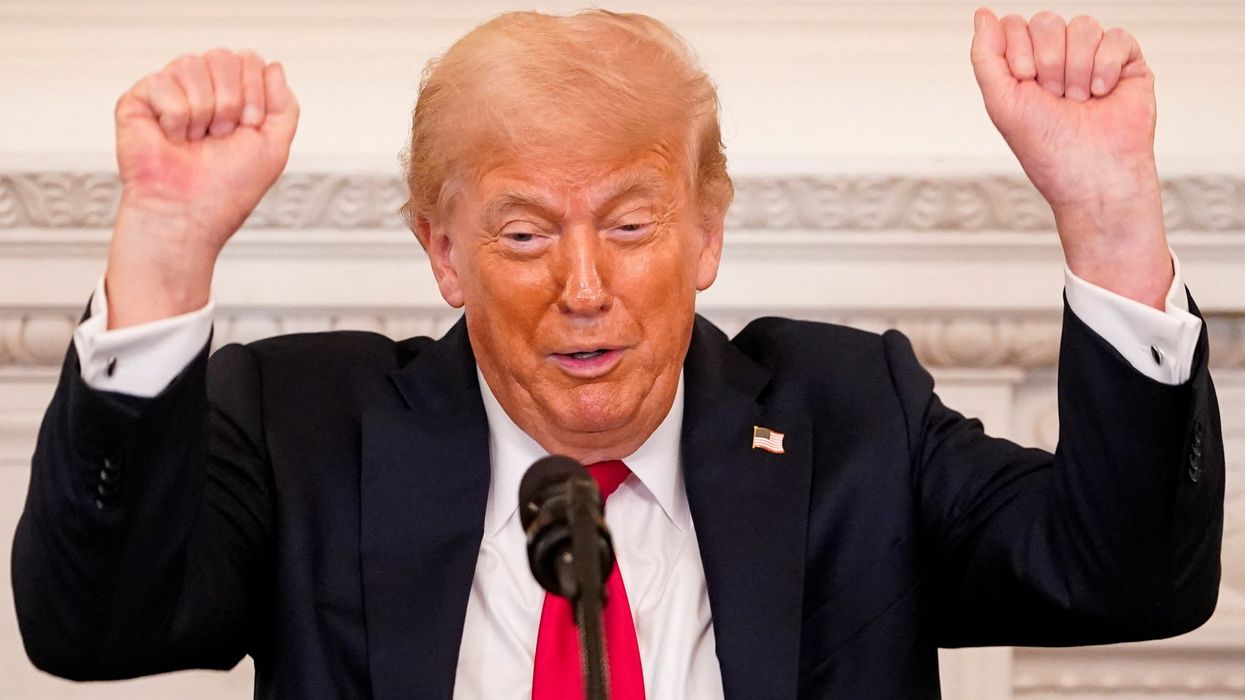
U.S. President Donald Trump gestures during the White House Faith Office Luncheon at the White House in Washington, D.C., U.S., July 14, 2025.
Before President Donald Trump took office, there was no widespread movement in America to annex Greenland or Canada. No one thought we should prioritize renaming the John F. Kennedy Memorial Center for the Performing Arts, renovating the East Potomac Golf Links or destroying the White House's East Wing to build a ballroom.
Yet millions of Americans support these things now, for no other reason than Trump wants them. And because these millions of Americans enable Trump's most grandiose whims, the rest of us seem to underplay the fact that those wishes are in fact signs of a profoundly disturbed mind. This is not mere grandstanding; Trump has draped his image over the Justice Department building and slapped it on passports, openly claimed to be America's all-time greatest president and even compared himself to Jesus Christ. Because Greenland is controlled by Denmark, America's NATO ally, Trump's threats of conquest have weakened that crucial international alliance. Similarly, by convincing Canadian Prime Minister Mark Carney to seek long-term trade agreements with China and the European Union, his public boasts that Canada will become "America's 51st state" (and private meddling in the ultimately-unsuccessful Albertan separatist movement) have led to a trade war loss instead of a victory.
In short, the gusts that blow through Trump's mind send chills through the worlds of global diplomacy and rattle the foundations of American democracy to their foundations. It therefore behooves us to better understand the mind. And few are more qualified to do so than Dr. Alan D. Blotcky, a clinical and forensic psychologist who wrote more than 40 articles for Salon, NY Daily News, and The Independent.
He has written extensively about how we can accurately assess Trump's motives through his public words and actions. In this exclusive interview with AlterNet, Blotcky made it clear that Trump's mind is not literally disconnected from reality. He is simply motivated by something terrifying — a desire to be "the last standing hero."
The following interview has been lightly edited for clarity, context and length.
Forensic psychologist's verdict: Trump is not psychotic.
Matthew Rozsa: In 2021, you argued that President Trump was, quote, "not delusional and knew exactly what he was doing." Do you still believe that, or has anything shifted?
Dr. Alan D. Blotcky: Yeah, I still believe that. I don't think he has a psychotic illness. I think he's a malignant narcissist who thinks that if he thinks something or believes something, that he can convince the world that it's the truth. So no, I don't think he has a delusional disorder. I don't think he's psychotic. I think he knows what he's doing.
Matthew Rozsa: It sounds like you're saying that he is so narcissistic, he believes through sheer force of will he can create the world that he wants. Is that correct?
Dr. Blotcky: Exactly.
Matthew Rozsa: How is that not a form of psychosis?
Dr. Blotcky: Well, I think he knows that many things that he believes are not true. It's his narcissistic game that he plays. He sees everybody else as pawns to be manipulated, and so he manipulates the world around him to fit his needs. But I don't think his particular beliefs are so fixed that he does not understand the difference between the truth and not the truth. He doesn't care, but he knows the difference.
Matthew Rozsa: There is a difference, though, between not caring about truth versus fiction and believing one can transform fiction into truth: that one can take a fiction and, by repeating it often enough and getting others to say it often enough and sifting through evidence often enough, you can turn that fiction into the reality in which the rest of us live. Trump seems to have that.
Dr. Blotcky: Yeah, that's exactly what happens, and that's exactly how it works. And he's not a very smart man, but he knows that exquisitely well. He knows that if he repeats something over and over and over again, that a certain percentage of people will begin to believe it. Especially as president, he's this ultimate authority figure, and there's a certain percentage of the citizenry that will believe what he says because, after all, a president wouldn't lie, would he?
Matthew Rozsa: It isn't so much that they don't think the president would lie, it's that they don't think he is lying when his lies are ideologically convenient for them. So for example, when he insults Somali immigrants or trans people, somebody who is already xenophobic, racist and/or transphobic is going to believe those lies because they're already inclined to. That is my take, anyway.
Dr. Blotcky: No, that's exactly right. And that's why those are the people who are his strongest supporters, because they align with his ideology, and they don't care if he's corrupt or criminal or deceitful or morally bankrupt. They don't care as long as it fits their ideology, and so they support him and they will support him to the end.
Matthew Rozsa: If Trump is manipulating the rest of us in a way that I think can objectively be described as malicious, or at the very least unempathetic, is there any way to manipulate him back so that he doesn't cause too much harm to the aforementioned marginalized groups or to democratic institutions or to global security?
Dr. Blotcky: Well, you know, if you go back and look at all of my writings back in 2021, I always believed that ultimately pushing back on the truth with him would ultimately marginalize him and that ultimately he would be rejected. The problem is that all the Republicans in Congress have succumbed, and their silence has enabled him to be the bad president that we have. If they did their job like they were supposed to do, he would be marginalized, and even if he had been reelected, he would've been marginalized, but there's no pushback in Congress. And I did not anticipate that. I guess I probably should have, but I did not anticipate that. But to answer your question, I think the way to deal with him, the only way to deal with him, is to push back, is to keep presenting the truth and the facts to not only him, of course, but to his supporters and to the country as a whole.
The problem, again, is the free press, in my mind, has fallen down, has succumbed to him as well. They have not published nearly as many articles as they should about his false and distorted and inaccurate and harmful beliefs and views. So I think it's been difficult to deal with him because the entities around him have not pushed back like I thought they should or would. I hope that answers your question.
Forensic psychologist's verdict: Trump supporters are motivated by money and fear.
Matthew Rozsa: It does, but it also raises another one, which is the reason they capitulate. Whether you're talking about law firms like Paul Weiss or media outlets like CBS, or you're talking about universities like Dartmouth, whether you're talking about Congress, Senate and House, the reason they capitulate is because the minority of Trump supporters is large enough and wealthy enough that they can bully majorities into submission.
Dr. Blotcky: Exactly. And it ultimately comes back to money and fear, you know. The rich people, the billionaires, the controlling people in these entities have succumbed to him out of fear, and they wanna maintain their financial status, and so they're not gonna buck him because he'll take them to court. He'll file lawsuits against them. He'll stop federal payments. He'll do whatever he can do to damage them, and they're not willing to take the high ground and the morally right ground to deal with him. And so that's part of the capitulation that has gone on in this country.
Matthew Rozsa: My additional concern is that as this movement follows Trump with cult-like devotion, they themselves will display some of the malignant narcissistic behavior that you describe. Before you respond, let me give you two examples: one policy, one interpersonal. The policy example is, before Trump's obsession with conquering Greenland began, I never recall hearing anyone in this country seriously talk as if we were going to break our NATO agreement and invade Denmark to take their territory. The fact that we suddenly, on a dime, adopted this position for no other reason than one man came up with it, to me, is one sign of malignant narcissistic traits spreading. One man's narcissism suddenly infects millions who support him. Maybe not a majority, but a large enough minority that they have an impact. And the other example is, I've had several encounters with Trump supporters who are very violent, emotionally and even physically, because of how strongly they believe in him.
That too, to me, speaks to a tendency that Trump has to make everyone feel as if his problems are theirs. I apologize for being so long-winded, but I wanted to be thorough. Do you understand the question I'm asking?
Dr. Blotcky: Yeah. Look, here's my position about this, and people don't talk about this, and this may sound overly cynical or fearful. I think Trump ultimately wants to destroy everything around him so that he is the last standing hero and rich person in the world. He doesn't care about democracy, he doesn't care about this country, he doesn't care about people. All he cares about is chaos and violence, and he could care less about the destruction of America. All he cares about is the grifting that he's doing so that he can walk away with billion after billion after billion, and he can say to everybody in the world that he's the richest, the smartest, the best, superlative you can find in every area. So he doesn't give a damn about this country. And any of his supporters that think that he does is a joke, in my opinion.
Forensic psychologist's verdict: Forensic psychology helps you understand Trump.
Matthew Rozsa: Now, you are a specialist in forensic sciences. I would argue that Trump is in many ways a literal criminal, from his financial crimes to the allegations of sexual misconduct against him. As somebody who studies criminal minds, what kind of mind does Trump have? Is he more similar to a serial killer or to a conman or to a domestic abuser? How do you typologically understand Trump?
Dr. Blotcky: I would say he's more like a conman. You know, he has the mind of a conman criminal. His position, and I've heard him say it, maybe not in so many words, but he essentially says, "If you don't stop me, then what I do is okay, and it's on you. If I rob a bank and you don't stop me from robbing the bank, then me robbing the bank is fine." That's the way a conman and a criminal think, and that's how he thinks. He doesn't have a moral compass. He's reacting to everybody else, and if you don't stop me, then it's fine that I do it. And if you do stop me, then I'll go on to my next endeavor. And that's what he does.
Matthew Rozsa: So to what extent do you think your professional and academic background gives you a unique perspective on Trump?
Dr. Blotcky: Well, I don't know how far into this you wanna get, but let me just say this. You know, one of the criticisms of these kind of comments is that I've never met Donald Trump, I've never interviewed Donald Trump, I've never evaluated him. So that's an important limitation in our discussion, in any of these discussions. And that's why the Goldwater Rule continues to be a principle that we stand behind as much as we can, because it is conceivable that Donald Trump personally and his personal life is different than his public life and his public persona. I think the chances of that are not strong, but it's possible. And I wanna say that, and I want that on the record.
Matthew Rozsa: I understand that's on the record. Is that all you have to say on the subject?
Dr. Blotcky: Well, I wanna highlight that because I don't wanna be misunderstood. It's conceivable that he's different, but we do have lots of records of him over the last 10 years. We have pictures and recordings and interviews and statements, and so we have a ton of material to try to base our opinions as best we can. But look at his behavior. Look at how many people have been hurt. Look how unempathetic he is. Look at how many lives have been hurt and harmed and even ruined by him. Look at how many people died during the pandemic because of his lies and inaction. So I just say look at his behavior. I urge others to look at his behavior, not just at his claims, because as we all know, he lies more than any public official in the history of America.
Matthew Rozsa: Where I struggle is knowing that he displayed many of these traits even when he was a young man, and now that he is older, there are some who think that there are indications of cognitive decline, but in fact, it may just be the same toxic traits that he had as a young man, but now as an old man. Or it could be both. What are your thoughts?
Dr. Blotcky: Yeah. I mean, again, I haven't interviewed him or evaluated him. He's 80-something years old. I suspect with whatever medical problems he obviously has, there's a likelihood of some cognitive slippage, but I still say it is his personality traits that are causing the problem, not his cognitive slippage.
Matthew Rozsa: I agree to a point. I interviewed someone named Dr. S. Jay Olshansky. I'll pull up the quote. Are you familiar with Olshansky?
Dr. Blotcky: I am not.
Matthew Rozsa: Well, Olshansky is a University of Illinois Chicago emeritus professor best known for developing the biodemographic paradigm of mortality. He studies how to slow aging and help humans reach the upper limits of their potential lifespans. When I interviewed him, he said, "I don't trust audio that I hear. Those can be doctored and altered. I don't trust opinions of others based on video and audio because those are often influenced by politics. Bottom line is, I think very few people have any valid basis for drawing any conclusion about cognitive functioning about the president." He was adamant that anyone who has not personally met Trump is not able to offer an informed diagnosis of his mental state. But at the same time, we can observe that he slurs his words. We can observe that he falls asleep during meetings. We can observe that he engages in odd, obsessive fixations like renaming the Kennedy Center or renovating the East Potomac Golf Course or trying to annex Greenland or starting a trade war with Canada.
And notice how, while the earlier issues are pettier, the larger ones begin to have international implications. At what point does it become necessary to disregard Olshansky's warning?
Dr. Blotcky: Well, that's the ultimate question, and I think you'll interview a hundred different professionals and you'll probably get 100 different answers. I think when democracy is being attacked the way it is, mental health professionals should speak out, but that's my opinion. The APA takes a different view of that, and I think that's why there's so much silence among mental health professionals, and that's why they have virtually been silent during these past two years. But the ultimate question is, at what point is it okay to voice your opinions and to raise issues? And that's why I think it's important to understand our limitations when we do so, the limitation being that I have not interviewed him, I have not evaluated him.
It is possible that he is different personally than he is in his role now. But I think people should speak out, and that's my opinion, but other people's opinions are just as valuable as mine.
Matthew Rozsa: I have gone through my list of questions. Is there anything else you'd like to say about these subjects?
Dr. Blotcky: I wish the people that we talked about earlier, whether it be the mainstream media or members of Congress, would push back more. I think that would be in the service of democracy, and it's what we need, and that is what is failing us.