

'Straight-up bribery': Insider tears apart Trump 'plan' to loot Social Security
Editor's Note: After this article was published, AlterNet received the following email from the White House.
“The doomers and naysayers have consistently doubted President Trump: when he pledged to create the historic Trump Accounts, lowered prescription prices with Most Favored Nations, secured the border with no crossings, cleaned up our streets, ended taxes on tips, grew real wages, renegotiated broken trade deals, and reshored key manufacturing back to the United States," White House spokesperson Davis Ingle told AlterNet. "President Trump has consistently proven his doubters wrong, drawing a clear contrast with the Democrats’ record of historic inflation, unfettered illegal immigration, skyrocketing crime, and weakness on the world stage. With the continued support of the American people, President Trump will keep delivering real results.”
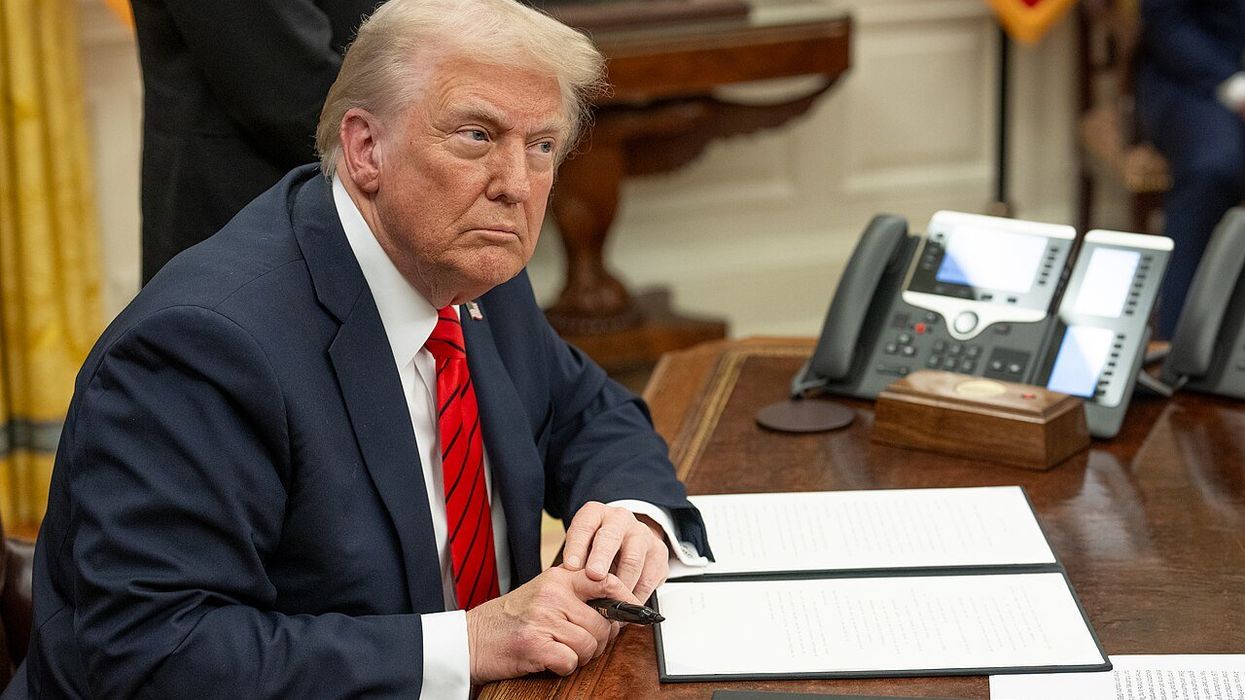
President Donald Trump and his closest advisers, including Secretary of the Treasury Scott Bessent and the world's richest man Elon Musk, claim they want to fix waste in America's biggest and most important social safety net.
Their critics say they are simply coming up with excuses to loot Social Security.
America's $2.56 trillion worth of Social Security funds are a constant point of contention in current political debate. Liberals want to protect the program and accuse conservatives of using terms like "reform" and "modernize" as codes for cutting benefits and ultimately privatizing it into institutions they can access.
To address these issues Trump is sending $90 checks to senior citizens, although those checks hail from a mysterious provenance. He is also offering to pay every American adult $5,000 if Republicans retain control of Congress during the midterm elections.
Democrats, by contrast, are trying to save the program. Democratic Senate candidates like Josh Turek of Iowa, James Talarico of Texas and Troy Jackson of Maine have argued that any serious financial issues facing Social Security can be addressed by simply forcing the rich to pay their fair share. Specifically, to keep the funds solvent past 2032, raise the current cap that says recipients are only taxed on earnings up to $184,500.
To learn more about the political dilemma facing Social Security, AlterNet spoke with President Joe Biden's Social Security Commissioner, Martin O'Malley.
This interview has been lightly edited for clarity, context and length.
ROZSA: I’m reading from NBC News. "A swath of Senate candidates across blue and red states are campaigning on raising Social Security taxes on higher incomes to prevent a benefit cut from taking effect in less than six years. Currently, Americans are taxed on earnings up to $184,500 to fund Social Security. These candidates, most of them Democrats, are calling for lifting that cap to boost revenues ahead of a fast-approaching 2032 deadline for insolvency." What are your thoughts on that?
O'MALLEY: Well, it’s the most straightforward way to strengthen Social Security for the far future, as well as increased benefits here and now. Right now, a person making a billion dollars pays nothing more into Social Security than a family making $184,000. So most Americans think that’s unfair, and that wealthier people should pay the same Social Security tax rate that all of the rest of us do, or rather the most wealthy people in America should pay the same Social Security tax rate that all of the rest of us do.
ROZSA: What do you expect the political backlash to this to be? Where do you think it will come from?
O'MALLEY: Ooh, I think if there’s any pushback from it, it’ll come from the 6% of Americans who make more than $250,000 or more than $400,000, depending on where Congress decides to scrap the cap. So people like Donald Trump have always hated Social Security. They feel like employers pay into it, but employers don’t get anything back from it like individual workers do. And that’s been true from the beginning of the program. But in terms of organized opposition, there aren’t many small businesses that are paying salaries in excess of $184,000. So I actually think as people come to understand the solution and what’s at stake as that cliff gets closer and closer, I think you’re going to find broad public support for requiring that the wealthiest of Americans pay the same Social Security tax rate that all of the rest of us do.
ROZSA: Trump is saying that he will pay every American adult $5,000 if Republicans retain the midterms, which to me sounds like socialism, but then they say that Social Security is socialism. And so my argument is there seems to be an inconsistency, a, dare I say, expediency to what is or is not defined as socialism. Does that make sense?
O'MALLEY: Yeah, but look, I don’t think that’s socialism or capitalism, that’s bribery. That’s paying people to vote a certain way. If he stood outside a polling place in Baltimore and around the corner from it was offering to give people $5,000 to vote for him, they’d put handcuffs on him, if he were a citizen. So that’s not capitalism or socialism, that’s just straight-up bribery.
ROZSA: All right. So overall, what are your thoughts on what needs to be done to keep Social Security solvent?
O'MALLEY: Yeah, the solution is very straightforward. The reason Social Security’s Baby Boomer surplus is being depleted sooner than they thought way back in the ’80s is because of income inequality. It’s because of the fact that as it’s currently structured, the wealthiest people in America pay almost nothing into Social Security, and they need to pay the same Social Security tax rate on their earnings that all of the rest of us do. And whether you’re an Independent or Republican or a Democrat, every American wants to see Social Security strengthened except for people like Donald Trump or Elon Musk or Vivek Ramaswamy or these other multimillionaires and billionaires who are the folks who have resented the program ever since its beginning.
ROZSA: I’ve never understood that resentment. I don’t understand why the people who have so much money are so upset about people who have less money receiving a little bit of extra help.
O'MALLEY: Yeah. Well, if they don’t have money to spend, they’re not gonna— If we go back to the days when millions of seniors died in poverty, when orphan kids had to sell themselves on the streets, that’s not very good for anybody’s profits in America. So, yeah, it’s the age of gilded greed, and with a lot of shades of eugenicist philosophy.
The notion that some people are useless, as Elon Musk said, non-character players. That guy, he said that empathy is the greatest weakness in the Western mind. The rest of the world, though, thought that empathy is what allowed us to create this land of opportunity, the strongest democracy once upon a time in the world, and the strongest economy, and the post-World War II era, up until the present, as hard as they worked to undermine it and its currency. Yeah, so the reason Elon Musk doesn’t like Social Security is not because he was able to find any gross inefficiencies and waste or even single prosecution of an illegal immigrant receiving benefits. No, he dislikes the program because he thinks that some human beings are waste. People that are too disabled to work in his economy are waste, just elderly. They’re waste.
ROZSA: I’m now going to bring up a personal observation here. Elon Musk, like me, is autistic. Donald Trump, although he has never been diagnosed, shows signs of ADD, which means if he is ADD, he’s also on the neurodiversity spectrum. I find it galling that they view disabled people as wastes when they are themselves disabled, and if they hadn’t been born rich, could also have been viewed as wastes. What are your thoughts on that observation?
O'MALLEY: Yeah. The biggest waste of money in America is the buckets and buckets of tax breaks that we continue to shower on the wealthiest of individuals and corporations. That’s the biggest waste in America.
ROZSA: I agree. So again, is there anything else you’d like to say before I close the interview?
O'MALLEY: Given how many Americans have earned their Social Security benefits and how much support there is for the program, it’s surprising to me, not that some candidates are saying that wealthier people should pay the same tax rate as the rest of us, but what’s surprising to me is knowing that people like Ken Paxton and Vivek Ramaswamy and Ashley Hinson are still talking about cutting it or privatizing it. That’s what surprises me. It’s not that people would want the fairness of the same tax rate for wealthier people, for the wealthiest people, but that some of these politicians, Republicans, are still talking about privatizing and cutting it. I don’t get that.

