

The war that broke MAGA: Inside the far-right mutiny against Trump
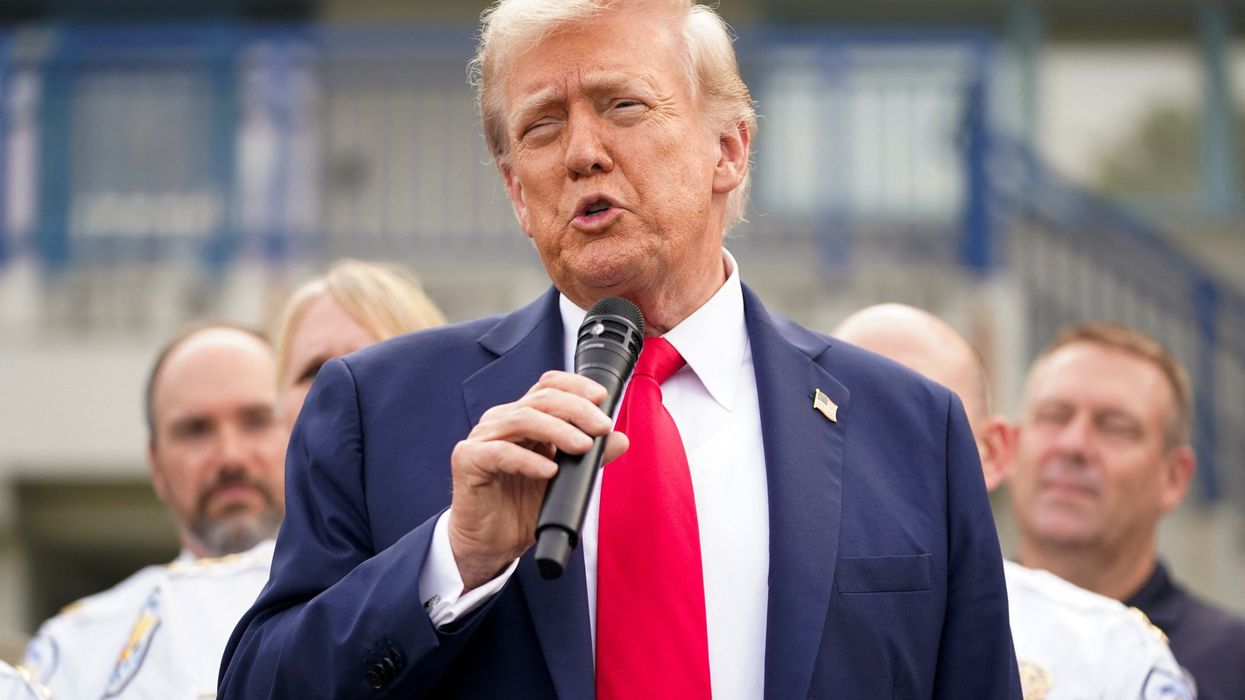
When you view President Donald Trump as an existential threat to American democracy, it can be difficult to understand why anyone would support him. Certainly I fall into this category: I interviewed a cult expert to understand the mindset of Trump supporters and, by juxtaposition, spoke with Sabato's Crystal Ball editor and polling expert Kyle Kondik to assess the chances of Republicans suffering setbacks in the upcoming midterm elections.
When I talked to Kondik, he had bad news for Trump and his supporters.
"Generally speaking, a president who is this unpopular should see his party lose a lot of ground in Congress," Kondik told AlterNet. "That said, Joe Biden also had poor approval in 2022, but Republicans didn't do all that well—they flipped the House but not the Senate. However, the Republican lead in the generic ballot was not as large as the Democratic lead is now."
Additionally, Kondik pointed to Trump's many unpopular policies.
"It's primarily the president's weak approval rating combined with the usual difficulty that the presidential party has in a midterm," Kondik told AlterNet. "I also think there may be even more for voters to react to in 2026 compared to even 2018, because Trump has acted as more of an imperial president and there is more dissatisfaction both with the economy as well as the president's foreign policy choices."
In contrast to Kondik, a former Trump supporter and Republican lawmaker, ex-Rep. Joe Walsh (R-IL), recently posted on X that he believes most Trump supporters will never abandon him, regardless of current polls and broader midterm election history.
"A Trump voter just told me - 'I know Trump lies to me all the time, and I don’t care. As long as I get tax cuts, right wing judges, and mass deportations, he can lie to me all he wants,'" Walsh wrote. "I give you examples every week of Trump voters who’ve seen the light and finally turned on Trump. They’re the exception. The vast majority will never turn against Trump. Like that guy,."
Walsh then added an emoticon of a finger pointing upward.
"He’s unreachable," Walsh continued.
If Walsh is right and most Trump voters are unreachable, then we need to examine how American politics got so tribal in the first place. To understand that, I spoke with attorney Clarine Nardi Riddle, who spent years as a close adviser to one of my dear friends, the late Sen. Joe Lieberman of Connecticut. Even though I was much to the left of Lieberman on a range of issues, we bonded over our mutual love of politics, and I had the privilege of writing articles with him and learning about how he nearly ran on a bipartisan presidential ticket during the 2008 election with a Republican, Sen. John McCain of Arizona, even though Lieberman himself was an independent Democrat.
Explaining the start of hyper-partisanship in Washington DC, Riddle identified one factor as being when "[Republican former House Speaker Newt] Gingrich, in '92 or '94 — I can't remember which year, but I could pin it down — when he urged everybody not to move to D.C., but to stay in their districts and campaign so they could keep getting elected. I think that was a turning point in people not meeting other people here in DC and getting to know them. Because if they only come in on Monday night and leave on Thursday night, they're doing partisan stuff Tuesday, Wednesday, and Thursday, and they're not getting to know their colleagues. They're not getting involved in the community with their family. They're totally focused on partisan types of things."
Riddle added, "When Joe moved here, when Joe came here in '89, he was told, 'Move here. Bring your family. Get involved in the community, in the schools, in the synagogue. Go to dinner with your colleagues. Do those kinds of things.' Because we all know it's easier to attack somebody you don't know than somebody you do know. When you know somebody, you're more sensitive about attacking them if you're going to differ with them."
In that spirit, I conducted the following interview with Carrie Sheffield, a former colleague of mine from Salon Magazine who is now a prominent conservative columnist (having been published everywhere from The Wall Street Journal and National Review to USA Today and The Daily Caller) as well as a singer (she performed at Trump's Great American State Fair). While Sheffield and I strongly disagree about politics, we have remained friends over a decade, and I reached out to her to try to gain insights into the world of Trump supporters.
In my opinion, she is incorrect about the state of the economy, which now includes a $40 trillion debt, a dollar that fell sharply in 2025 and brutal inflation; about the declines in violence crime and rape, which predate Trump; and about Trump's efforts to rebrand the Kennedy Center, which has driven many artists away from the venue. Yet in this conversation, I presented Sheffield's views in their entirety, including with her sources, and emphasized the importance of disagreeing without being disagreeable.
This interview has been lightly edited for clarity, context and length.
Trump supporters remaining loyal.
ROZSA: What are you seeing among Trump supporters right now? Through your work at Independent Women, on Virginia's Board for Professional and Occupational Regulation, and in conversations with voters, have you noticed any shift in how people who backed President Trump feel about him in 2026?
SHEFFIELD: It’s highly typical for an incumbent president to see some margin softening heading into midterm elections, however, President Trump’s base is rock solid, and voters like myself admire his pursuit of a strong tax and regulatory agenda, boosting U.S. energy independence, reforming education, and bolstering national security.
Important context’s getting lost in some media coverage: a broader crisis of confidence in U.S. institutions. Compare the RealClearPolitics favorability polling aggregators for President Trump, along with national Democrats and Republicans. They're all clustered around nearly exactly the same approval. So I would be cautious about any side interpreting dissatisfaction in the electorate as a midterm mandate.
In Virginia government, I've seen firsthand how affordability is often shaped by small regulatory decisions most voters never hear about. As I recently wrote in the Richmond Times-Dispatch, our Board for Professional and Occupational Regulation voted against recommending creating a new occupational license for radon professionals after finding complaints were rare, existing remedies were working, and additional licensing risked adding duplicative costs and red tape.
It's a small example, but an important one: affordability isn't just about the big economic headlines. It's also the cumulative cost of thousands of government decisions that eventually show up on someone's bill. My comments here are my own, of course, and not on behalf of the Virginia board on which I serve.
This small Virginia case illustrates a much larger national issue. Research cited by the federal government estimates occupational licensing triggers 2.85 million fewer jobs and $203 billion annually in higher consumer costs. That underlying Brookings research also found licensing often raises prices and restricts employment without clear evidence of corresponding improvements in service quality.
One occupational license may look insignificant. Multiply that thinking across hundreds of occupations, thousands of regulations and 50 states, and it becomes an affordability issue affecting the entire country.
This concern is bipartisan. The Obama White House issued a major occupational-licensing report in 2015 warning licensing can raise prices, restrict employment opportunities, and impede worker mobility. At the time, roughly one-quarter of American workers needed a state license for their jobs, compared with less than 5% in the 1950s. The Obama administration urged states to eliminate unnecessarily burdensome licensing rules and improve license portability. Its 2016 fact sheet noted at least 11 states had proposed 15 reforms following that initiative.
Nationally, President Trump built on this deregulatory principle. During his first administration, his licensing order emphasized that excessive licensing imposes higher burdens on lower-income Americans.
Trump applies the same cost-conscious philosophy through Executive Order 14192, “Unleashing Prosperity,” requiring federal agencies issuing a new regulation to identify at least 10 existing regulations for elimination. It requires the incremental cost of new regulations, after accounting for deregulation, to be significantly below zero.
There's also a bipartisan lesson in the Virginia experience. I was appointed by former Republican Gov. Glenn Youngkin. My term runs through June 2028–now during Democratic Gov. Abigail Spanberger's administration. It would benefit the country if other Democrats took a cue from Spanberger and worked across the aisle to reduce unnecessary regulatory costs and improve affordability for families. Good regulatory policy shouldn't belong to one political party.
ROZSA: Why do you think some Trump voters are souring on him? Where you do see disillusionment, what's driving it: cost of living, tariffs, foreign policy, tone, or something else? Given your background at Goldman Sachs and Moody's, how much do you think economic anxiety explains?
SHEFFIELD: It’s important not to paint Trump voters with too broad a brush. There are millions of Americans who remain strongly supportive of President Trump and believe he delivered on issues we care deeply about. At the same time, Americans across the political spectrum are clearly concerned about affordability and the direction of the country.
My time managing municipal credit risk at Goldman Sachs and rating bonds at Moody's taught me to look past political rhetoric and examine incentives, prices, growth, and what households are actually experiencing.
In my conversations with voters, people are practical. They care about affording groceries, housing, energy and raising a family. They care about peace and security. Those kitchen-table concerns transcend personality and party.
I also think there's a mistake to treat “the economy” as though Washington alone determines every family's economic circumstances. Where Americans live increasingly matters. State tax rates, energy policy, housing and occupational regulations, and the overall regulatory environment have enormous effects on cost of living and economic opportunity.
That's why interstate migration is so fascinating. The Committee to Unleash Prosperity's U.S. inter-state migration analysis looks at states gaining and losing adjusted gross income. People aren't simply moving themselves; they're moving income, businesses, entrepreneurship, and future tax revenue with them. That makes interstate migration a real-world laboratory for state economic policy.
According to IRS migration data compiled by Vote With Your Feet, the top 10 states for net domestic migration gained a combined 6.4 million people from 2012 to 2023. This meant the top 10 states for income migration–nearly all conservative leaning–gained approximately $476 billion in adjusted gross income. Florida alone gained roughly 1.75 million people and $224 billion in income, while Texas gained nearly 1.5 million people and $63 billion.
Meanwhile, Left-embracing states like New York lost a net 2.01 million people and $124.6 billion in adjusted gross income, while California lost 1.85 million people and $114.1 billion.
Those numbers are a powerful reminder that states compete for people, businesses and capital. Tax, regulatory, housing, energy and occupational-licensing policies aren't abstract debates—they help determine where Americans choose to live, work, invest and raise their families.
We need to look beyond a single national political narrative. America's economic story is also written in Albany, Austin, Tallahassee, Sacramento, and every other state capital. Governors and state legislators wield tremendous power to make their states more—or less—affordable places to live, work, start a business and raise a family.
Republicans as a complicated group.
ROZSA: How does the mood among Republican officials compare with the base? Do you see any daylight opening between GOP elected officials and the White House, or between those officials and their own voters?
SHEFFIELD: Republicans aren't monolithic, and neither are Trump voters. There are robust policy debates within the coalition—on trade, family policy, foreign policy, AI, the proper balance between federal and state power, and the role of government in the economy.
AI and data centers are particularly interesting examples. There are conservatives who emphasize rapid innovation and America's need to beat China technologically, and others who put more emphasis on local control, energy costs and protections against potential harms. Those aren't necessarily irreconcilable positions.
In fact, the data-center debate is already scrambling normal partisan lines. The House recently passed the Ratepayer Protection Act 417-3, addressing whether data centers and other large electricity users should bear infrastructure costs rather than shifting them onto ordinary ratepayers. Reuters reported on that extraordinary bipartisan vote.
President Trump rightly emphasizes the strategic importance of building the infrastructure America needs to lead in AI, while also discussing the ratepayer legislation with Senate leadership. I think that's an important combination: America needs to build, innovate and compete with China while making sure communities and ordinary families aren't unnecessarily burdened by that growth.
I actually think policy debate can be healthy. A strong political coalition should have room for serious discussion about how best to achieve shared goals.
ROZSA: Could anything bring them back to Trump? For voters who have drifted away, what would it take to win them back, and what would you advise the administration or the party to do?
SHEFFIELD: Ultimately, voters are going to judge the administration on results they can see and feel in their own lives. At the national level, there are also significant security and economic outcomes that deserve more attention among voters.
One is public safety–an issue that especially affects women. August brought positive news that President Trump’s commitment to public safety is bearing fruit. The FBI’s Uniform Crime Reporting Program shows 2025 saw the largest annual decline in violent crime rates since FBI estimations began in 1936. Violent crime fell 9.3% in 2025 —the largest annual decline ever recorded. Murders fell 18.1% — tying the lowest recorded rate. Robberies dropped 18.5% — amounting to ~38,500 fewer robberies. Property crime fell 12.4% — the second-largest decline ever, with ~750,000 fewer crimes. Rape fell 7.6% — a staggering 10,000 fewer victims as the Trump administration continues delivering for America’s women.
Also, as my Independent Women colleague Patrice Onwuka recently pointed out, recession fears didn't materialize; employment remains strong, real wages have been outpacing inflation, corporate earnings have been robust, federal revenues have reached records, and enormous technology investment has helped propel economic activity.
Record low poverty and record high median incomes in 2025 suggest President Trump’s economic agenda works.
Women have posted some particularly remarkable gains. Independent Women's recent reporting on economic data shows women holding 50.1% of U.S. payroll jobs, a record 55 Fortune 500 companies led by women, and 14.2 million women-owned American businesses generating $2.8 trillion in receipts. Women-owned businesses grew 12% from 2022 to 2025, nearly twice the growth rate of businesses owned by men.
I would return to outcomes rather than personalities. The struggle of real wages negatively affected by the Iran conflict and energy prices as what makes it hard for families to feel so much of the economic progress listed.
Those are measurable concerns. Ultimately, voters will decide for themselves whether the results meet their expectations.
ROZSA: Where can people find common ground? Independent Women emphasizes finding shared policy agreement across political lines, and your memoir centers on healing and forgiveness. Where do you see realistic room for agreement between disaffected Trump voters and Americans on the other side, whether on AI and technology or other issues?
SHEFFIELD: At Independent Women, we collaborate with open-minded people on the Left who are willing to work across ideological lines for shared policy goals. I don't expect them to become conservatives, and they shouldn't expect me to become a progressive. We don't need to agree on everything to work together.
That's a major part of the philosophy behind the AI and Tech Center I direct at Independent Women. We believe America should lead the world in AI and emerging technology, grounded in free enterprise and human creativity, while taking legitimate concerns about security, privacy, families and economic stability seriously. The answer shouldn't be choosing between innovation and protecting people. Good policy enables both.
AI and data centers may be one of the best opportunities for that kind of coalition. I've highlighted constructive ideas coming from the center-left. For example, the Chamber of Progress's Democratic AI Opportunity Agenda, proposes no public subsidies for hyperscalers, requiring operators to provide or purchase their own power, rather than shifting costs to ratepayers, closed-loop water cooling, and enforceable community-benefit agreements. Those are ideas conservatives and liberals can both embrace.
We're seeing similar unexpected coalitions elsewhere.
School choice is historically identified with conservatives, but some Democrats are as well. Colorado Democratic Gov. Jared Polis embraced the new federal school-choice program, while Democratic governors elsewhere have reconsidered earlier decisions not to participate. Education Week documented that shift.
Ukraine is another example. Voters on the Left and Right believe America has a strategic and moral interest in resisting Russian aggression. The House's bipartisan Ukraine Support Act brought together Democratic and Republican sponsors. House members highlighted that coalition.
We're also seeing movement to recognize biological realities when protecting women and girls. Democrats are beginning to say publicly that fairness in women's sports requires acknowledging sex differences. Democratic candidates in several states moved on this issue, and the AP reports Democrats are recalibrating their approach to transgender issues.
That's encouraging to me. Common ground means discovering that people who disagree with you on 80% of politics can still work together on the other 20%.
My memoir, Motorhome Prophecies: A Journey of Healing and Forgiveness, is a story about reconciliation and restoration after experiencing severe child abuse. My own life taught me that you can disagree profoundly with someone without denying their humanity. America desperately needs more of that.
My Christian faith teaches me that human beings aren't abstractions or political categories. They're people made in the image of God. Forgiveness doesn't mean abandoning conviction. We desperately need both grace and truth.
Performing at the Great American State Fair.
ROZSA: Your singing career has also recently been taking off, and you've performed at a lot of conservative events. As an artist, how do you feel about the controversies regarding Trump's relationship with the arts, such as the Kennedy Center controversy or his budget cuts to the National Endowment for the Arts (NEA) and the National Endowment for the Humanities (NEH)?
SHEFFIELD: I'm the daughter of a former music professor. I was raised awash in the immortal music of Bach, Beethoven, and Mozart. Art isn’t merely ornamental. Art helps civilizations transmit beauty, meaning, and identity from one generation to another.
That's why it has been such a treasure for me to see some of my own values finally embraced at the Kennedy Center.
In June, I attended the Kennedy Center’s Mark Twain Prize for American Humor honoring Bill Maher. I interviewed Democratic Sen. John Fetterman–a maverick I am increasingly admiring–on the red carpet.
The experience became even more interesting when Maher later publicly acknowledged he'd been wrong about President Trump's endorsement record. As I wrote in the Daily Signal, it’s culturally healthy to celebrate an artist who can disagree fiercely with people politically and still be willing to say, “I was wrong,” when the facts require it.
That's part of what I hope the Kennedy Center can represent: not an arts institution for one political tribe, but a national stage large enough for people who profoundly disagree.
I've seen greater openness there to faith-based art and storytelling. I wrote about “Revival Generation,” a documentary premiering at the Kennedy Center last year, chronicling the UniteUS movement. The film tells stories of young people confronting addiction, mental illness, unforgiveness, and other struggles and finding healing and community through Christian faith. Whatever someone's own religious beliefs, those stories deserve a place in America's cultural conversation.
As I wrote for The Washington Post, our great cultural institutions should reflect the whole country. In terms of budget cuts, the reality is that millions of Americans with traditional values are upset to see our tax dollars subsidizing “art” that undermines our voices.
For too long, many traditional conservatives felt culturally homeless in institutions meant to represent American culture broadly.
I don't want to replace one ideological monoculture with another. I want the doors opened wider. Bach's Christian faith didn't diminish his genius. It inspired it. Beauty, music and creativity are bigger than either political party.
Ultimately, artists need freedom. Conservatives should reject the idea that art belongs to the political Left, just as progressives shouldn't treat conservative or Christian artists as interlopers in American cultural life.
ROZSA: On a happier note, what are your favorite anecdotes from being a successful singer? You show your patriotism by singing; I show mine by sparing people my singing.
SHEFFIELD: [laughing] First, I appreciate your patriotic sacrifice, Matthew.
In March, I had the joy of vocal soloing at the Kennedy Center, where Hollywood legend Rob Schneider introduced me before I led “The Star-Spangled Banner” on the mainstage. For someone whose family devoted so much of our lives to music, this was a meaningful, full-circle experience. Performing at this crown jewel of American culture is a highlight for any musician.
It was especially meaningful because of my father, Ralph Alvin Sheffield, Jr., a renowned music composer and classical guitarist–protege of legendary Andrés Segovia.
This Independence Day, by invitation of the White House Task Force 250, I sang on the mainstage of the Great American State Fair, hosting a National Mall crowd in a one-hour program of music and prayers for our nation. Toward the end of the service, I gave a tribute to Dad during our last song, “Amazing Grace,” while jets flew overhead--a final salute to my late father, who passed away just days earlier on June 29.
Another highlight: last year, I co-wrote “My Heavenly Father Is” with musicians Kim Walker-Smith, Mitch Wong, and Mia Fieldes. The song mirrors my own journey of healing. Our song was featured on ABC News and debuted at the iconic Franklin Theater near Nashville, TN at a Great American Media film screening. Our song was adapted by a professor at College of the Ozarks, where I gave my first college commencement speech in May and performed our song with the college’s chorale.
For me, music engages faith, community, beauty and meaning. Music integrated with faith community is a powerful antidote to mental illness–including the wave of anxiety, depression and suicide gripping America.
There is strong scientific data showing regular faith and religious practice are highly tied with strong mental health and low addiction. Harvard Medical School’s David Rosmarin's research examines relationships among spirituality, religion, mental health and neurobiology. Rosmarin directs McLean Hospital's Spirituality & Mental Health Program. Rosmarin's work challenges the assumption that faith should be compartmentalized away from serious mental-health care.
My own experience with music has made that connection tangible: music gives voice and meaning to pain and suffering. Bringing the two together is profoundly healing for me.
There is something beautifully full-circle about it. I spent much of my professional life analyzing markets, interviewing policymakers, writing about politics and public policy. Voting is often a combination of head and heart. Journalism engages the mind. Policy engages institutions. But music can bypass all of our defenses and go directly to the heart. I've come to treasure that.

