
Top Clinton aide calls out Clinton, Obama and Biden over biggest blunders
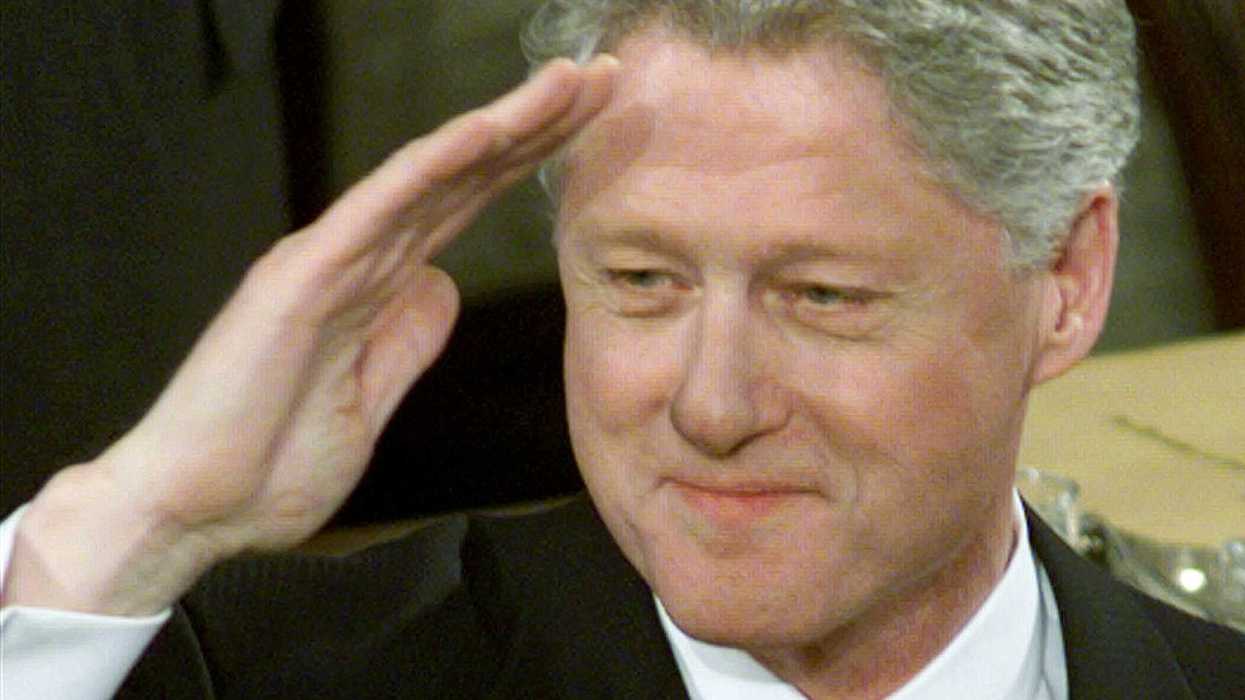
Bill Galston is the kind of adviser who puts the "brains" in "brains trust."
A senior fellow at the Brookings Institution and top adviser to former President Bill Clinton, Galston is perhaps most famous today for his "Wall Street Journal" columns, which combine his insiders' knowledge of American politics with the moderate perspective of someone who genuinely wants government to work for its citizens.
Speaking exclusively to AlterNet, Galson talked about how past American presidents prioritized humility, from Dwight Eisenhower preemptively accepting responsibility for the D-Day invasion of France if it failed to John F. Kennedy admitting his administration failed in the Bay of Pigs invasion of Cuba. By contrast, President Donald Trump is famous for his refusal to admit he was wrong, whether about the outcome of the 2020 presidential election and his decision to invade Iran or the realities of man-made climate change and the threat posed by artificial intelligence.
The following interview has been lightly edited for clarity, context and length.
Humility in the Trump era.
Matthew Rozsa: I recently read your editorial "Leaders Used to Accept Responsibility." You mentioned how General Eisenhower was ready to accept responsibility if the D-Day invasion had failed, and how President Kennedy did accept responsibility when the Bay of Pigs invasion failed. Why do you think political leaders in America today have not adopted the Eisenhower-Kennedy approach to humility?
William Galston: Well, I've been thinking hard about that column since I wrote it, and I think it's an interesting question as to whether Kennedy and Eisenhower represented the norm, or exceptions that we remember precisely because they were so clearly exceptional. So I'm not prepared to say, as a sort of blanket historical judgment, that taking responsibility is higher or lower now than it has been in the past. My sense is that it's lower, but I certainly can't prove that with rigorous historical analysis. Having said that, the human motivations that lead people to try to evade responsibility are eternal and strong. If something goes disastrously wrong, it's only human to look for ways of minimizing your own role in the disaster, and to look either for broad historical forces or other individuals to blame instead.
So that's not a very satisfactory answer, but—
Matthew Rozsa: It's an honest one, and that's really, given the question I asked, all I can expect. I would say, and I have not been a presidential advisor like you were for Clinton, I have not been alive and involved in politics for as long as you have, but I have been interested in politics most of my life, and I've been a professional journalist for a decade and a half. Even in my lifetime, I've noticed that there has been less of a premium placed on humility. Say what you will about George W. Bush and Barack Obama, but both of them made mistakes, and neither of them has shied away from owning their mistakes. I don't think they did so as elegantly and poignantly as Eisenhower and Kennedy, but I don't think either of them would say they look back on their presidencies without regret.
William Galston: I think that's right. And—
Matthew Rozsa: The same thing is true of Joe Biden. He definitely regrets not being more forthcoming about his health, and at the very least getting in advance of those stories. Obama has said that he regrets not doing more to take urgent awareness of the threat posed by Vladimir Putin in Russia. And Bush has acknowledged that the Iraq war was not well prosecuted, at least early in his administration, before the surge.
William Galston: Yeah. Well, I had extraordinary personal evidence of that last one. I was invited to a full-day seminar some years ago at the Bush Center. And at the end of it, President Bush, who attended the whole thing, said, "Wanna see my art gallery?" We all said, "Sure." And he walked us to it, in a different part of the building. And to my astonishment, every painting on the wall was something he had done personally, and every single one of them was a portrait of an Iraq war veteran.
And we stopped in front of every picture, and he explained who the subject was and, in many cases, what had happened. And it was pretty clear to me that each of these paintings was an act of penance. So I do think that the outcome of the war, and the way it was prosecuted, was for him a policy mistake, but more than a policy mistake. It's something that he took responsibility for in a very personal, almost spiritual way. So that would certainly confirm it. I think Biden is a less clear case, because I've read accounts of his recently published account of his presidency, and he still can't bring himself to acknowledge clearly that it was a terrible mistake to seek a second term, a mistake with consequences that the country had to live with for a long time. So—
Matthew Rozsa: We're still living with those consequences.
William Galston: We are still living with those consequences. I shouldn't have put it so clearly in the past tense. I would be happier if President Obama had taken more responsibility for the aftermath of the Great Recession: for the painfully slow recovery that led to Donald Trump's election, I believe, and for the social consequences of the extraordinary loss of manufacturing jobs that we endured during the first decade of the 21st century. So I'm not sure what kind of grade I'd give him overall. And getting a little bit closer to home, I haven't studied this matter, and I'm not sure whether the guy I worked for has ever fully acknowledged the negative consequences of the decision that was put into effect right at the end of his presidency, that is, to allow China into the WTO under very, very accommodating terms.
I think that will go down in history as a very large blunder, based on an honest assessment of the situation that just turned out to be dead wrong.
Can things be fixed?
Matthew Rozsa: I guess, then, my next question is about the consequences for the spirit of America's body politic of the decline in humility. And before you answer that question, I want to clarify what I mean by the spirit of the body politic. I'm not being religious or metaphysical. I'm saying that good faith and the ability to be humble when necessary are essential to democracy functioning. And my question is, if those traits have been permanently eroded, what will the consequences be for our civic estate?
William Galston: Well, first of all, I don't think anything is permanent. If my 46 years in and out of presidential politics have taught me anything, it's that. And I always, at this point, recall the famous story of a young stock clerk who rushed up to J.P. Morgan when he happened to spot him and said, "Mr. Morgan, Mr. Morgan, what will the market do?" And Morgan looked at this guy and said, "Well, sonny, it will fluctuate." And so does politics. I think that at some point, when things go too far in one direction, countervailing forces kick in. I'd point out, for example, that in the most recent election, religious forces in the form of liberal mainline Protestantism turned out to be very effective politically. And I think part of their effectiveness was as a counterpoint to how harsh and partisan evangelical Protestantism has become, especially in this century.
And so I'm not convinced. Well, to put it positively, I think there may be much more political space right now for what I'll call political humility, which is a special kind of humility. It consists in the acknowledgment that no one leader and no one political party has a monopoly on wisdom. That is the strongest basis for a politics of compromise and conciliation.
It also happens to be the truth. And I have a hunch, I can't prove this, that the American people are sick and tired of the politics of arrogance: the belief that I'm right and the other side is wrong, and the belief that I represent the forces of unalloyed good and the other side is pure evil. I think the time may have come for a U-turn on all of that.
Matthew Rozsa: I definitely hope you're right. You remind me of something that my friend, the late Senator Joe Lieberman, once said. He described himself as a centrist, not because he wanted to be in the ideological center, but because the concept is bringing people from all sides together to agree on at least some issues, and then, by acting in good faith, getting things done on a policy level that help people. My sense is that that's what you're describing, and the era that Lieberman functioned in was not that long ago. But even though you said that that ethos can be restored, we need to act to restore it. It won't happen on its own. I think it would be foolish and complacent to just sit back, do nothing, and assume it will happen through political evolution. What steps do we, the people, need to take?
William Galston: Well, I would say there's a very simple answer to that question. And it's not an answer that's going to come from civil society. It's an answer that's going to come through the political choices we make. Very simply, it is our responsibility at this point, I believe, to respond affirmatively to the peacemakers and negatively to the warriors. We've done the reverse for quite some time now. George Bernard Shaw once said that democracy is the only form of government in which the people get exactly what they deserve. And I think the truth of that aphorism has been demonstrated in recent American politics. So, to repeat, the most important thing we can do is reward the politics of conciliation with our votes.
And if people of that political stripe start winning, then others will rush to imitate them, and we'll have a generation of leadership that has been taught through experience the politics of conciliation. Not conciliation in all things: there are differences in principle, and people have to stand on those differences.