

White House UFO adviser says space aliens don't care who the president is
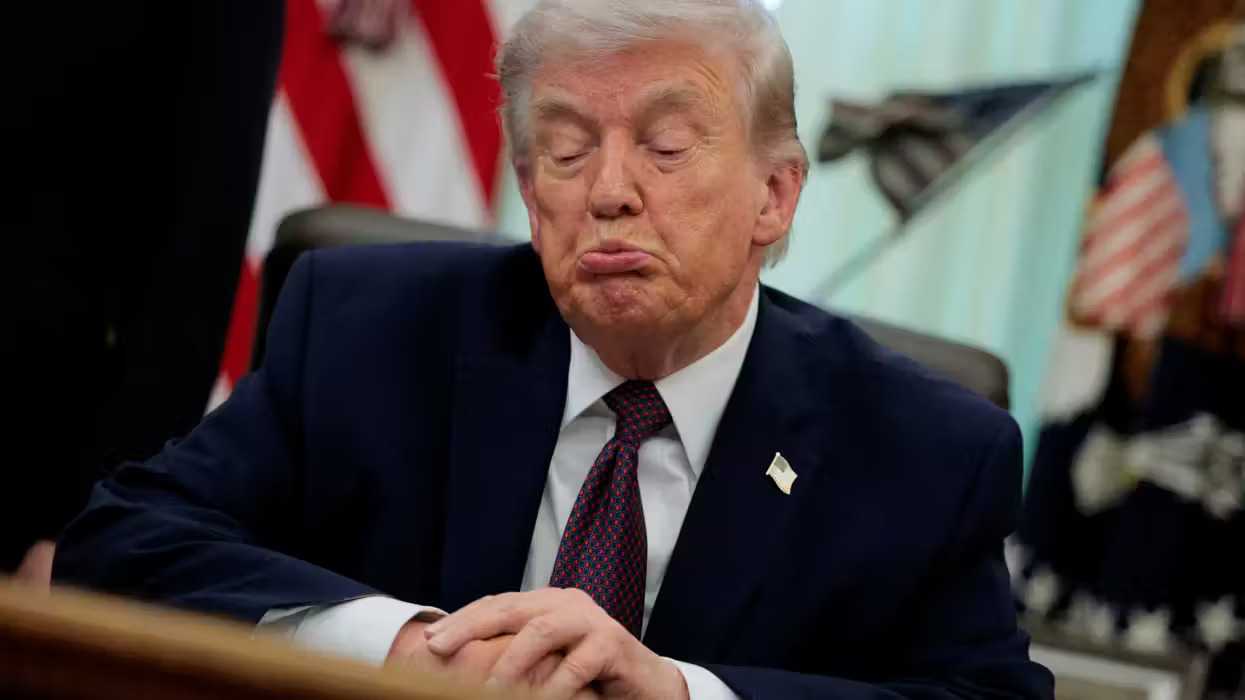
U.S. President Donald Trump reacts during an executive order signing on mail ballots, in the Oval Office of the White House in Washington, D.C., March 31, 2026.
Editor's note: The original headline for this story has been changed.
President Donald Trump has repeatedly promised to reveal to a curious world what America's government knows about UFOs and UAPs. Has he lived up to his promise?
It's a vow that precedes his second term. During a congressional hearing in 2023, when President Joe Biden was in office, a number of experts came over to disclose that they had witnessed unidentified flying objects (UFOs) and unidentified anomalous phenomena (UAPs). They included David Grusch, a former Air Force officer and intelligence official; former intelligence and Defense Department employee Lue Elizondo; and journalist George Knapp. As a result of both that hearing and other UFO/UAP-related disclosures, 2023 proved to be a historic year when it comes to Earth's search for the truth about these mysterious sightings in the sky.
Flash forward three years and Trump's new administration — led by a man who has repeatedly insisted he has a keen interest in disclosing more to the public about UFOs — in theory took a giant step forward toward revealing whatever truth that is out there. Aaron Lukas, Principal Deputy Director of National Intelligence, released a memo declaring that "consistent with Presidential Direction, the Department of War (DoW) and the Intelligence Community (IC) will implement a process to ensure current and former government employees and contractors with relevant information on UAPs shall have prior non-disclosure agreements (NDA), agreements, oaths, or commitments waived when speaking with authorized government representatives of the All-Domain Anomaly Resolution Office (AARO) or PURSUE [Presidential Unsealing and Reporting System for UAP Encounters]."
The memo added, "All members of the IC will, within 30 days of the receipt of this memorandum, coordinate with the Office of the Director of National Intelligence (ODNI) to establish a PURSUE designee, and inform their workforce of the President’s order."
To learn more about both this directive and the Trump administration's overall attitude toward UFOs and UAPs, AlterNet spoke with Dr. Avi Loeb, a Harvard theoretical physicist who specializes in cosmology and astrophysics. In June, shortly after the Trump White House announced that he had been appointed chairperson of their new UAP Science Advisory Council, Loeb told AlterNet that he felt like "a kid in a candy store."
Here is how Loeb's interest — to which he brings the mind of an informed scholar and the heart of an enthusiastic child — has intersected with government policy on this polarizing issue.
The following interview has been lightly edited for clarity, context and length.
Trump's ideas about UFOs/UAPs:
Matthew Rozsa: Many in the science community have criticized the Trump administration as being, quote, "anti-science." What do you think of that view, and what has your experience been?
Dr. Avi Loeb: Well, I can only comment on the work of the council. In that regard, science is treated very favorably. In fact, this is a historic change in the way government has regarded its partnership with scientists on unidentified anomalous phenomena. Until this year, scientists were blocked from accessing data pertaining to UAP. One can think of a variety of reasons for that. One is that some of the data was classified. Another is that the people responsible for identifying objects in the sky — members of the Pentagon or the intelligence community — didn't want to be scrutinized by the public, Congress, or scientists over whether they were doing their job. The defense budget is close to a trillion dollars in 2026, and yet there are objects in the sky we don't understand. So in a way, there was a natural tendency to hide this information, partly so that adversarial nations wouldn't become aware of holes in US defense.
But now we're in a new era, where scientists are invited to advise the government on this phenomenon. I'm very pleased to serve in that capacity, because at the very least, by assembling the council — which now includes about 20 brilliant scientists — I'll be able to help the Pentagon and the intelligence community fulfill their mission of securing the safety of strategic US assets, in case we're dealing with objects manufactured by adversarial nations.
But there's also a chance of a scientific reward. Even if it's a small chance — even if we find one object out of a million that isn't human-made — that would be the biggest discovery in the history of science, in the history of humanity. It would have huge implications for the future. There's no bigger reward a scientist could hope for. So either way, it's a win-win situation as far as I'm concerned.
You might say the US government deals with down-to-earth topics related to national security and doesn't have the bandwidth to make cosmic scientific discoveries. But that's not true. In the 1960s, a treaty was signed between the United States and the Soviet Union banning nuclear explosions above the atmosphere. The US wanted to monitor the situation and make sure the Soviets weren't cheating, so it launched a network of paired satellites called the Vela program. In 1967, they detected a gamma-ray burst — the kind of signal you'd expect from a nuclear explosion above the atmosphere. At first it was classified, but five years later it was published in the Astrophysical Journal by scientists from Los Alamos, who determined the source was actually coming from the universe at large.
It took 25 years, from 1972, until astronomers measured the distance to these sources and realized they came from the edge of the universe. In fact, they originate from the collapse of the cores of massive stars: when a star consumes its nuclear fuel, the core collapses into a black hole, and as material swirls into the black hole — like water going down a drain — jets are produced perpendicular to the accretion disc. Those jets drill a hole through the star's envelope, and if we observe a jet pointed directly at us, we see it as a gamma-ray burst. So these long-duration gamma-ray bursts turned out to be the birth sites of black holes formed from collapsing stars. What started as a national-security operation to monitor the Soviets ended up as a cosmic discovery of great value to astronomers.
That's an example from the 1960s, and I wouldn't rule out the possibility that the US government could make another cosmic discovery now, in the context of unidentified anomalous phenomena, by monitoring the sky for national security. Astronomers usually look at only a small portion of the sky at any given time with their telescopes and ignore objects flying overhead, whereas the US government monitors the entire sky, and the ground, continuously for national security purposes. It's possible that decades of monitoring have produced data on rare events of great scientific value. That's why, as a scientist, as soon as I was asked to establish and lead the UAP Science Advisory Council, they had me at hello — I immediately agreed.
Rozsa: I like the "Jerry Maguire" reference.
Loeb: Yes. So in this context, I'd say it's fortunate for both science and national security, because they'll each benefit from the involvement of my council. And the situation is much better than the one envisioned by Steven Spielberg, because in his film "Disclosure Day" — released on June 12th, which was actually one of the days when a tranche of information, one of five released so far, was disclosed — it was an actual disclosure day. But in the film, the scientists who know something are chased, their car smashed against a moving train. My car is intact, and I'm simply being asked, as a scientist, to help the government figure this out.
Rozsa: If I may interject — this is actually a great point to segue into my next question.
Loeb: Go ahead.
Rozsa: Do you think President Trump believes in (A) alien life forms, and/or (B) UFOs?
Loeb: I haven't had the opportunity to discuss it with him directly. Based on his public statements, I think he's open-minded and would follow whatever the evidence shows. Obviously, for a president, it would be a great boon if, during his term, we discovered we're not alone — that we have a neighbor in our cosmic environment. That kind of discovery would be remembered millions of years into the future. It's not like a dispute with another nation, which in a century will likely be forgotten. This would be a major discovery that shapes the future of humanity. If it happens during President Trump's term, that's how he would be remembered for millennia.
Rozsa: That's an interesting point, and it leads naturally to my last question from my editor. If aliens landed on Earth tomorrow, would you be glad President Trump is in office?
Loeb: A visit by aliens — if they arrived, they likely wouldn't care much about how we've divided up the land on Earth's surface. Anything we care deeply about — disputes over territory, nationality, ethnic origin, the things we read about constantly in the news — probably isn't important at all to a visitor from far away, because Earth is just a tiny rock, a few millionths of the mass of the sun, left over from the sun's formation. It's a tiny fraction of the real estate available in the Milky Way. If someone arrives from the vast expanses of interstellar space, recognizing how humans divided up territory on Earth is a very low priority for them. They wouldn't care about the United States, and they wouldn't care who its president is.
On the other hand, for us it's a great opportunity to learn about new technologies, new science, our technological future — because if they arrive in our backyard before we arrive in theirs, they're probably far more advanced. We've had just one century of modern science and technology since the discovery of quantum mechanics, which underlies artificial intelligence and our best technology. If they've had a thousand years, a million years, or a billion years since their equivalent discovery, who knows how much more advanced they'd be? For us, it's an opportunity to learn.
So I see it as an asymmetric encounter — we have a lot to gain from observing their capabilities. That also implies we shouldn't immediately fire at an alien visitor just because we want to shoot them down, since who knows what the consequences might be if they're technologically superior. Just like having a visitor in your backyard, what you want to do first is figure out their intent and capabilities before deciding how to respond. You can't really plan ahead, because so much is unknown — we can't have a fixed protocol. It's a very different situation from receiving a radio signal from far away, where the signal took thousands of years to reach us and we therefore have thousands of years to respond. Here, we're dealing with a visitor in our own backyard — we'd have to respond promptly, and it would be wise to first listen and watch, just as on a blind date it's more prudent to listen to the other side before you speak.
The disclosure memo:
Rozsa: I think that's a great observation, and I'm glad you said it, because it leads into my questions about the memo — "UAP Disclosure Is No Longer Optional." I've really been looking forward to discussing this with you. You wrote that the memo from Aaron Lucas waiving NDAs for current and former government employees on UAP matters is important. How did you first learn about the memo, and what was your initial reaction?
Loeb: The memo was shared publicly on X by Aaron Lucas. I saw it shortly before that, but the intent was to make it as public as possible, because the goal is to allow whistleblowers to speak out. In the past, they were worried about legal repercussions from various non-disclosure agreements or contracts they'd signed. This memo states clearly that those non-disclosure agreements are being waived for current and former government employees. Each government agency is being asked to designate a representative on UAP who will try to collect as much information as possible and encourage everyone to be open about what they know — even if it's classified, they can speak in classified forums with the task force declassifying information, or with AARO, the All-domain Anomaly Resolution Office at the Pentagon.
Some whistleblowers have expressed concern that waiving NDAs isn't enough, and I know the Office of the Director of National Intelligence is trying to accommodate their concerns. This matters a great deal to me, because strategically speaking — as some whistleblowers, like David Grusch, have said under oath before Congress — the US government allegedly holds materials from crash sites: dozens of spacecraft, by his most recent account, along with biological pilots recovered from them. If that's true, we simply need guided access to that material, and that would be the end of it. That would convince anyone with doubts, because it's easy to verify whether something is human-made or not, and easy to examine biological material to determine whether its origin is terrestrial.
So if we're able to get that guided tour, or access to the material — even if it's held by corporations, wherever it may be — that would settle any doubt, and then we could start addressing the implications. That would save a great deal of time. Strategically, I'd much rather get there directly than take the alternative approach: analyzing blurry videos or images to determine whether the motion of an object is consistent with human-made technology. That's far more tedious, complicated, and often inconclusive if the data isn't good enough.
So if there is something real behind what Grusch and other whistleblowers are describing, I'd like to know everything about it. If they have legal concerns, let's remove those barriers, let them tell us everything, and then verify it. That seems like the right approach: let them say what they know, then check it and determine whether there's anything real behind it — whether these are simply stories they were told, or whether it involves crash-site material related to human-made aircraft recovered on battlefields, which people labeled "alien" because they didn't want adversarial nations to know about it.
I can imagine a scenario where there's a real program to retrieve materials, with biological pilots, but all of it is human-made. To verify that, we need direct access to the evidence rather than relying on testimony — that would be the fastest path to determining whether we're actually being visited. But if it turns out there's no clear evidence of non-human technology, even after every whistleblower has spoken and we've checked it all out, then the only remaining option — more tedious — is to collect new data, or reanalyze old data if it's good enough.
Unfortunately, none of the objects in the five tranches released so far demonstrate beyond reasonable doubt that they're non-human-made. All of these orbs and other objects could potentially be explained as human-made technology. Over the past several months, I've examined various possible explanations — such as laser spots, since focusing a high-powered laser can produce a hot blob of glowing air, and the military does use powerful lasers. I wondered whether some reported orbs could be explained this way, and the answer is: not all of them can. Some could be drones — we know drones move in coordinated swarms, and some orbs did that too. But other orbs moved too fast to be explained by drones.
Finally, I published a new paper examining what would happen if a "warp bubble" — a region of space where spacetime is distorted, an idea dating back to 1994, proposed by the Mexican physicist Miguel Alcubierre — passed through Earth's atmosphere. People have talked about warp drives as a means of interstellar travel. What I found is that if such a bubble moved near the speed of light, it would shock the surrounding air and produce a fireball brighter than the sun — something we don't observe. But if it moved slower than the speed of sound, the glow observed around some orbs could potentially be explained this way. That's more speculative; I did it mainly to illustrate that we could be observing a new phenomenon, possibly originating from another technological civilization — we just don't know. The best way to find out is to gather new data, which is what the council is working on in cooperation with the Office of the Director of National Intelligence and AARO at the Pentagon. The idea is to place new sensors at sites where UAP have been reported and try to characterize their nature with better data, since we can't go back and improve the data behind past reports — but we can collect new data going forward.
Rozsa: My next question is also about the memo. You draw a direct line between this memo and the corroboration problem that has dogged witnesses like David Grusch, George Knapp, and Lue Elizondo. Do you expect any of them, or others, to come forward now that the legal excuse is gone?
Loeb: Yes, I very much hope they will — that's the only way for us to determine what stands behind what they've told us. If it turns out everything they've described is real, they'll be heroes. But if it turns out we can't substantiate any of it, the conclusion will be different — that perhaps they were told stories that weren't true. The only way to find out is by looking for evidence. What I'm doing — looking for evidence — draws attacks from believers, who say, "We already believe this, we already know the answer, why should we seek evidence?" And I say, "Show me the evidence and I'll believe it too." At the same time, some in academia attack the pursuit of evidence itself, saying there's probably nothing there and we shouldn't waste our time. What they're missing is curiosity — the US government itself says it sees things it doesn't understand, so as citizens, we should help figure that out. This disregard for the evidence, on both sides, is inappropriate. I think the best way to make progress is, as in a detective story, to collect enough evidence that everyone eventually reaches the same conclusion.
Rozsa: So now I want to ask something I've been meaning to ask since our last interview. You described the prospect of working with this administration on UFO research as being, quote, "a kid in a candy store." Now that you've chaired the UAP Science Advisory Council for a while, has the reality lived up to that ambition?
Loeb: Not yet — but we've only just started. It's the summer, things are slow, and we've been working on this for only a couple of months. My hope is that a year from now I'll know much more, and I can properly assess it. If it turns out there's nothing there — that we're dealing only with human-made objects or well-understood natural phenomena, and nothing as spectacular as some whistleblowers promise — then at some point I could decide it's no longer worth my time. It's not as if we should chase ghosts; you could spend your life doing that and end up with nothing.
The only reason I'm intrigued is that there's real potential to collect evidence. It's a work in progress — unlike the weather, which just comes your way, this requires effort. If evidence is held somewhere within government or corporations, we have to work hard to get it. If it doesn't exist, we can collect new data on past reports and look for similar objects. That's what I've done with the Galileo Project, and now we can do it in partnership with the government. But if, after all that effort, we find nothing tantalizing, it's time to move on to something else — that's how science is routinely done. When it was realized 80 years ago that most of the matter in the universe is invisible, many scientists got excited and started searching for it. In recent decades, they've searched for specific particles that might make up dark matter, and many of those searches turned up nothing — at which point the community moves on to something else. That happens a lot in science; we search in the dark, not knowing what we'll find. This case is different, because some people claim to have worked within government and to be aware of actual evidence. So I very much look forward to seeing it, if it exists.
Trump's funding for UFO/UAP research:
Rozsa: I now want to talk about your essay, "Are We at the Top of the Cosmic Food Chain?" You point out that nearly a trillion dollars went into AI last year, while UAP research received a tiny fraction of that. Do you believe the current government is doing enough to address that imbalance?
Loeb: No. Given the importance of figuring out what UAP are, for national security alone — consider the possibility that we're dealing with, say, Chinese spy drones. We know that in 2023, a Chinese spy balloon was shot down over the United States by the US military. Whenever I find an ant in the kitchen, I know there are many more under the sink that I'm not seeing, and that's what concerns me. For the same reason, I'd argue that determining what these orbs and other UAP are is an urgent matter, because we don't want adversarial nations entering our territory without our knowledge. If it turns out this technology was developed by other nations, we have the legitimacy to shoot it down — just as we'd have the legitimacy to remove an unwanted visitor from our backyard. But we don't know that yet, so we need to find out.
Looking at the defense budget, investing tens or hundreds of millions of dollars in this effort — maybe even a billion — makes a lot of sense. It's important; we're talking about things happening over US sovereign territory. At the same time, if it turns out to be something more exotic, that would be the biggest discovery ever made, and it would be remarkable if the US led the way in making it. So I think it's absolutely worth the investment right now. Just to give a sense of scale: the Galileo Project, which I lead, has had people dedicated to this task for five years already. We've built three observatories, and the funding is roughly a million dollars a year — that's too little. It needs to increase by several orders of magnitude to make faster progress. That funding could come from government, if it decides this is a priority, or it could come from wealthy individuals — this is the scale of funding wealthy individuals give to scientific projects. The benefit for them would be early access to information if we are indeed dealing with alien technology that surpasses what we've developed so far. They'd be the first to know, and there would be enormous financial implications if we discovered alien technology or alien science — it would be a quantum leap in our knowledge. So it makes sense for people willing to take financial risks to take a small risk on research into unidentified anomalous phenomena.
Rozsa: I'm glad you mentioned that, because my next question is also about your essay. You argue that alien technology could hold more financial upside than AI. Can you elaborate on what that means in terms of specific possibilities?
Loeb: We invested about a trillion dollars in AI over the past year, much of it in data centers. Those data centers essentially reflect the knowledge humanity has collected on the surface of this one planet — that's pretty much what they encompass. But the real estate on Earth is a tiny fraction of what exists out there; there's far more real estate on planets around other stars. A visitor from elsewhere in the Milky Way might carry far more knowledge than we currently have, and their technology and science could represent a knowledge base much bigger than all of our AI systems combined. That's why the opportunity for us to grow in knowledge and understanding is far greater if we interact with alien intelligence, or the products of alien intelligence, than if we simply interact with the artificial intelligence we've created ourselves.
After all, you can think of artificial intelligence as a digital mirror — it reflects what we already know as humans. AI systems can perform tasks faster and better than humans, but they don't know more than we collectively know, because they're trained on a dataset of everything humans have ever thought or written. Alien intelligence, on the other hand, could be trained on something vastly bigger. That's why the opportunity is so great. It's a bit like growing up familiar with your own family, then going on your first blind date with someone from a completely different family — it opens your eyes to things you've never seen before. I'd say we're dealing here with a blind date of interstellar proportions, and one far more significant for humanity.
Rozsa: I want to go back to "Disclosure Day", the film you mentioned earlier. Did you speak with Spielberg while they were making it?
Loeb: No — I spoke with him about a decade ago, when he received an honorary degree at Harvard. He told me that if I ever discover aliens, he should be the first to know.
Rozsa: Interesting. I see a lot of your ideas in that film, in terms of how humanity might react to the disclosure that alien life exists. So my question is: if we did make contact, who would you trust most to communicate that to the public honestly and responsibly — scientists, corporations, the media, or politicians?
Loeb: I think it needs to involve all of them, because "the public" includes many different groups. First, you'd want to communicate with the scientific community, so they can reprioritize their work — as of now, this subject sits at the periphery of scientific attention. Once there's a shred of evidence beyond reasonable doubt, it will become the hottest topic in science; everyone will want to work on it, Nobel Prizes will be awarded, and all the current ridicule and dismissal will vanish. Everyone will suddenly say, "Of course — we always thought it was a reasonable possibility." Once the entire scientific community is engaged, we'll be able to learn much more about the implications of what we've encountered.
Then there's the wider public that politicians know how to reach, and politicians will need to decide on policy — including how to respond to a visit. Is it a risk? Could the visitor be hostile? Should we consider an aggressive response, or not? Those are political decisions that need to be informed by all the data scientists collect, so policymakers understand the risks, capabilities, and possible intent of the visitor.
You'd also want psychologists involved, since they're accustomed to studying intelligent systems, aided by artificial intelligence to help analyze the data. And eventually there will be spiritual implications, so you'd want clergy and philosophers part of the conversation too. I'd argue that all facets of society's leadership need to be included in how this is communicated, because different parts of the public respond to different aspects of it. It's such a major event that it would affect everything — it could affect the stock market, since the financial future would become uncertain; it could affect world politics, as different nations might realize they need to cooperate because the risk comes from outside. It's a bit like a knock on the door that makes an arguing family stop and listen to the visitor together. Everyone would become curious about the visitor and set aside their fights — so it would affect world politics, and it would affect academia, since attention would shift toward understanding what we're dealing with and how it will shape humanity's future.
There's a great deal of work to be done on the implications, and it has to be a collective effort of humanity as a whole, because we're all in the same boat — we can't avoid being affected. And if some nation acts irresponsibly — say, by firing on the visitors — that could affect all of us. So we'd need to coordinate our response internationally.
A zen approach to dealing with haters:
Rozsa: I have one last question. Looking back at the full arc of your career — from a Harvard astronomer studying black holes to a White House science advisor on UAPs — is there anything about this path you'd have done differently, or would warn your younger self about?
Loeb: No, I'd have done the same thing. It reminds me of Pablo Picasso — he started painting very realistically, and only later in his career developed his own style, pioneering Cubism and other approaches to drawing and painting. When asked why he did it that way, he explained that he first wanted to master the craft, to demonstrate he could paint as realistically as the artists before him — and only after gaining enough confidence was he able to do his own thing.
I'd say the same applies to me. It took me several decades to master the craft of doing science, and to recognize that on many occasions, pioneering, breakthrough discoveries were ignored by a mainstream community that was headed in the wrong direction. I gained enough confidence after chairing the astronomy department for a decade, chairing the Board on Physics and Astronomy of the National Academies, and so on — enough understanding of how science is actually done — to recognize that it's not about getting as many likes as possible; it's about doing the right thing. As I see it now, that's become an inspiration to a lot of people. I'm very glad I went that way.
At the same time, I've also taken a lot of hits from people trying to bring me down for their own reasons — some just want the limelight themselves, and when they see me recognized publicly by the media, they try to tear me down. That's scientific jealousy, and I've seen it over and over. Perhaps the one piece of advice I'd give is: ignore the haters, and do the right thing — because attention is exactly what they want. It took me a while to learn that. Early on, I responded to it; now I know how to manage it and focus on what matters.
Rozsa: "Haters gonna hate," says Queen Butterfly.
Loeb: (laughs) Yes — but I should say there are many more people who are inspired and encouraged. I get a lot of emails from parents telling me their kids decided to become scientists after seeing me on television. I get messages from artists sending me things they've created inspired by my work — bronze sculptures, watercolors, songs, books. I just received a children's book whose author said it was inspired by my work after she read it. So I get an enormous, positive response, and that makes it worthwhile. Of course, the biggest reward would be finding something that shapes the future of humanity — that's what I'm hoping for. But even if we don't find it, at the end of my life I'll be able to tell myself: I gave it a try.

