
Trump loses control as Congress questions Pentagon chaos and strategy
REUTERS/Jonathan Ernst
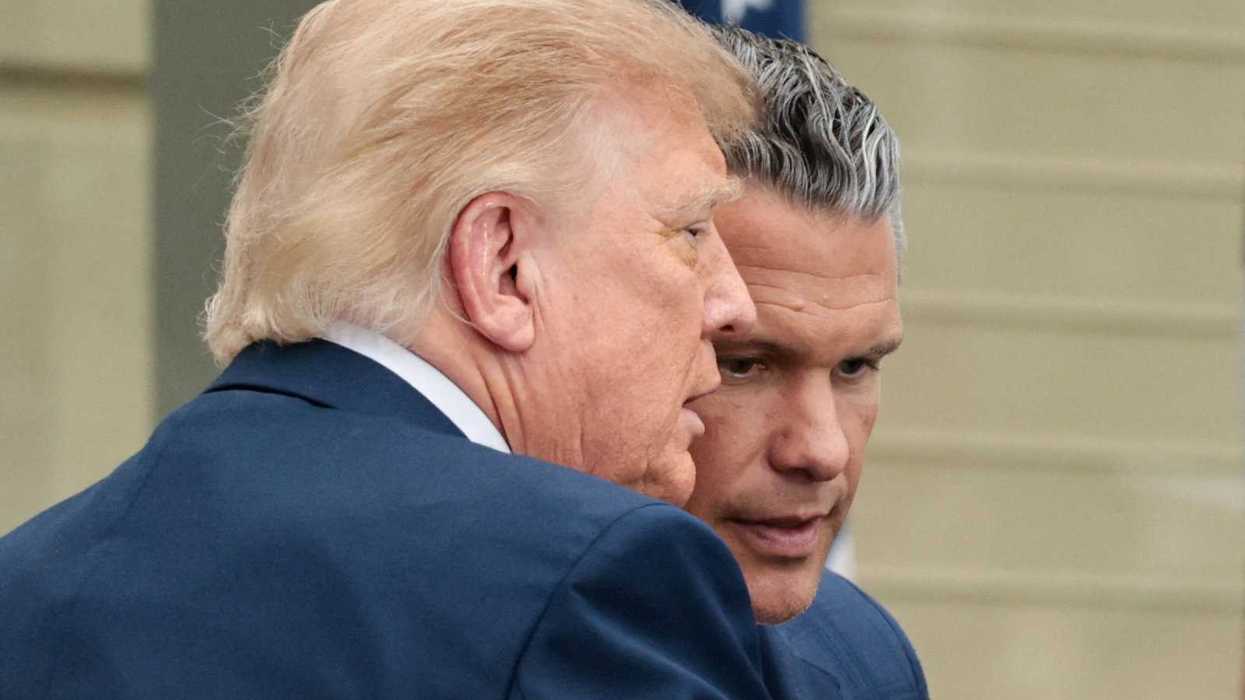
U.S. President Donald Trump greets U.S. Defense Secretary Pete Hegseth in Washington, D.C., September 11, 2026.

U.S. President Donald Trump greets U.S. Defense Secretary Pete Hegseth in Washington, D.C., September 11, 2026.
Just how War/Defense Secretary Pete Hegseth is going to immediately improve the U.S. military by firing up to 20 percent of its generals and admirals remains a question.
But then, put it on the building heap of unanswered issues on the Pentagon’s front table.
Rather than stress military brainpower and effective management at a time when drone inventiveness and artificial intelligence are showing us the new battlegrounds, Hegseth remains on alert for what ideal military members look like, and the elimination of anything smacking of diversity and inclusion.
Even as Hegseth brags about U.S. dominance over Iran, in the Middle East or in Asia, he seems to be taking the military on a circuitous tour to talk about “lethality” while just leading a series of unexplained and odd strategic and tactical consolidations. It remains unclear how threatening any of this is to Iran or Russia or China.
In recent days, the U.S. has hurriedly removed a dozen B-52 and B-1 bombers operating out of RAF Fairford in Britain since the opening days of the Iran war (and for decades before), following a foiled terror attack on the base by a handful of Iranian British dual citizens and belief there could be a drone attack on the base. Still, withdrawal – or retreat – hardly seems the signal for military dominance, even as 50,000 American service members remain on under-defended bases in the Middle East and hardly seems to reflect the warrior-above-all approach that Hegseth espouses.
At the same time, Donald Trump is talking about deploying a third aircraft carrier group within striking distance of Iran, presumably to back up his tough talk about “annihilating” a country of 93 million.
Hegseth delivered a “state of the force” address to selected military troops that said he was now after a fit, lethal army. “No fatties, no trannies, no beardos, no weirdos, no wimps, no radicals—just warriors,” emphasizing strict enforcement of fitness, grooming, and uniform standards, as if that is the main issue facing the military. On Thursday, he promised to livestream a Gladiator-like military execution from Fort Hood, an unneeded, anti-humanitarian decision that seemed embarrassing to those in the Pentagon.
Meanwhile, Trump wants weapons, nuclear reactors and a Space Force in space while talking about taking oil fields from vanquished foes.
Our military conversation is out of whack.
Who is Hegseth Persuading?
In Congress, the members from both sides of the aisle increasingly are asking publicly what Hegseth is doing and questioning why Trump won’t act to bring him under control. For himself, Hegseth sees no bounds in speaking out against all tradition about partisan politics – indeed to talk of promoting himself as a presidential candidate.
It is widely believed that Hegseth is being kept in office, in part, because he refuses to rule out deploying troops to polling places or to U.S. streets if the election does not follow Trump’s wishes – not because he sees strategic advantages that others do not, or even leads brilliant military tactics.
This is the same Hegseth who will not be honest with the public about casualties among American service members or among Iranians or other targeted groups. This is the same Hegseth who is either in denial or resistant to acknowledging the rate of using the most expensive U.S. weaponry in Iran, drawing down defenses elsewhere on the globe.
This is the same Hegseth who sees the next target just over the horizon in Cuba or Greenland without follow-up of where the U.S. already has launched combat. This is the same Hegseth who is widely cursed by troops held without basic services for months in the Middle East with no understood purpose for being there.
Should the November election result in a Democratic change in majority in one or both houses of Congress, Hegseth is emerging as the top candidate for public roasting over the outstanding questions he has created with divisive hiring and promotion policies and short-term strategic thinking.
New initiatives introduced by the secretary have included the development of autonomous warfare technology and partnering with non-Ivy League universities for officer recruitment. Most of his initiatives have concerned culture within the military as seen by Hegseth personally as opposed to studies of trends.
Who is Hegseth’s intended audience, because he sure has trouble focusing on current forces, recruitment targets or management of a hulking Department of Defense.
The Wall Street Journal saw his recent address as a polarizing attack, even accusing the press of ‘treason’ for publishing what’s leaking out of the Pentagon because Hegseth will not answer straight questions for fear of public criticism. For Hegseth, revived culture-war grievances mean that the Pentagon is “no longer the woke department or the weak department.”
Does it feel as if the U.S. military is feared around the world?
Terry H. Schwadron retired as a senior editor at The New York Times, Deputy Managing Editor at The Los Angeles Times and leadership jobs at The Providence (RI) Journal-Bulletin. He was part of a Pulitzer Gold Medal team in Los Angeles, and his team part of several Pulitzers in New York.

