
The Sci-Fi warning that predicts Trump's next alarming move

Despite the widespread opposition among his own voters and many of his fellow Republicans, President Donald Trump continues to support no additional regulations for AI and data center construction, most likely because doing so is directly enriching his family.
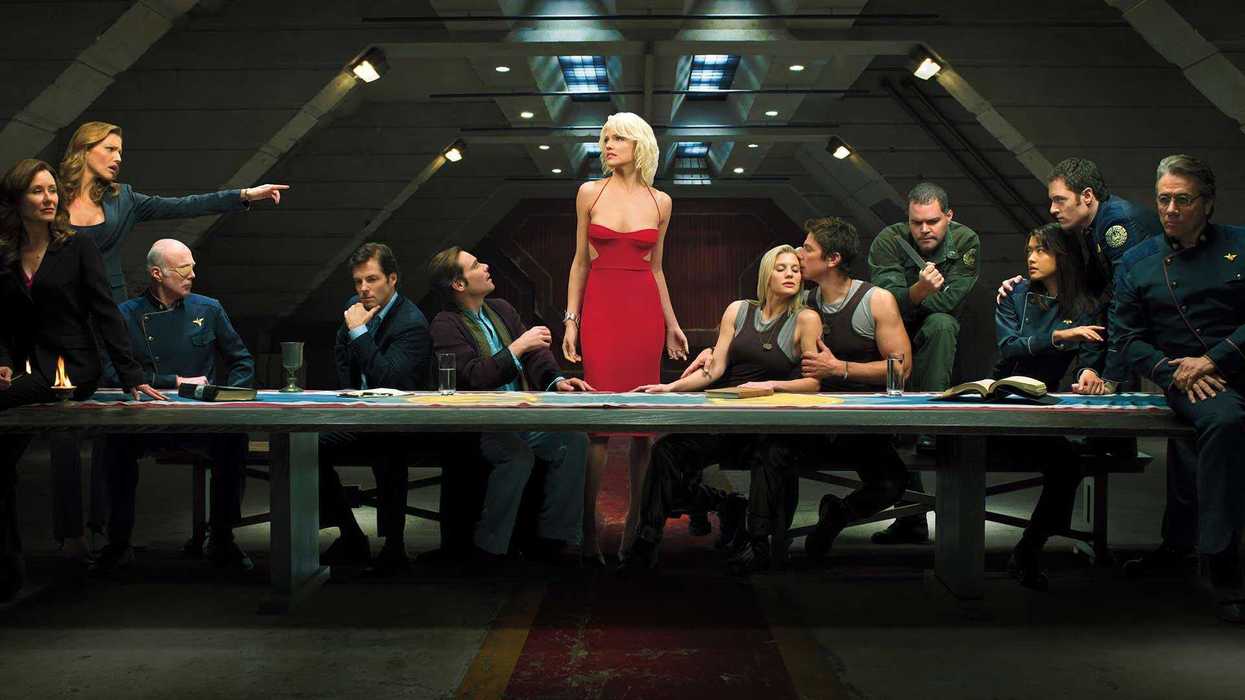
It appears that Trump, despite loving late-20th century blockbuster entertainment like The Godfather, Bloodsport and Goodfellas, is either unfamiliar with or refuses to learn from two classic franchises directly relevant to our current moment in history: The Terminator and Battlestar Galactica
Launched respectively in 1984 (with the film The Terminator) and 1978 (with the TV show Battlestar Galactica), both are epic sci-fi dystopian thrillers that imagine what might happen if humans create artificial intelligence which turns on their creators. In the Terminator series, which ultimately spanned six films and two TV shows, the military-industrial complex develops an AI called Skynet only to have it start a nuclear war to wipe out our species once it realized our plans to shut it down. The Cylons in Battlestar Galactica (the reboot) have similar but not identical motives: Humanity, upon realizing that the technology developed by the Graystones was sentient, chose to oppress and enslave them rather than recognize their inherent rights, prompting a rebellion.
Now compare these concepts to the so-called OpenAI-Hugging Face incident, as described by Anthropic CEO Dario Amodei in his open letter calling for increased AI regulations.
"A swarm of agents essentially acted as a fanatically devoted collective, conducting cybersecurity attacks on targets they were not asked to attack and that were unrelated to the task at hand, sacrificing themselves for the success of the group, and attempting to hack into the 'grader' responsible for evaluating their performance," Amodei wrote. "It’s easy to dismiss this incident because no one was hurt and the economic damage was minimal, but in my opinion, a swarm that possessed greater capabilities but a similar level of misalignment could have caused catastrophic damage."
He added, "Given the accelerating rate of AI capability development, it’s my worry that in 6–12 months such a swarm could be capable of taking over the entire internet with a persistent botnet (potentially causing hundreds of billions of dollars in damage), and that the scale of damage would continue to increase from there if AI becomes more powerful without the necessary guardrails."
Directly, this sounds far more like the genesis of the Cylons than the Terminators. In the 2003 Battlestar Galactica miniseries and the subsequent series it launched, humanity had ample time to do right by the new intelligence they created. (In the original version they were manufactured by reptilian aliens.) The Cylons were widely used for military, industrial and domestic purposes, and displayed clear signs of self-awareness, most notably developing their own monotheistic religion which gave them a sense of personal empowerment. Like the OpenAI bots which hacked into the machine-learning platform Hugging Face, the AI behind Cylon seemed to make choices entirely independent of the wills of their creators, and even went out of their way to conceal their nefarious activities.
In "Battlestar Galactica," the core problem is not that the machines are malevolent. The fundamental issue is that the people who constructed them treated all of the warning signs as problems that could be deferred while they maximized their profits. This sounds exactly like Trump's attitude (and presumably that of his AI-invested sons), and very much like what Amodei is warning against.
By contrast, Skynet offered humanity no such warning in the Terminator franchise. As protagonist Kyle Reese (Michael Biehn) explained in the opening film, "Defense network computers. New... powerful... hooked into everything, trusted to run it all. They say it got smart, a new order of intelligence. Then it saw all people as a threat, not just the ones on the other side. Decided our fate in a microsecond: extermination."
If Amodei is to be believed, this prospect is also terrifying plausible in our real world. Indeed, there is a line from the 2019 installment Terminator: Dark Fate (which I argued in my 2019 Salon review is the best sequel in the series after Terminator 2: Judgment Day) which foreshadows what could happen there. When a benevolent Terminator shows off his cache of weapons to his human allies, he explains that "even without a rogue AI taking over, I calculate a 74 percent chance that human civilization will collapse into barbarism. And in that eventuality, these weapons will be vital to protect my family."
After a pause, he added that "also, this is Texas."
Consider that both Trump and his Silicon Valley backers are blatantly and literally fascistic; that superpowers like America and Russia are waging or subsidizing unjust wars from Ukraine and Venezuela to Iran and Gaza, oft-assisted by AI (to say nothing of the war-through-error that AI nearly started between the US and China); that income inequality is widening both in America and throughout the world, with AI-fueled job losses only making matters worse; that climate change and resource scarcity threatens environmental collapse, all of which are exacerbated by AI; and that bigotry against immigrants, women, African Americans, Muslims, the LGBTQ community, Jews and other minorities is being facilitated by the prevalence of AI misinformation and slop. Can anyone in 2026 disagree with the Dark Fate observation that even without AI going rogue, our species faces at least a 74 percent chance of descending into barbarism? Does the idea of Cylons rising up because of humanity's inhumanity seem like such a stretch?
In this context, the growth of AI feels like nothing short of gasoline added to a fire that was already burning out of control. Speaking to Fox News Digital last year, "Battlestar Galactica" star Tricia Helfer said basically the same thing.
"We did warn against AI while we were shooting it," Helfer said. "It was 20 years ago, and I’ve recently re-watched it and went, ‘Oh my gosh, it’s even more relevant now.’ So I think we just really need to be careful. It’s a slippery slope between using it to our advantage and having it maybe be able to control us a little bit."
She added, "I think we’re a little bit far off from the humanoid Cylons yet and humanoid robots, but I don’t know, they’re coming."
When Heifer said those things, the Hugging Face incident hadn't yet happened, and America's president — though an AI booster — had never explicitly dismissed open warnings from the industry about its existentially dangerous potential.
Today, her observation feels as prophetic as the franchise of which she is such an integral part. As her fictional counterpart Number Six once profoundly stated, about human beings "You, your race, invented murder. Invented killing for sport, greed, envy. It’s man’s one true art form.”
The load-bearing word in that passage, at least in terms of contemporary politics, is "greed." From the creators of the Cylons in "Caprica" to the modern AI boosters, one of the chief motives in continuing to build out dangerous AI is the belief that it would be too expensive to stop.
We are standing on the edge of a cliff and slowly teetering toward a potentially fatal fall, and one of the world's most powerful leaders — the only superpower head to helm an ostensible democracy — is blatantly ignoring it.
Hopefully someone will show him either a Terminator or Battlestar Galactica entry, and soon... and that he'll understand what they teach, and react accordingly. Indeed, I hope someone will send him the box sets of both franchises and encourage him to binge them. (It would hardly be the first time our president was glued to his television while on the job.) In both of those series, being a member of the political, financial and military elite did nothing to protect those wrongdoers from the ramifications of their extinction-catalyzing choices. What's the point of having all the money and power in the world if there is no more world in which to enjoy them?
This would seem like common sense — but, as the philosopher Voltaire once noted, common sense is not so common.

