
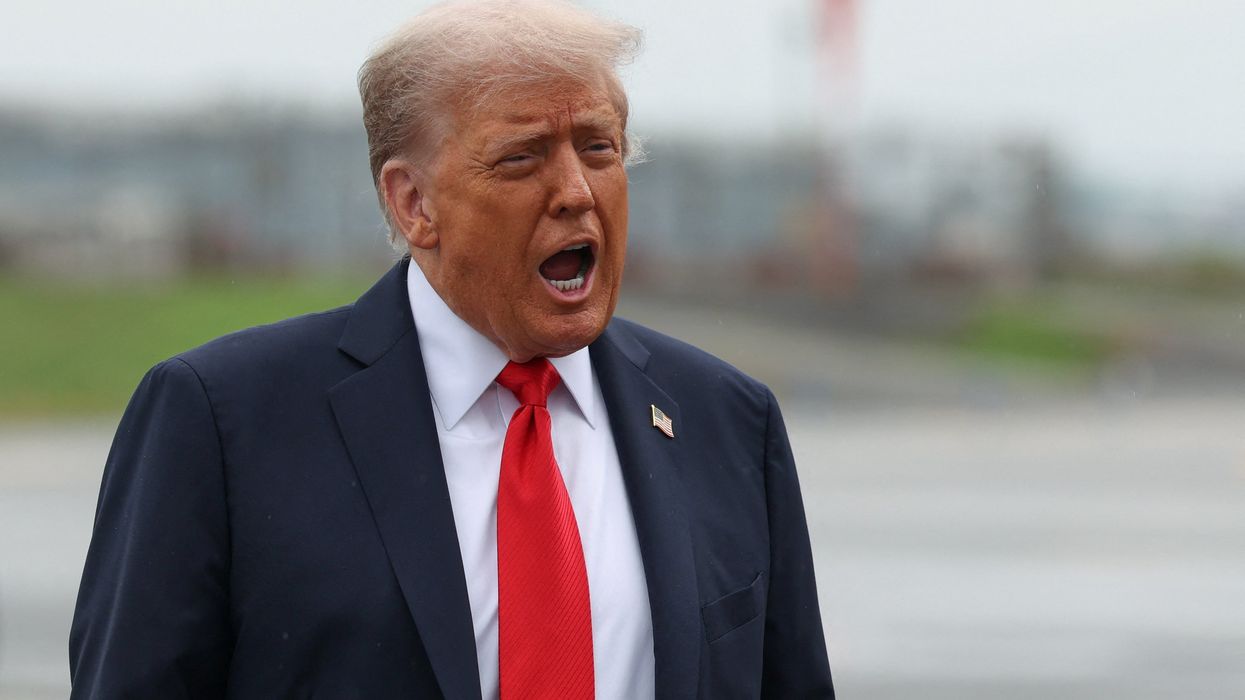


Yesterday (September 14) — just two days after Dario Amodei, the chief executive officer of leading AI firm Anthropic, called for “slowing down” the pace of AI development so guardrails could be put in place that would “greatly reduce the risk that something goes seriously wrong” — Trump threw a tantrum:
“The only control or ‘guardrails’ that AI needs is a STRONG AND SMART (High IQ!) PRESIDENT, and the U.S.A. has that, in spades!
In the same post, Trump even hinted that the government might pursue criminal or regulatory penalties against AI companies, such as Amodei’s Anthropic.
“The Trump Administration has stopped AI ‘people’ from doing bad, or potentially bad, ‘things,’ like Dario (Anthropic!), who is now pretending to be a ‘perfect little angel’ — and we will continue to do so!”
Then Trump interrupted a speech being given by Jensen Huang, Nvidia’s chief executive, at a conference in Los Angeles to say — over a speaker — that worries about AI were “a hoax …. Robots are not going to be taking over the world. That’s not going to happen.”
Trump has called AI data centers “the oil of the next 50 years” and says they are delivering wealth and investment to communities in the U.S. In July he insisted that data centers are “Cash Cows,” creating taxes and jobs that “amount to LIQUID GOLD!”
Trump’s rejection of any regulation of AI or its data centers contrasts with the views of many voters. A March Gallup poll showed that nearly half of those surveyed “strongly oppose” the construction of local AI data centers, including almost 40 percent of Republicans.
Yet Trump remains adamant that nothing should be done. “We can put up guardrails, and we can do this and that, but I think you have a lot of negative forces that are bringing it up,” Trump told reporters Sunday while traveling in Ireland. “And they’re bringing up things that won’t happen.”
Why would Trump be so opposed to regulating AI — even in the face of growing public concern, even with midterm elections just around the corner?
It can’t be that he knows very much about AI.
And it can’t be that Trump loves AI because of what it can do. Yes, he’s used it to make fake photos and videos of himself, but that doesn’t explain his adamant refusal to regulate it.
It can’t be that he’s worried about China catching up to or surpassing the U.S. in AI. China has a small fraction of the data centers America has, and China isn’t poised to leapfrog our technological advantage. Besides, even China is considering imposing guardrails on its AI.
So what explains Trump’s absolute refusal to regulate AI? Could it possibly be that he and his family have personal financial stakes in it?
Indeed, Donald Jr. and Eric Trump have invested substantially in American Data Centers, a firm created to support AI cloud computing and AI infrastructure.
They made these investments soon after their father announced a $40 billion investment pledge in U.S.-based data centers from his business partner Hussain Sajwani, unveiled another $500 billion in planned investments in private-sector AI infrastructure, and signed an executive order rolling back Biden-era policies that took a more cautious approach to AI and directed “the development of an AI Action Plan to sustain and enhance America’s AI dominance.”
The Trump sons also hold advisory roles and ownership stakes tied to Dominari Holdings’s American Ventures fund, which targets AI infrastructure, data centers, and cryptocurrency. American Ventures has reportedly raised more than $1 billion across 21 investment vehicles backing companies tied to AI, crypto, drones, nuclear energy, and data centers.
Donald Jr.’s own investment firm, 1789 Capital, is backing emerging technology companies working in AI and defense. The firm has bought shares in some of the most coveted private companies before many went public, including SpaceX, Anduril, Cerebras, and Reflection AI, often by leveraging their political and business connections to secure a stake or help boost the companies’ sales.
The growth of Donald Jr.’s investment firm has been astonishing. Two years ago it managed a few hundred million dollars. It now oversees more than $3 billion. As of June 30, its main investment fund generated returns of roughly 200 percent, according to a person familiar with the firm’s performance. While still early in its investment cycle, those returns eclipse the average returns of about 21 percent from venture capital firms started in 2023, according to PitchBook, a provider of financial data.
Donald Jr. and Eric’s father seems to be turning his attention away from being president — “I’m getting a little bit tired of politics now,” he said a few days ago — toward things that excite him more, such as his ballroom and triumphant arch, as well as making even more money for his family off his presidency.
But as he focuses on making himself and his family wealthier, he’s leaving the rest of us more vulnerable to AI.
One of the first responsibilities of a new Congress, come January, will be to establish guardrails around AI — assuming that by then Trump can no longer control what Congress does, and that January isn’t too late.
Robert Reich is a professor of public policy at Berkeley and former secretary of labor. His writings can be found at https://robertreich.substack.com/.
Report typos and corrections to:
feedback@alternet.org.

#story_page_sidebar
MOST POPULAR
{{ post.roar_specific_data.api_data.analytics }}
MOST POPULAR
ContactAdvertise with AlterNetPrivacy PolicyWriter GuidelinesPress InformationAbout AlterNetMeet the AlterNet StaffDebug Logs
@2026 - AlterNet Media Inc. All Rights Reserved. - "Poynter" fonts provided by fontsempire.com.