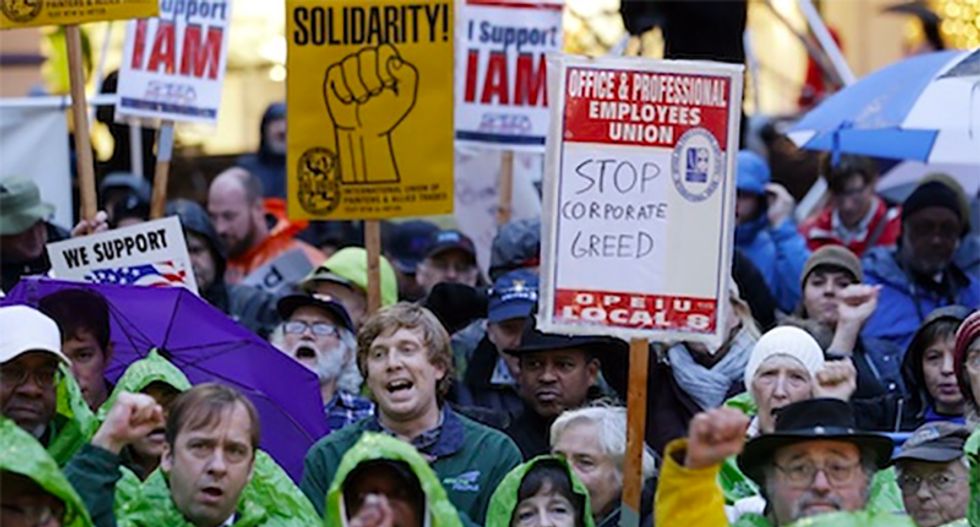
This Labor Day will be a historic one for a coalition of organized labor and immigrant rights advocates in New York. In January, both camps celebrated the passage of the state DREAM Act, which made undocumented immigrants eligible for in-state college tuition assistance. Several months later, the state legislature overcame bipartisan resistance to authorize driver’s licenses for undocumented immigrants, a critical measure for migrant workers in upstate New York. And in the closing days of the legislative session, the legislature passed the landmark Farmworkers Fair Labor Practices Act, which, as one bill sponsor put it, will “end Jim Crow-era working conditions and provide overtime pay, a day off, unemployment benefits, and the right to organize.”
This article first appeared in Salon.
But on the national stage, unions and immigrants remain under threat. With Donald Trump in the White House, U.S. Immigration and Customs Enforcement officers are stepping up their raids, immigrant families are being separated at the U.S.-Mexico border and the xenophobic rhetoric has reached a new low with the shocking manifesto issued by the suspect in the mass murder of shoppers in a Walmart in El Paso, Texas. Meanwhile, labor unions are playing defense following a string of adverse decisions from the U.S. Supreme Court and the National Labor Relations Board — both bolstered by Trump appointees — while right-to-work laws have decimated union membership in a number of states.
An alliance between unions and immigrants offers a path forward, as Trump escalates his aggressive campaign to exacerbate racial tensions and target the undocumented immigrants that labor unions are hoping to organize. The relationship between immigrants and labor, in fact, is at the very center of the bitter battle over how the United States chooses to define itself in the 2020 presidential election.
Historically, there have often been political fault lines between undocumented workers and rank-and-file union members. But after years of losing millions of members, labor activists say their movement depends on embracing and elevating immigrants. Today, labor is in a struggle that is not just an ideological fight for social justice, but one for their very survival. As organizations that are defined by a collective effort that purports to be empowered by and for workers, what really matters is where you work, not where you were born.
“If there is a future for unions, it is to build (a) coalition with immigrants,” said Chaz Rynkiewicz, director of organizing with Construction & General Building Laborers Local 79. “Most unions, and ours was one of them, were formed by immigrants.”
While there have been tensions between the two groups over the decades, they also have a long history of joining forces. A half-century ago, the AFL-CIO was teaming up with the civil rights movement, while Cesar Chávez and Dolores Huerta were fighting to protect farmworkers. And their efforts built on other trailblazers who looked to extend worker protections — regardless of race or immigration status.
Twenty years into the 21st century, technology and automation has further tipped the balance of power to capital with the so-called gig economy, upending the long-standing social contract between employers and labor.
This has played out dramatically on the streets of New York City amid fierce competition in the taxi industry with the advent of Uber and Lyft.
In the late 1990s, long before ride-hailing companies caused the value of city taxi medallions to collapse, labor organizers Bhairavi Desai and Javaid Tariq formed the New York Taxi Workers Alliance. Today, it has 21,000 members from all over the world, and it has been successful at getting some regulatory relief for drivers, several of whom have died by suicide in recent years.
It’s an effort that builds on the rich tradition of immigrant organizing that is part of the American union movement’s DNA. “Going back to the Lawrence textile strike in 1912, you had two dozen different languages and vastly diverse political experiences at play,” said Joshua Freeman, a labor historian and professor at CUNY’s Graduate Center. “And considering that the (New York Taxi Workers Alliance) membership is voluntary, it is impressive with how much they have accomplished.”
The union’s initial organizing drive started in 1996. “Since then, day and night, we struggled to organize the drivers,” Tariq said. “It is a scattered labor force. It is not a factory, and there are people from over a hundred countries with different languages.”
He continued, “We are out there in the summer, in the winter, in the snow going to the airports where the drivers are hanging out, to the change of shifts at the garages, to ethnic restaurants.”
Many members come from countries with authoritarian governments where protesting and labor organizing risk serious repercussions. Tariq said part of driver engagement centers on civics.
“We are always telling them, ‘You are in the USA. You are in America,’” he said. “You are a hardworking, law-abiding person, so you don’t have to be afraid to speak up. That’s the main thing — if you don’t speak up, people will crush you.”
“If they’re doing construction work that the laborers cover, we are concerned about them,” Rynkiewicz said. “We do recognize there are obstacles for a lot of different immigrant groups, but we want to make it as easy as possible for any construction worker — whatever their immigration status — to navigate those obstacles, whether it be immigration, housing or health. We are here to serve the workers.”
Charlene Obernauer, the executive director of the nonprofit New York Committee for Occupational Safety and Health, said unions can’t afford to ignore the circumstances of their undocumented co-workers who share the same construction sites.
“We know there can be dozens of union workers and dozens of nonunion workers on the same site, and if there is a nonunion worker who doesn’t report a safety violation, guess who is walking through that same site? Union workers,” Obernauer said. “If nonunion workers don’t feel comfortable (reporting) violations, then everybody is less safe.”
She continued, “For the New York City labor movement, there definitely has been a recognition that they need to organize all workers in order to be successful, and that all workers have the right to a union, and all workers should be protected by a union.”
As a presidential candidate, Trump exploited nativist fears of migrant laborers in flipping counties in key Rust Belt states where, historically, labor had helped anchor the New Deal coalition. These voters with union roots voted for Ronald Reagan, but many of them also voted for Barack Obama twice.
“There were certainly a fair number of white male (union members) in key states like Pennsylvania, Ohio and Wisconsin that voted for Trump for president,” Freeman said. “Some of them were drawn to Trump’s rhetorical commitment to the idea of rebuilding manufacturing. Many of them found the support in the Democratic Party under President Obama and his predecessor for free trade hurting their own industry and their own lives. … Some may have thought there should be more border controls.”
The Trump administration has repeatedly found ways to target immigrants. When Trump unveiled his plan to penalize immigrants for using government assistance, New York Attorney General Letitia James filed a lawsuit opposing the move — and a big part of the crowd cheering her on were members of 1199 SEIU, the nation’s largest health care union.
Many of its members are from immigrant families, some with U.S. citizens, green card holders and undocumented individuals all living under the same roof.
1199 SEIU Vice President Keith Joseph said with the low wages paid in the home health care sector, it was not uncommon for caregivers to turn to some form of public assistance to fill the gap, which, under Trump’s proposal, could have long-term legal consequences for the entire household in terms of obtaining a green card.
“They do not come here for a handout,” Joseph said at James’ Aug. 20 press conference in Manhattan’s Foley Square. “They come here to work — and work hard — and the jobs they do, the average person who is a U.S. citizen born here would not do. They do not complain, and they uplift themselves and their families while they build community all at the same time.”
Joseph continued, “When you look around and ask, who are these people taking care of? They are taking care of the everyday New Yorker who is in the hospital, in the nursing home and in home care. … If you go on the subway in the early morning and see who is traveling from the Bronx to Brooklyn to take care of the patients in their homes who don’t have anybody else but the worker who does that job rain, storm or shine.”
The bitter debate over whether New York State should permit undocumented immigrants to obtain driver’s licenses found immigrant rights groups partnering with unions like 1199 SEIU. But even with Democrats in control of the state Senate, which had long been the last bastion of power for Republicans in state government, it hasn’t been easy.
In Erie County, Clerk Michael Kearns, a registered Democrat who ran as a Republican, is taking the state to court over the passage of the Green Light bill.
During the debate, Republican state Sen. Fred Akshar warned his Senate colleagues that granting undocumented immigrants driver’s licenses was “only continuing this state’s trend toward favoring criminals over law-abiding citizens.”
Even some top Democrats worried they would be punished politically for siding with the undocumented immigrants. In March, Gothamist cited anonymous sources claiming that Gov. Andrew Cuomo, while publicly supportive, was secretly working against the bill. Prior to the narrow 33-29 vote in the state Senate to approve the measure, Jay Jacobs, the state Democratic Party chairman, warned fellow Democrats they could be “thrown out of office” at the next election for passing the measure.
Yet Democratic supporters strenuously defended the law. “Many of these people are the very same people that cut your lawns and take care of your parents, that are home care attendants, that do the jobs in this state and in this country that nobody else wants to do,” state Sen. Luis Sepúlveda, who sponsored the bill, argued on the floor. “They work your farms, they work your households, they do everything that if we didn’t have, who knows how people in our communities would be able to have this stuff done.”
It is these immigrant workers that labor leaders increasingly see as an opportunity, not a competitive challenge. “We can do more,” Héctor Figueroa, the former president of 32BJ SEIU, wrote in a New York Times commentary that ran shortly after his death in July. “That’s why our union is running a breakthrough campaign in fast food. That’s why we are supporting the taxi workers’ union in New York City, which won the first ever minimum pay rate for Uber drivers and regulations on app companies to protect driver livelihoods. We are also backing New York State farmworkers in their fight for collective bargaining rights, and we helped them to win those rights in this legislative session.”