
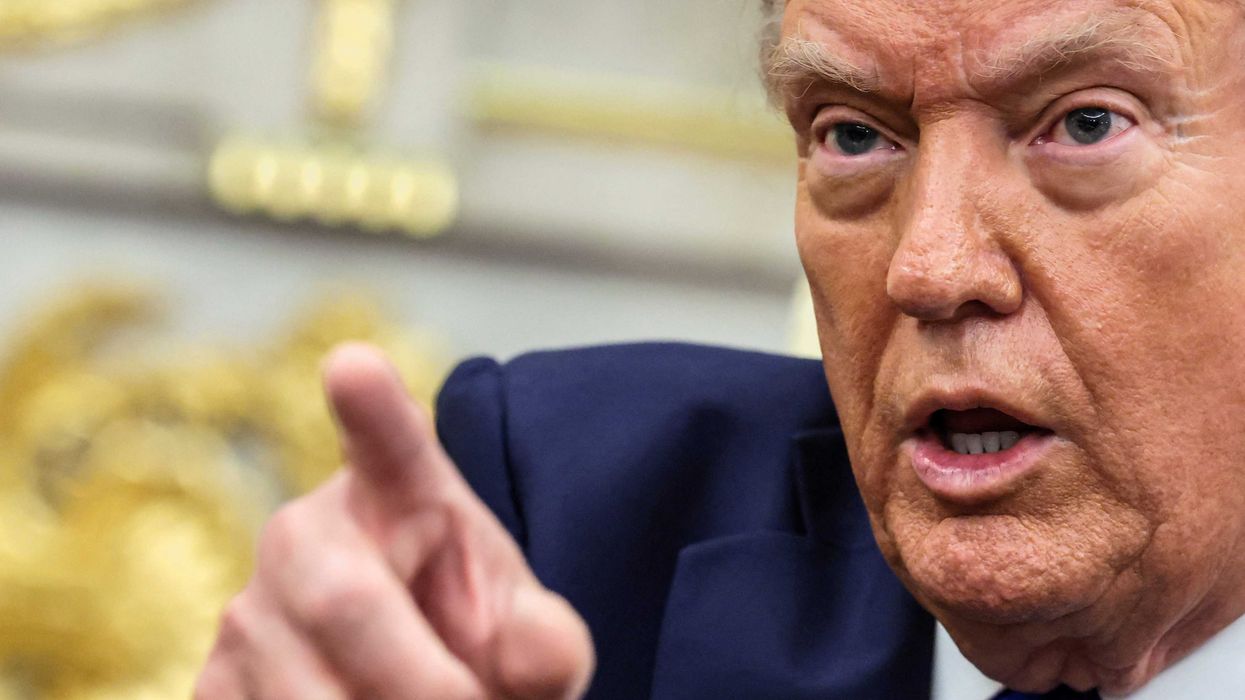


President Donald Trump will deliver his "State of the Union" address on Tuesday and is expected to bring up some of his election conspiracies before calling on Republicans to act.
Trump's Justice Department obtained a subpoena ordering the seizure of all ballots from Fulton County, Georgia, based on unsubstantiated claims from a 2020 campaign aide. The source of that claim was never disclosed to the judge. That raid could make a huge difference in 2026 and 2028, one Georgia reporter wrote.
The greater concern, according to Sen. Reverend Raphael Warnock (D-Georgia), is that Trump continues to rage about 2020 conspiracy theories to justify making voting more difficult ahead of the 2026 midterms.
The party in power in the White House generally loses seats during the midterm election. Whether the Republican Party will lose many seats is up in the air. Meanwhile, GOP lawmakers are scrambling to pass legislation that would add last-minute challenges to voting this November.
Michael Gold, the New York Times' congressional reporter, said that if Republicans don't get the election barriers they want, they'll likely spend the next few months criticizing Democrats over the matter. Polls, however, have shown that the top issue for Americans is the economy.
The proposed legislation is known as the SAVE Act, or the Safeguard American Voter Eligibility Act. It has passed the House, but Democrats are filibustering it in the Senate, requiring a 60-vote threshold to pass it.
It would mean Republicans would be forced to kill the filibuster as it currently exists or eliminate it entirely. For years, there has been a rule allowing a filibuster threat to block votes on legislation. Both the left and right have argued that it was always meant to be a "talking filibuster," requiring a lawmaker to hold the floor to stop the measure.
"They hope to either force the bill through over Democrats’ objections or, at the very least, spend substantial time making the public case for why it is desperately needed," the report said.
Study after study has proven that there is no rampant voter fraud due to undocumented immigrants voting. However, Trump has argued that there were 3-5 million illegal votes cast in 2016, and he should have won the popular vote, a PBS News fact-check said at the time.
“We are going to have the Save America Act, one way or the other, after approval by Congress through the very proper use of the Filibuster or, at minimum, by a Talking Filibuster,” Trump wrote on Truth Social last week.
However, Senate Majority Leader John Thune (R-S.D.) isn't sold on the idea. He is considering the "talking filibuster," but it could become a problem if Republicans lose power in the Senate again. The institutionalist has frequently sought to uphold the legislature's norms.
Gold wrote that Trump doesn't care much for norms or traditions the way Thune does.
The Times continued, saying that Thune "has also warned that embarking on that tactic would disrupt his party’s ability to move on other legislation in a year when Republicans are eager to demonstrate their commitment to addressing affordability."
The legislation would add serious barriers for women who have gotten married and changed their name to something other than the one on their birth certificates. For impoverished people, accessing documents could be another barrier, as getting a new birth certificate, a REAL ID, and a passport isn't free.
The League of Women Voters said that nearly 80 percent of married women, more than 69 million American women, take on their partner’s surname when they get married. The requirement would require that the name on their photo ID match the name on their proof of citizenship.
It is already illegal for non-citizens to vote, and 36 states already have voter ID requirements. The SAVE Act would make voter ID requirements much stricter, and only 10 of those state voter ID laws would meet the federal requirements if the bill were to become law. It is unclear whether every U.S. citizen would be required to reregister to vote.
Other parts of the law make it illegal to count ballots that are received after election day. In 18 states and the District of Columbia, anything postmarked by Election Day is counted even if it is received after Election Day.
The law would also give Trump's Department of Government Efficiency (DOGE) access to all voter rolls across all states and territories, though it doesn't explain why that temporary department would oversee the process. There was concern in 2025 about a data breach of Americans' personal Social Security information after a DOGE employee shared it with an unauthorized server, according to one court filing; the Social Security Administration acknowledged this in a statement.
Any states that don't cooperate would automatically lose all federal funding.
A recent University of Maryland study found that as many as 21 million eligible voters lack easy access to the documents necessary to prove their citizenship.
Report typos and corrections to: feedback@alternet.org.

#story_page_sidebar
MOST POPULAR
{{ post.roar_specific_data.api_data.analytics }}
MOST POPULAR
ContactAdvertise with AlterNetPrivacy PolicyWriter GuidelinesPress InformationAbout AlterNetMeet the AlterNet StaffDebug Logs
@2026 - AlterNet Media Inc. All Rights Reserved. - "Poynter" fonts provided by fontsempire.com.