
NYT pounds the Supreme Court over Trump double standard
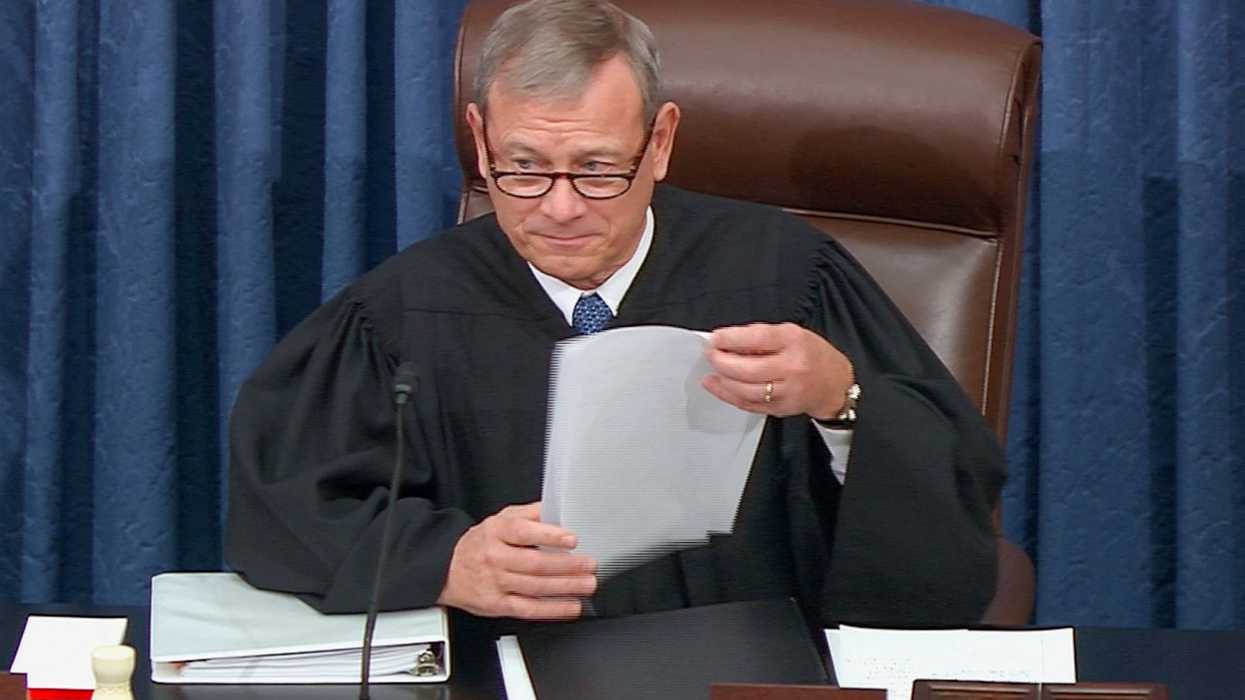

President Donald Trump and President Joe Biden are treated very differently by the Supreme Court — and that double standard is hurting the American people, at least according to the editorial board of a prominent newspaper.
“When Mr. Biden was president, the court quickly acted to halt several policies it considered illegal, including his second attempt at student-loan forgiveness,” wrote The New York Times' editorial board on Tuesday. “When faced with blatant defiance of the law from Mr. Trump, however, the court’s Republican-appointed majority sometimes takes its time or demurs. In the meantime, Mr. Trump’s policies do damage.”
Earlier in the article they described how the Supreme Court has already rejected Trump’s tariffs, characterizing them as illegal because they lacked congressional authorization, but that the president has continued to levy them despite not receiving legislative approval on future occasions.
“President Trump’s repeated attempts to impose tariffs have become an encapsulation of his second term,” the Times wrote. “They have hurt the American economy and his own popularity. They also range from legally dubious to blatantly illegal.”
They continued, “With Mr. Trump now engaging in a trade war with Canada — which has decided to stand up to his bullying — we want to step back and explain both the economic and the legal damage from his tariffs. We also urge Congress and the courts to take action and stop this madness. The tariffs offer a signature opportunity for the other two branches of the federal government to insist that Mr. Trump abide by the Constitution and stop punishing American workers and consumers.”
In terms of the Supreme Court, they contrasted its behavior with Trump’s tariffs and how they reacted when Biden tried to circumvent around the issue of student loans.
“It is true that other presidents have at times taken a similarly combative approach to a Supreme Court decision,” the Times claimed. “They have abandoned policies that the court rejected and enacted alternatives that tried to accomplish the same goals in different ways. Only a few years ago, President Joe Biden did so with student debt. ‘The Supreme Court blocked me from relieving student debt,’ Mr. Biden said. ‘But they didn’t stop me.’”
Yet unlike Biden, Trump has twice tried to circumvent the Supreme Court’s ruling, and they have not made a point of urgently stepping in as they did with Biden and student loan relief.
“When Mr. Biden was president, the court quickly acted to halt several policies it considered illegal, including his second attempt at student-loan forgiveness,” the Times pointed out. “When faced with blatant defiance of the law from Mr. Trump, however, the court’s Republican-appointed majority sometimes takes its time or demurs. In the meantime, Mr. Trump’s policies do damage.”
They added, “After the Supreme Court threw out Mr. Trump’s original tariff policy, the average effective tariff rate on U.S. imports fell to 7 percent, from 14 percent, according to the Yale Budget Lab. The rate has since risen to 11 percent.”
After pointing out that Trump’s tariffs have raised prices without leading to the manufacturing revival he promised, they concluded that there is an “even more important principle,” namely upholding the US Constitution.
“Mr. Trump is breaking the law,” the Times wrote. “Congress and the judiciary need to respond.”
The Times is not the only one to call out Trump’s attitude toward tariffs as being problematic. In August, The Washington Post's David J. Lynch wrote that “as Carney prepared to walk away — a rare example of a foreign leader telling the president ‘enough’ — Trump was retreating on another trade front. On Friday, after insisting for more than a year that tariffs do not affect consumer prices, he lifted tariffs on beef imports, saying the move would lead to lower grocery prices.”
Lynch continued, “The two developments, coupled with legal challenges to Trump’s tariffs, leave the president’s signature economic policy in a state of flux.”
Speaking with AlterNet in July, Ed Gresser — the Vice President and Director for Trade and Global Markets at the liberal-leaning think tank Progressive Policy Institute — noted the irony of Trump using big government to control the economy despite describing his opponents as communists.
“I don't think of it as communism, although the Trump administration is actually a very big-government presidency — taking stakes in big companies and trying to manage them in a fairly inappropriate way,” Gresser explained. “So it's a bit odd to see them drumming up fears of socialism, since that's very much in the background of a lot of what they've done."
Also speaking with AlterNet in July, Dr. Robert Shapiro — undersecretary of commerce for economic affairs in the administration of President Bill Clinton and principal economic adviser to Clinton's 1992 campaign — analyzed how Trump’s tariffs are hurting American businesses.
“It's about uncertainty,” Shapiro explained. “Every investment is based on an assessment of the likely future demand for whatever you're investing in, and how much it's going to cost to produce it. So there are assumptions about labor costs, material costs and other input costs — and again, about demand. If you have a set of arrangements that give you some confidence about the price of your inputs coming from Mexico or Canada, or about demand for goods in Canada — and don't forget, we have virtually no trade deficit with Canada; we have enormous trade, and it goes in both directions — so it's certainly right, and it's not just about investments based on these probabilities that the trade agreement can help reduce uncertainty about.”
Shapiro continued, “It's also about how much you're going to produce today, apart from investment, because you've got thousands of companies selling goods or services into Canada. And so there's uncertainty about whether this will lead to more conflict with Canada, which would hurt Canadian demand for US goods, or whether Canada will impose a new tariff in retaliation for ours that makes my goods less competitive there. Of course it's bad — it's bad for American workers, it's bad for American investment.”

