
Former Bush official exposes one of Trump’s 'worst self-inflicted policy debacles'
REUTERS/Evan Vucci
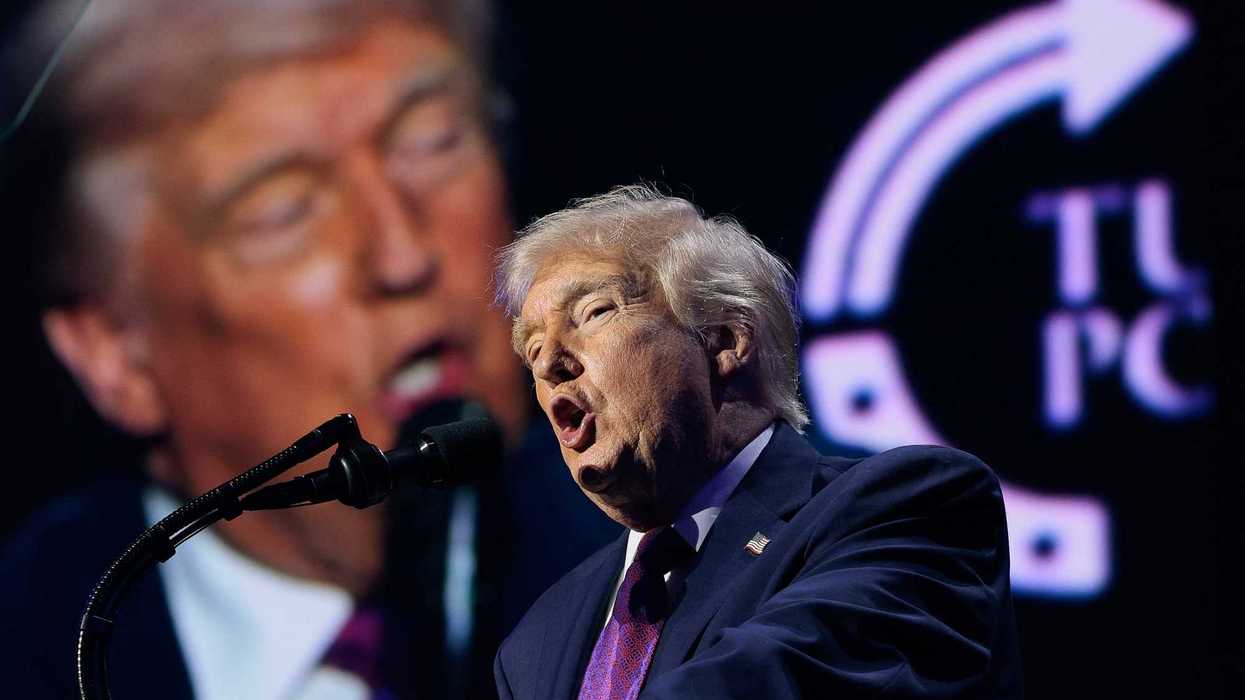
U.S. President Donald Trump speaks during a Turning Point USA event at Dream City Church in Phoenix, Arizona, U.S., April 17, 2026.

U.S. President Donald Trump speaks during a Turning Point USA event at Dream City Church in Phoenix, Arizona, U.S., April 17, 2026.
As of Monday, businesses could begin applying for tariff refunds after the Supreme Court declared President Donald Trump’s signature economic plan unconstitutional. This represented not only a major blow to Trump’s agenda, but according to a former White House official, it is “the very definition of failure.”
“In the history of the worst self-inflicted policy debacles, the administration’s tariff policies should be on the short list,” wrote Kim R. Holmes, historian and former assistant to the secretary of state under George W. Bush. “There is no redeeming value at all to the whole sordid affair," Holmes said.
According to Holmes, the tariffs — which took in over $166 billion by essentially charging an import tax to American consumers — were “wasteful of government time and money.” They “fleeced consumers who will not get the money back that was paid in higher prices,” “harmed the economy and US companies” and “did nothing to restore US manufacturing.”
As Holmes notes, some of the money raised will remain in the U.S. Treasury to little benefit, as the funds were “still taken out of the US private economy and thus is still not available for investment, hiring new employees, paying wages and other things that American companies need to do.”
What’s more, the very fact that the Trump administration attempted the unconstitutional policy “set a terrible legal precedent” that “along with other instances of bending the law, generally undermine the rule of law.”
Trump had originally claimed that his power to apply the fees without congressional approval was validated under an obscure 1970s emergency statute that didn’t even include the word “tariffs.” The Supreme Court disagreed with the president, asserting, “In light of the breadth, history, and constitutional context of that asserted authority, he must identify clear congressional authorization to exercise it.”
And now that the administration is reimbursing companies, says Holmes, “it’s admitting…that the tariff critics were right all along and that Trump was obviously wrong. That is the very definition of failure.”
The tariffs, which Trump often applied to both adversarial and allied countries in an attempt to extract policy concessions, disrupted the global economy, fractured alliances, and boosted the perception of China as a more reliable trade partner. This not only benefited China economically, but pushed the world to view Beijing as a more reliable ally.
“The tariffs have increased China's soft power and weakened America's,” wrote fiscal policy analyst and former congressional staffer Kurt Couchman in a reply to Holmes. “Violating agreements with other countries has real costs," Couchman added.

