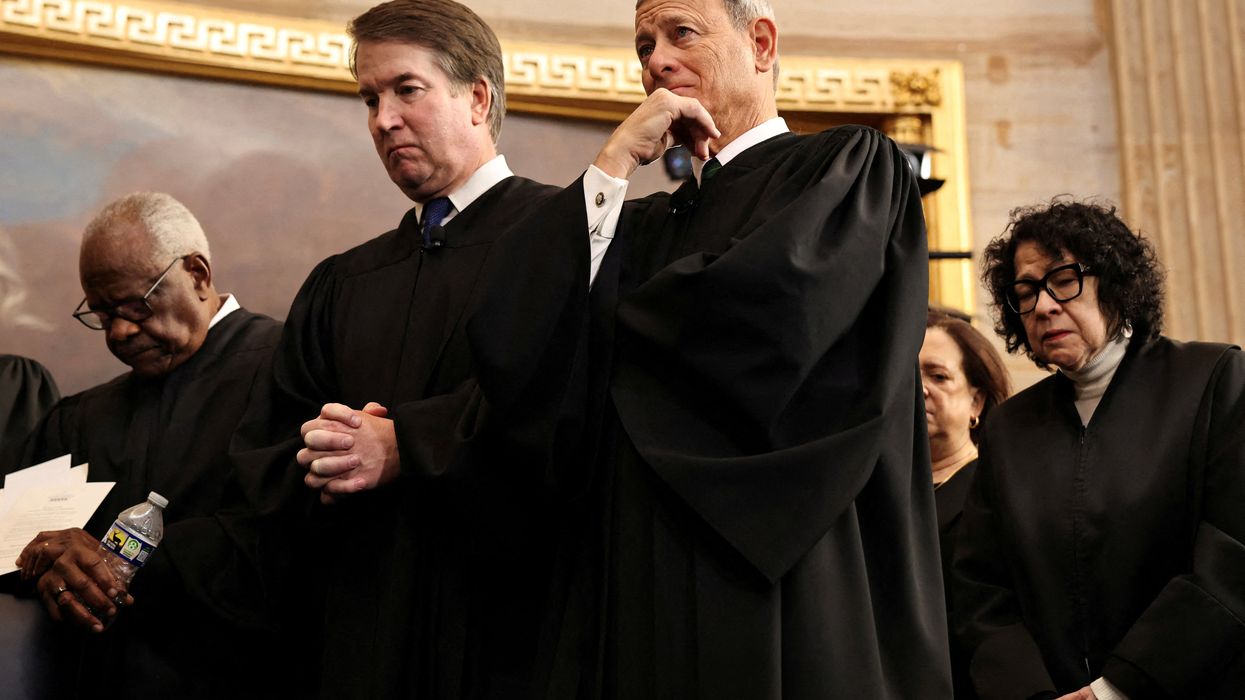
The U.S. Supreme Court is expected to issue its ruling over whether President Donald Trump can unilaterally issue tariffs or if he overstepped his authority and only Congress can issue the taxes.
According to the Financial Times, whether or not the Supreme Court's conservative majority agrees to support Trump's broadening of executive powers is inconsequential because he's preparing to move forward with tariffs.
"Nobody thinks the tariffs are going away," said trade lawyer Ted Murphy. “They are just going to be reissued under a different umbrella. They will reissue tariffs the same day.”
The ruling is likely to cause "turmoil" among financial markets and traders, the report said. It could potentially leave "the federal government on the hook for billions of dollars in repayments of levies that have already been collected."
Article I, Section 8 of the Constitution explicitly grants Congress the power "to lay and collect taxes, duties, imposts and excises."
So, Trump used an executive order declaring an "economic emergency" under the National Emergencies Act, which effectively unlocks about 150 statutory powers Trump can pick from, The Brennan Center for Justice explained.
"That law can only be invoked, however, when the national emergency stems from an 'unusual and extraordinary threat' to national security, foreign policy or the economy," the Brennan Center continued.
One person familiar with the administration's thinking told FT that the recipe of laws Trump is cooking up will depend on the details the Court outlines in the ruling.
Section 122 of the Trade Act of 1974 and Section 338 of the Tariff Act of 1930 could both be triggered by Trump to tax goods from 15 percent to 50 percent.
The latter, in particular, allows for up to 50 percent if a "foreign country that discriminates against US commerce, and can be used to respond to any 'unreasonable charge, exaction, regulation, or limitation.'"
"If the Supreme Court rules against the administration, Trump’s power to use tariffs both as punishment and reward will be significantly diminished,” said lawyer Lori Wallach, who serves as the director of the Rethink Trade group.
“With other laws, the administration would have to make a case for using tariffs,” she said. “It will be less like: ‘I have woken up and decided I am annoyed with this Canadian TV advert so I am going to increase the tariff rate.’"
Trump asked his supporters to "pray" the Supreme Court makes the right decision on the matter. His spokesperson, Kush Desai said that there could be“economic and national security consequences” of the Supreme Court rules against Trump.
Read the full report here.