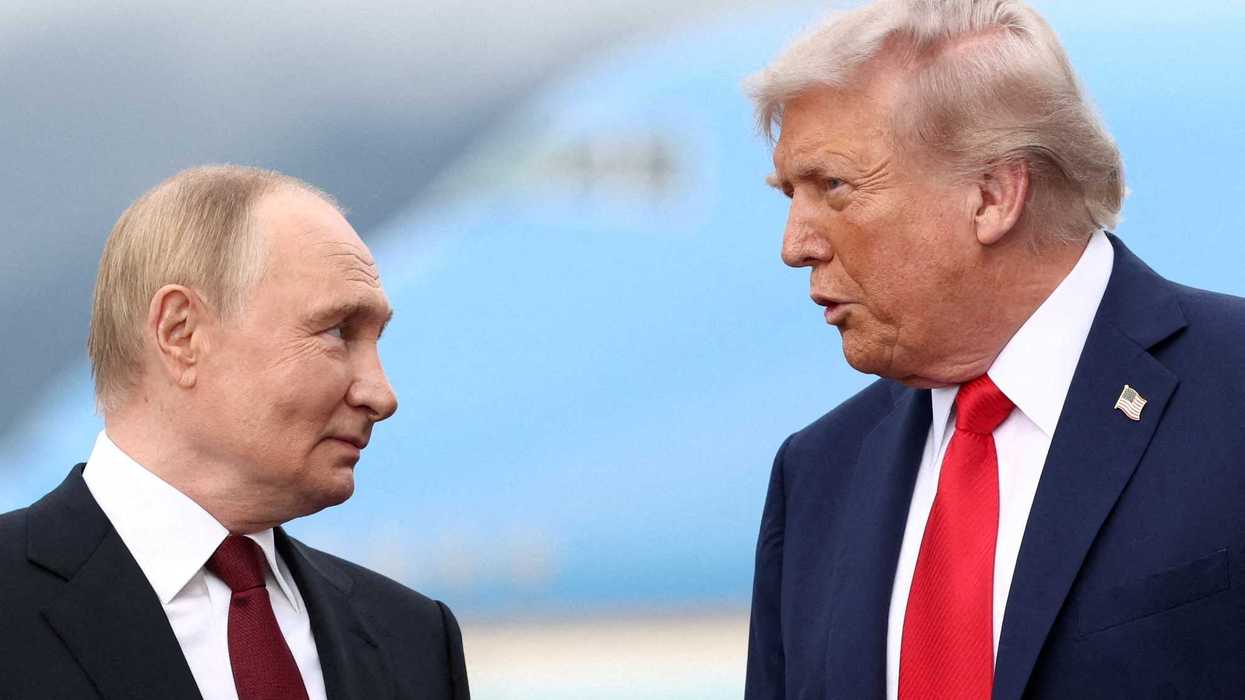
At the NATO summit in Turkey last week, President Donald Trump made an announcement that experts say will not only benefit Russia, but could change the balance of global power. This is according to international relations analyst Derek Grossman, who explained in Foreign Policy on Friday how Trump’s intention to sell F-35 fighters to Turkey weakens U.S. sanctions against Russia, emboldening its arms buyers to ignore restrictions and enriching the Kremlin.
For Trump to sell fighters to Turkey, Grossman explains, he “had to contend with the Countering America’s Adversaries Through Sanctions Act (CAATSA). Turkey was already under CAATSA sanctions for its purchase of Russia’s S-400 air defense system and needed Trump to lift these restrictions if it was to receive the F-35. He decided to do so — and that decision has implications far beyond Turkey.”
As Grossman elaborates, “Passed by the U.S. Congress with overwhelming bipartisan support and signed into law by Trump during his first term in 2017, CAATSA creates what is effectively a secondary sanctions regime. It allows the president to punish foreign governments, companies, banks, and individuals engaging in 'significant transactions' with Russia’s defense or intelligence sectors. The U.S. State Department maintains a list of entities in these sectors, including Rosoboronexport, Moscow’s principal state arms exporter.”
If a banned transaction is discovered, CAATSA offers a number of penalties that can be applied, “including U.S. defense export embargoes, asset freezes, and visa restrictions on foreign officials…Invoking CAATSA can thus jeopardize a government’s access to U.S. weapons, technology, and financing. Enforcement is not automatic but determined by the executive branch.”
Trump has previously leveraged CAATSA against Turkey and China, but according to Grossman, his “recent decision to lift CAATSA sanctions on Turkey will have wider consequences for Moscow’s strategic partners across the Indo-Pacific region. This primarily means India, which continues to purchase S-400 units and other Russian arms despite CAATSA…To be sure, neither the first Trump administration nor the Biden administration ever formally exempted India from CAATSA. Instead, they both deprioritized CAATSA enforcement in the interest of maintaining a strong strategic partnership with India in hopes that the latter would help the United States counter China.”
According to Grossman, the second Trump administration has “looked the other way” on CAATSA enforcement, such as when India received another S-400 regiment last month. Now Trump’s decision to remove CAATSA restrictions from Turkey will encourage India to continue pushing to see how much leniency the U.S. will extend.
And India is hardly the only example. “In Southeast Asia,” writes Grossman, “two governments must be breathing sighs of relief following Trump’s Turkey decision. One of them is Indonesia. Under President Prabowo Subianto, Jakarta has been pursuing a sweeping military modernization and professionalization drive that has involved diversifying arms imports, including from Russia. In 2018, Jakarta was negotiating the possible purchase of 11 Su-35 fighters, but by 2020, it had nixed the deal. It became clear that Indonesian concern about U.S. punishment under CAATSA was the primary reason.”
“Vietnam, too, must be happy about Trump’s CAATSA reversal,” asserts Grossman. “Since the Cold War, Hanoi’s military has become heavily dependent first on Soviet and then Russian arms. In recent years, it has sought to build a more diversified defense, including arms purchases from Washington. Some of this diversification away from Russia may have been fueled by CAATSA concerns. Nonetheless, Hanoi has tried to maintain defense procurement from the Kremlin and even devised schemes to circumvent potential CAATSA restrictions: In 2025, The Associated Press reported that Hanoi and Moscow had devised a backdoor payment scheme that would use profits from joint oil and gas ventures to pay off defense contracts, effectively shielding these transactions from the reach of Western financial institutions and their sanctions mechanisms. CAATSA enforcement has evidently been a concern, and Trump’s recent Turkey precedent should provide a sense of relief.”
Grossman raises more examples of country who subtly or overtly seek to circumvent the sanctions, writing, “Trump’s decision to back away from imposing CAATSA on Turkey gives these countries even more confidence to continue business as usual with the Kremlin… by signaling a more permissive approach to CAATSA enforcement, Trump has inadvertently reduced one of the few remaining political obstacles to future Russian arms sales in the Indo-Pacific.”
Trump’s reversal on Turkey, Grossman reasons, means that “Indo-Pacific governments will increasingly conclude that CAATSA is not a fixed rule but a policy tool for applying selective leverage according to Washington’s political priorities. That may release some of the pressure on U.S. allies and partners today, but it also risks weakening one of Washington’s most potent instruments for constraining Russia’s global military relationships.”