Two experts have raised concerns about the relationship between President Donald Trump and the Republican-controlled Congress. According to The Hill's David Wippman and Glenn C. Altschuler, Congress has shifted its approach to governing under unified party control.
"Past presidents have treated unified government — that is, one-party control of the White House and Congress — as an opportunity to enact bold legislative agendas," the experts wrote. "Franklin Roosevelt's New Deal reshaped banking protections and labor law and started Social Security. Lyndon Johnson's Great Society featured Medicare, Medicaid, civil rights and voting rights bills, as well as education reform. Barack Obama induced Congress to pass the Affordable Care Act, financial reform, and an $800 billion economic stimulus package."
"But the 119th Congress, rather than using control of Washington to legislate, has delegated power to a president," they added.
The scholars focused on the method of Trump's agenda implementation rather than its content. Instead of passing legislation, Republican lawmakers have allowed Trump to implement policy through executive order.
"Republicans' principal legislative success this term is the 'One Big Beautiful Bill Act,' a package of tax breaks and deductions benefiting various Americans, paired with cuts to Medicaid, clean energy credits, and federal food assistance," Wippman and Altschuler explained. "Beyond that, Congress has funded the government, including the annual defense appropriation, and approved measures such as the Laken-Riley Act, which requires the detention of non-citizens convicted of certain crimes."
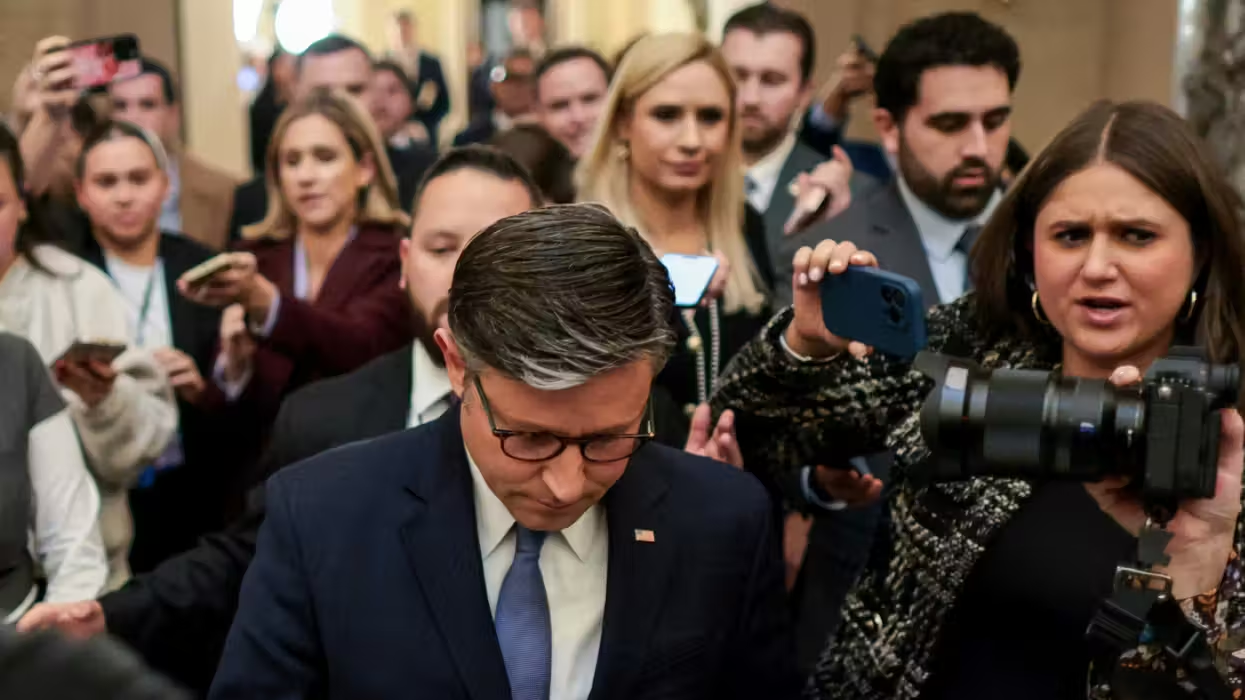
Trump has stated "we don't need to pass any more bills" to Senate Republicans. House Speaker Mike Johnson has blocked votes on measures opposing Trump's tariffs and other policies the president opposes, including legislation to compel the Justice Department to release its files on Jeffrey Epstein.
Members of Congress have responded to this approach. Frustrated members from both parties have filed discharge petitions to force votes on measures the Speaker refused to bring to the floor.
Representative Max Miller (R-OH) stated "without question" he will vote against keeping Johnson as Speaker. Some House Republicans have expressed anger with Johnson in both public and closed-door settings. Johnson has also reneged on an agreement with a group of midwestern Republicans regarding ethanol fuel legislation tied to the farm bill.
According to Politico, rank-and-file lawmakers have expressed concern about their ability to govern and retain their majority in the coming months, with quiet conversations occurring about alternative leadership for the House GOP.