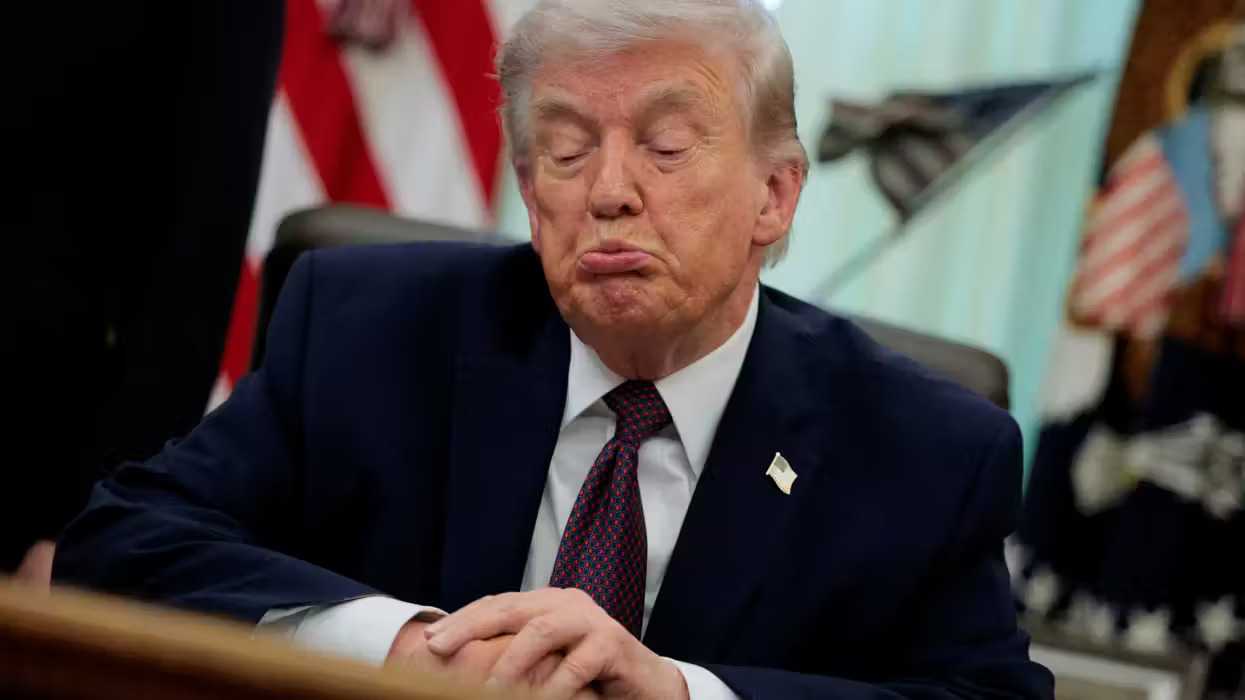
After New York City announced a plan to levy a tax on high-value second homes, President Donald Trump – who will likely have to pay the tax – declared not only that he was against it, but that he would do whatever he could to block it. According to reporting from Bloomberg Law, however, he lacks the “unilateral power” to do so.
The matter dates back to April, when New York Gov. Kathy Hochul (D) pushed to include a tax on non-primary residencies -- typically homes that stand empty while their owners live elsewhere -- in the state’s $277 billion budget. As Bloomberg explains, “The levy that took effect July 1 applies to single-family homes with market values of $5 million or more, and co-ops and condominiums worth at least $1 million. New York City Mayor Zohran Mamdani has said the surcharge would help fund city streets and schools and promote safety.”
Then on Tuesday, Trump took to social media to assert that he was looking into whether his administration “has any legal right to avert” the surcharge, also known as a “pied-à-terre” tax. While Trump has claimed that it is a “dangerous political ‘experiment’ that will “destroy what was once a great City and State,” as Politico notes, he has personal stakes in the matter, as his Trump Tower penthouse is valued at $6 million and therefore qualifies for the tax.
“I am looking to see if the Federal Government has any legal right to avert this disaster, before it is too late, for the millions of people who cherish New York and want to see it thrive, as opposed to becoming a filthy, crime ridden, decrepit place of mockery and scorn,” Trump wrote in a post on Truth Social.
Hochul has pushed back against Trump’s characterization, saying, “I believe that in the state of New York if you have a $5 million second home, that you should be able to afford to pay for police and fire and trash removal and snow removal in wintertime. It’s about paying your fair share. Donald Trump should focus on all the pain he’s causing New Yorkers and knock it off and not worry about us.”
But regardless of Trump’s efforts, as Bloomberg reports, “states have broad authority to set their own local levies unless they conflict with federal law. This is according to Hayes Holderness, a professor at the University of Richmond School of Law specializing in state and local taxation, who explained that the federal government’s power to intercede in such cases is mostly limited to the US Constitution’s commerce clause, which grants Congress the ability to regulate interstate trade and blocks states from restricting it. Neither applies to the city’s new tax on high-value property. As Holderness explained, “It’s going to be difficult for the federal government to find any jurisdiction to interfere with the New York City tax. The local property taxes have generally been seen as obviously the purview of the states, and the federal government has little power to change that.”
Ben Williams, who leads the property tax department at Rosenberg & Estis, agreed that Trump lacks the “obvious unilateral power,” telling Bloomberg, “Any federal challenge would need a specific constitutional or statutory basis. Disagreement with the tax or concern about its economic consequences, standing alone, would not be enough.”
Regardless of such limitations, Trump is raging about the issue, posting, “Financial, and then Social, RUIN, is a 100 percent certainty - And then the Radical Left Jihadists charge Congestion Pricing on top of everything else.” This is in reference to Trump’s attempt to end federal approval of the city’s traffic congestion pricing after it took effect in January 2025, which was foiled when a federal judge slapped down the president’s meddling.