
Loser Trump's losses with Republicans 'becoming a pattern': analysis
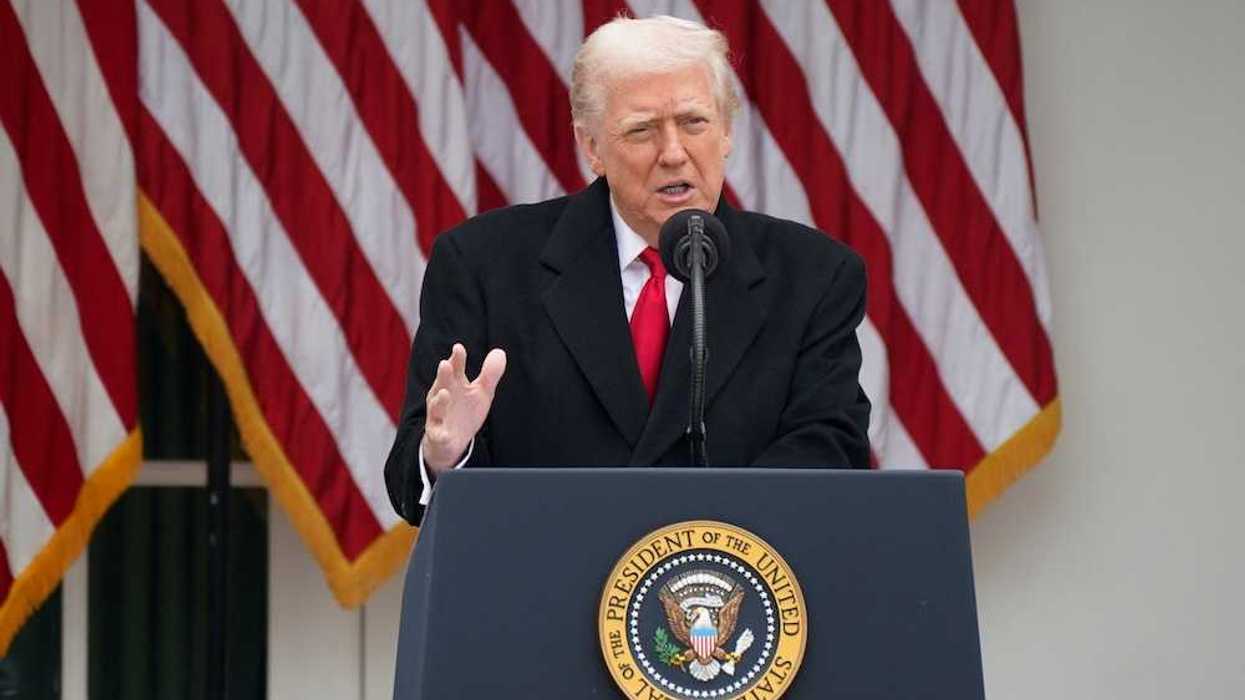

President Donald Trump’s repeated losses among Republicans is “becoming a pattern,” according to a veteran political journalist, at least when it comes to his tariff policies.
Pointing out that Sen. Mike Crapo (R-ID) denounced Trump’s trade position against Canada and Mexico, and was then joined by Sen. Josh Hawley (R-MO), veteran political journalist Robert Kuttner wrote for The American Prospect that “this is becoming a pattern.” Crapo and Hawley have indeed been joined in their anti-Trump defiance by a pair of Kentucky Republicans, Sen. Rand Paul and Rep. Thomas Massie, with the former endorsing the latter in a primary despite Trump’s opposition because of Massie’s repeated policy criticisms.
On top of Crapo, Hawley, Massie and Paul, Kuttner pointed out we can now add the Republican Supreme Court Justices who voted to overturn Trump’s unilateral tariffs.
“The President asserts the extraordinary power to unilaterally impose tariffs of unlimited amount, duration, and scope. In light of the breadth, history, and constitutional context of that asserted authority, he must identify clear congressional authorization to exercise it,” wrote the Republican chief justice, John G. Roberts.
Kuttner wrote that he anticipates Trump’s GOP defections will only get worse as “Republican incumbents will be much more concerned about Democrats hanging the president’s crazy and unpopular policies around their own necks in the midterms. Defections will feed on themselves.”
Making matters worse for Trump is that now “thousands of companies” are going to “ask for refunds from the tariffs imposed under IEEPA. That will be a huge mess, and the Supreme Court offered no guidance on how to proceed with it.”
Finally, because the U.S. trade deficit numbers came in yesterday at a record $1.2 trillion for 2025 and US production jobs fell by 88,000 during that same time, “the entire effort amounted to nothing.”
NBC News called the Supreme Court’s decision a “major blow” to President Trump, and even prior to the ruling, Financial Times journalist Alan Beattie predicted that Trump’s trade policy could collapse because its legal precariousness made it inherently unsustainable.
“In this light, the rush of bilateral ‘gunboat deals’ is a high-stakes game of bluff, with the US holding a position that could weaken markedly,” Beattie wrote. “Trading partners surely know the US wants to get its tariffs down.”
Beattie added that there appears to be a zeitgeist shift against Trump’s tariffs.
"It's now implanted in public discourse that American companies and consumers, not foreigners, are paying the tariff costs,” Beattie wrote.
As this anti-tariff discourse continues amidst fallout from the Supreme Court’s decision, conservative commentator Mona Charen predicted Republicans will pay for it up and down the ballot.
“Voters are rarely able to connect policy to outcomes, but they have done so in the case of tariffs,” Charen wrote for The Bulwark. “Back in 2024, Americans were about equally divided on the question of trade, with some favoring higher tariffs and roughly similar numbers opting for lower tariffs. Experience has changed their views.”

