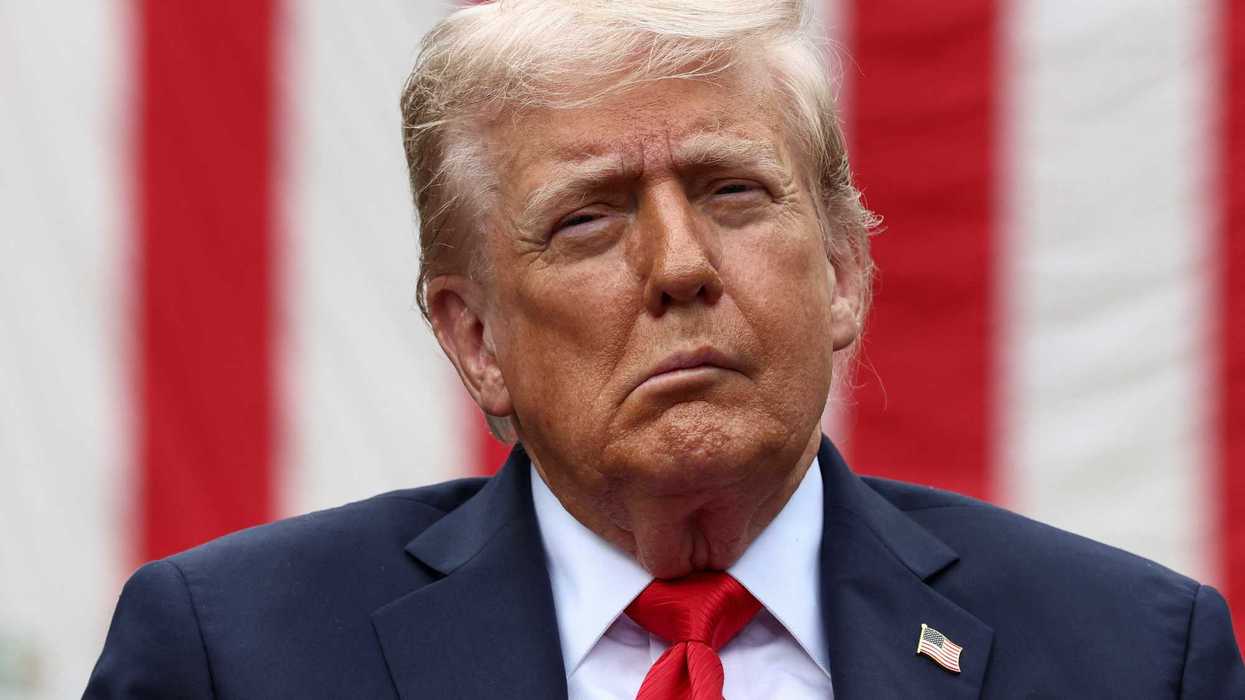
Who says Donald Trump is expecting election magic (or interference) to forestall trouble from the mid-term voting that looks likely to flip at least one house of Congress?
Last week, he had the Justice Department’s Office of Legal Counsel (OLC) put out a new opinion arguing that Trump can assert executive privilege over communications with “personal advisors” even if they do not work at the White House or within the government at all.
Of course, that is a preemptive interpretation that would broaden the number of people President Trump could try to shield from the inevitable flood of congressional investigations that a Democratic majority in either the House or Senate would launch if successful in November.
As a matter of public policy, it conforms to the Trump standard for delay and resist to any inquiries about what Team Trump is doing about war and peace, economics and tariffs, immigration, environment, health and government and budgets. As a matter of law, “The legal opinion has more holes in it than a slice of Swiss cheese,” Charles Tiefer, a professor emeritus at the University of Baltimore School of Law, told Talking Points Memo. “It’s clearly a devious tactic to try to cover up the investigations into Trump’s corruption before they even get started.”
Trump makes no secret that he prefers to talk with corporate leaders about economic policy than he does, say, U.S. intelligence sources or domestic policy staffers, particularly if those corporate officers throw million-buck donations his way.
It is also clear from congressional hearings that Cabinet members feel absolutely no public responsibility to discuss controversial topics from vaccine policy to war decision-making and regularly turn questions into opportunities to attack the patriotism of the congress member or senator who sounds at all critical.
The Trump mantra is to love Trump and what he orders without question about substance or process, about legalities or Constitutionality, because the Trump ends always, er, trump the means.
Clear Message to Back Off
The Hill.com noted that the Justice Department opinion is not “binding,” but that it nonetheless signals the Trump administration is thinking about how to respond to pending investigations.
In a political season in which voters are turning out in droves to tell sitting officials that they are wrong, that Trump policies are worsening their lives, this is a signal that Trump, armed with an immunity from criminal investigations decision from the Supreme Court, simply does not think he should be questioned ever.
Any number of congress members have told administration officials to hold on to notes and documents in issues ranging from handling of the Jeffrey Epstein Files to decision-making about launching strikes against small boats in the Caribbean.
Trump’s strategies for eluding Congress to act unilaterally, strategies that are failing systematically before the courts over tariffs and various aspects of mass deportation policies, seem ripe targets two months before the elections.
Traditionally, the president may assert executive privilege over communications only with executive branch staff. But the Justice’s Legal Counsel office argues that Trump could seek and get from those outside the government, adding that they merit protection. “Without a promise of confidentiality, the President’s ability to ‘decide and act quickly’ on matters of unrivaled importance would be seriously hindered.”
Even this opinion suggested that Trump could only assert executive privilege for discussions with outside advisers who are “limited to communications ‘in performance of (official) responsibilities,’ and made ‘in the process of shaping policies and making decisions.’”
This is the same OLC that in April decided the White House should not have to comply with the Presidential Records Act, which mandates the broad preservation of White House records, including communications between staff – or retain his myriad posts on his own Truth Social outlet. The next month, a federal judge ordered the Trump administration to comply with existing records law.
Attorney General Launch
Todd Blanche’s first week as a confirmed attorney general got off to a bad start amid the obvious criticisms that even his first speech to Justice Department prosecutors was rife with embarrassing contradiction between what was said and what he has done.
Blanche promised a Justice Department marked by integrity, impartiality and respect for the rule of law, only to unleash an avalanche of public response to underscore that his record as acting attorney general has been the opposite. He has not only allowed but invited White House interference in an “independent” Justice, saying aloud that Trump should refer criminal prosecutions of those in his political way.
On Sunday, Blanche declined to say that he would always act independently of White House control but claimed during an interview that President Trump has “never” demanded he prosecute specific people – clearly a excusing statement for Trump’s demanded prosecutions of former FBI director James Comey, New York Attorney General Letitia James and even the former Olympic canoeist who picked up a piece of floating paint in the reflecting pools.
Blanche has shown that he is willing to sign off on prosecutions without first seeking evidence of wrongdoing, that he sees judges who rule against Justice as radical leftists, that the department is better off having lost 16,000 prosecutors and turning Civil Rights and antitrust enforcement upside-down.
Trump is talking openly about renewing the so-called anti-weaponization fund under different auspices to reward those convicted over Jan. 6, 2021, crimes, including those who attacked police officers – even as Blanche was talking about Justice “backing the blue” entirely.
Of course, as a member of Trump’s inner circle, Blanche, Trump’s former personal lawyer, no longer needs an special opinion about being a “private advisor” to claim executive privilege. Blanche is a pending co-conspirator to undercutting the Constitution.
Terry H. Schwadron retired as a senior editor at The New York Times, Deputy Managing Editor at The Los Angeles Times and leadership jobs at The Providence (RI) Journal-Bulletin. He was part of a Pulitzer Gold Medal team in Los Angeles, and his team part of several Pulitzers in New York.