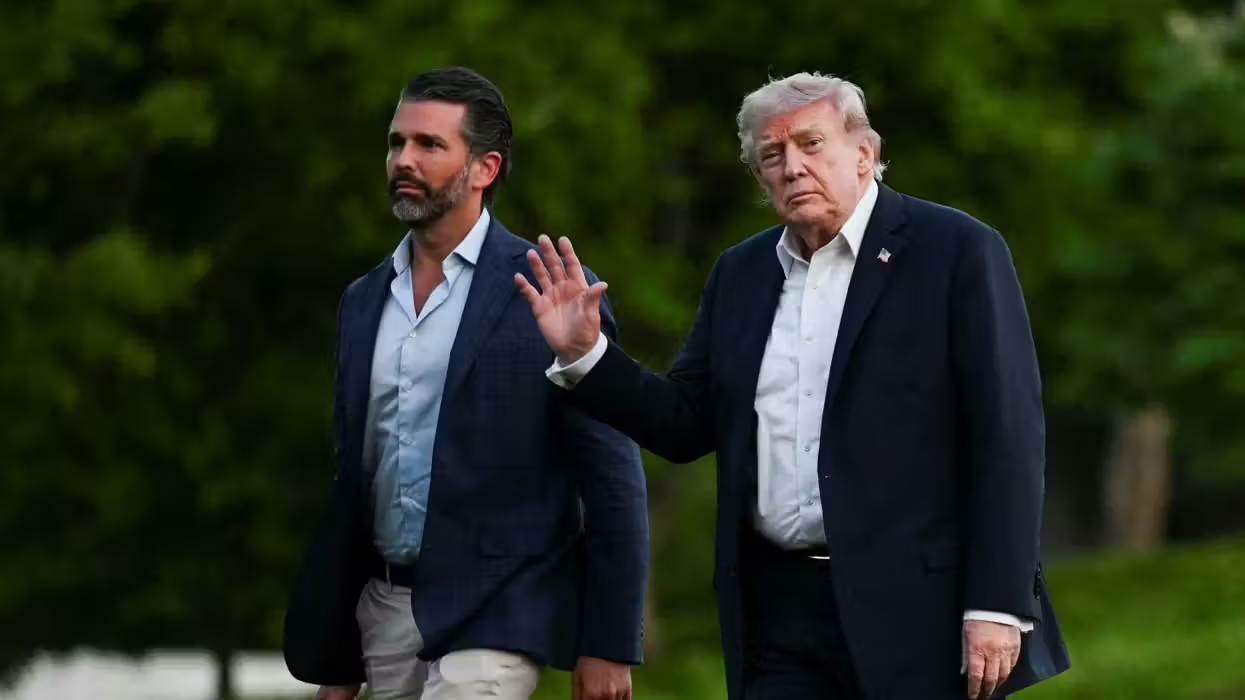
A lucrative corner of the Trump family's business interests could end up before the Supreme Court, a major setback for their money-making operations.
A bipartisan coalition of attorneys general from 39 states and Washington, D.C., is asking the justices to examine whether states can regulate sports-related contracts offered by Kalshi, a prediction market platform with direct financial ties to Donald Trump Jr.
The president's eldest son holds an equity interest in Kalshi and also has links to rival Polymarket through his investment firm 1789 Capital. The firm in which he is a partner has investments in Polymarket reportedly totaling hundreds of millions of dollars.
The dispute is focused on whether these contracts should be treated as federally regulated financial products or gambling subject to state laws.
The Trump administration has backed federal oversight through the Commodity Futures Trading Commission, which could limit individual states' ability to regulate the industry.
State officials say those rules protect consumers and preserve their regulatory authority.
In a Friday opinion column in Mediaite, Ana Marie Cox argued that a Supreme Court ruling against Kalshi could deliver a huge setback to the controversial industry which is benefiting from the administration's approach.
“A Supreme Court decision against Kalshi could pop the prediction market bubble,” Cox wrote.
New Jersey set off the legal challenge by attempting to apply its gambling laws to Kalshi, but a federal appeals court sided with the company, while other appeals courts have taken different positions on states' regulatory powers.
The attorneys general want to take the fight to the Supreme Court.
“They cannot strip the States of their core sovereign power through relabeling and window-dressing,” the coalition wrote in its brief.
The National Football League, tribal governments and gambling groups also joined the fight, arguing that the platforms should not operate beyond the state safeguards already put in place.
Prediction markets allow users to trade contracts on political appointments, elections and other real-world events, and we have already seen White House insiders with privileged information profiting from it
Cox has an example involving three suspiciously timed bets on the appointment of White House press secretary Katie Zacharia. The trades, which only had a 1 percent probability for Zacharia, are being investigated by Kalshi. She also made note of other reports about profits made by traders betting on Trump administration decisions that looked suspiciously like insider trading.
A teleprompter minder made over $100,000 buying predictions on what Trump would say, and a report found that $2.4 million worth of trades were related to specific events in Trump's Iran war.
Cox predicted the conservative-majority Supreme Court might ultimately give the administration what they want.
Whether the justices would even be willing to hear the case is yet to be seen, but with growing concerns about the prediction market, a huge blow to the Trump family’s latest money-making scheme could be coming.