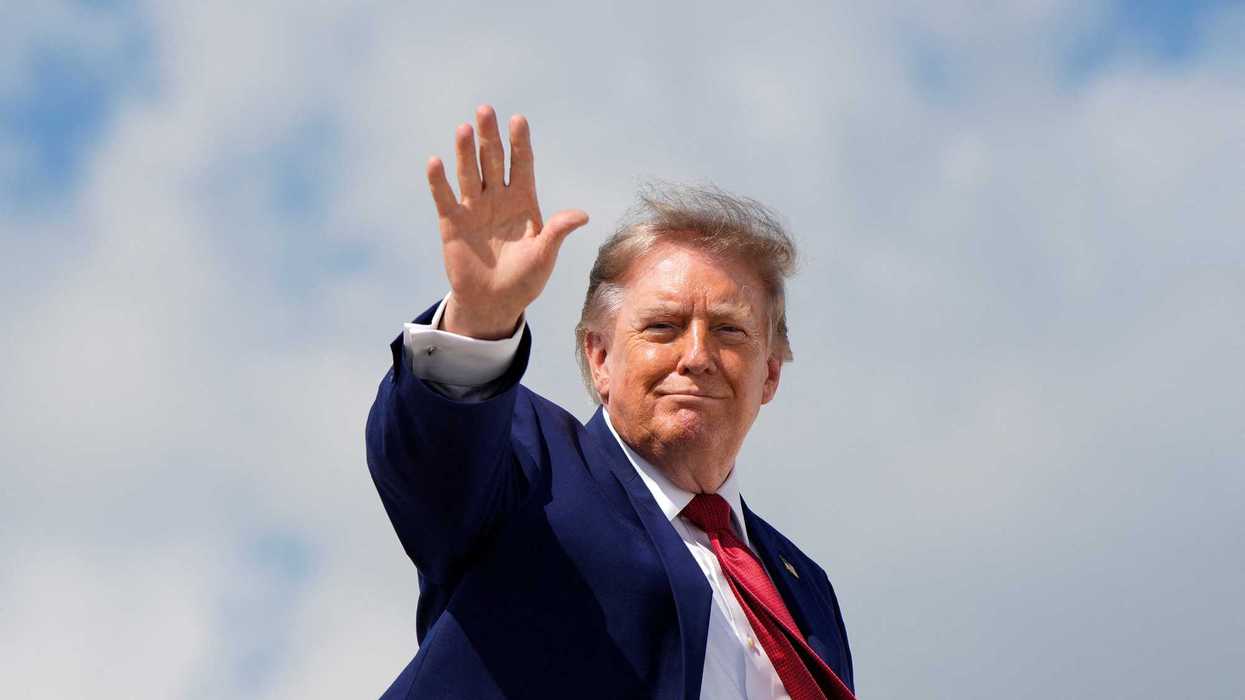
Charles Stewart, professor of political science at the Massachusetts Institute of Technology (MIT), is an expert on the mechanics of America's federal government. And he has an observation about President Donald Trump:
Entertainer-style politics, as defined by Stewart and AlterNet in our recent interview, refers specifically to politicians like Trump who prioritize on performative gestures and capturing widespread attention over all other governing approaches. While Trump was not America's first president who liked to be entertaining, he is the first (indeed, the only) one to go directly from a career as an entertainer (starring as the host of a reality TV show) to becoming the leader of the free world.
Speaking exclusively with AlterNet, Stewart broke down exactly what that has meant for America and the rest of the international community.
The following interview has been lightly edited for clarity, context and length.
Trump's leadership style.
Matthew Rozsa: When I interviewed psychologist Dr. John D. Gartner in November 2026 about how partisan ego blocks major legislation, I pointed out how in the early 1970s, President Nixon considered an Obamacare-esque healthcare system and was not able to pass it because Democrats in Congress, despite agreeing with him, did not want a Republican president to get credit for a popular policy. I connected that to Senator-elect Abdul El-Sayed's suggestion that Democrats lay down their ego to butter up Trump by allowing him to put his name on a potential Medicare for All bill. Given your extensive scholarship in congressional committees, legislative organization, and American political development, how would you describe that tactic practically, and what does it say about the nature of the way the political game is played?
Charles Stewart: Yeah, I think that it's being played out in a very unusual and perhaps a distinctive way with President Trump in international politics. I mean, generally, especially with domestic politics, you get things done through a combination of interest meeting opportunity. And in some cases, there are more opportunities than others. I think in the area, for instance, of health policy or social policy in general, that's just very difficult to do these days in terms of domestic politics. And so I think we can interpret something like Senator-elect El-Sayed's suggestion as being kind of trolling Trump, and really kind of as a message on his behalf, rather than a serious negotiation strategy.
I should also say that on the international realm, the fact that international leaders have discovered that oftentimes they can go a long way with flattery is pretty unique, if not totally unique, in the annals of international relations, where presidents have relied more heavily on traditional diplomatic norms and forms of negotiating. And so it seems to me that what we're seeing mostly in domestic politics these days is some version of more traditional zero-sum politics, especially on the defining issues that separate the parties. We're able to see greater deal-making on less ideological issues. We may very well be seeing, for instance, some ways of negotiating around the Iran war, around artificial intelligence, things where there is not a clear ideological divide between parties and where there in fact are divides within the parties.
And it's really where you get divides within the parties that you're able to get bipartisan effort. These days, usually those are in the area of low-visibility issues, which would make deals on, like, the Iran war or AI a little more unusual because they're high-profile, but make them possible because there are divisions within the parties, and therefore cross-party coalitions could be had.
Matthew Rozsa: I'm intrigued by the fact that you've described the trolling, publicity-focused approach to negotiation that we're in right now as unusual. And you mentioned Trump's foreign and domestic policies. Am I correct in saying that you're basically arguing that Trump has created a normalization of trolling as part of the process, but that this normalization is temporary?
Charles Stewart: Yeah. And I resist the term normalization, but it's certainly the case that Trump's communication style is very aggressive, and it fits into a trolling type of confrontational style that we've seen in social media over the last decade. And actually, I would say probably the group of people who've been the most closely associated with him politically, certainly among the mass public, have been those who've adopted that sort of communication style. At the same time, I think that that communication style does not work well when you need the cooperation of other people who need assurance that your willingness to compromise will not be trumpeted as a sign of weakness, and where both sides are willing to kind of praise the other as a way of getting to some sort of a resolution.
So in any case, I think that it's certainly become a regular way of communicating to the public, but it's also, I think, demonstrated that it is not the way that you communicate if you are trying to reach some sort of common understanding, some sort of legislative accommodation, with people you might otherwise disagree with.
Trump in historical perspective.
Matthew Rozsa: I would argue that there might be some precedent in American political history to the type of performative politics that you're describing. For example, if you look at the presidency of Theodore Roosevelt, he knew how to use publicity to not only advance his personal brand, but simultaneously advocate for causes he believed in, like conservation or workers' rights or consumer protection. Would you agree with that analogy? Or if I'm wrong, what makes the trolling culture of today so much different than the way previous presidents would try to garner publicity? And by the way, Roosevelt did the same thing before he was president, back when he was governor of New York.
Charles Stewart: Right. So Teddy Roosevelt was famous for — he actually gave us the term "the bully pulpit," and he went public on some of the issues that he cared about. I'd say a couple of things. One is that presidents before and presidents after have used that bully pulpit to carry a message to the nation: first of all, to rally public opinion, and then secondly, to get people to come support you who may be on the fence, who may be reluctant to support you. And Roosevelt himself, on the one hand, was taking advantage of divisions within the Republican Party between a conservative wing and a more progressive wing.
And his going public was in part rallying Republicans who would be in coalition with him, but also progressives and others who might otherwise support Democrats. And so I would say that Roosevelt's efforts were in the service of building majority coalitions for executive action or for legislation, but in a way that attempted to bring together coalitions who wouldn't necessarily act together.
Matthew Rozsa: Yet there was also an element in which he was an entertainer.
Charles Stewart: Oh, yeah. But many other presidents have had a bit of the entertainer in them. And certainly part of the strategy of going public has been to figure out what it takes to succeed in the current media environment. It was said that John Kennedy was successful in the new television environment because he was a cool presence on a television screen, in sharp contrast, for instance, to Nixon. And so presidents oftentimes become successful because they take advantage of the new media moment and can use it to bring people to their side. But I do not think that we would call Teddy Roosevelt fundamentally an entertainer, whereas Trump, I think, is probably best understood as being fundamentally an entertainer who has been successful in garnering votes and getting elected in his own right.
But so was Ronald Reagan, right? I mean, he was a very different communicator. And his efforts at communication were more in this ironic coalition-building style of bringing together, oftentimes across partisan aisles, majority coalitions that other Republicans probably could not have successfully brought together.
Matthew Rozsa: I would say the other key difference is that while Reagan started out as a professional entertainer, he then became a California governor. Trump never transitioned into any political career between being a reality TV star and running for president. I would also point out that when I refer to previous presidents like Teddy Roosevelt as entertainers, I was not doing so professionally, but rather figuratively, in terms of describing their political style. Trump, unlike all the other presidents save Reagan, actually was a professional entertainer.
Charles Stewart: Right. And so I think that's one of the reasons why Trump actually has not been particularly successful domestically, legislatively.
Matthew Rozsa: Whereas Reagan was.
Charles Stewart: He was.
Matthew Rozsa: You can dispute whether his policies were good or bad, but he implemented them.
Charles Stewart: Well, he assembled people around him who knew how to do that. I mean, legislating domestically is a hard thing to do, and you don't just push buttons to make things happen. And Reagan understood that. Again, I don't know if this is a difference without a distinction, but the skills that Reagan honed as an entertainer, addressing many different audiences, and having that as his, I would say, special sauce, is probably one of the things that made him so successful, because he could communicate to a small audience, and he could communicate to a mass audience. And he knew what worked and what didn't, in a way that other politicians tend not to know.
But as you say, Trump has many of those skills as well in the modern media environment. What he doesn't have is the set of skills honed by doing the small ball of politics, in the same way that Reagan did, or that Teddy Roosevelt did, or many of the other presidents whom we would consider to be successful communicators. They had those skills as well.