Editor's Note: This article originally misstated that only organic arsenic can appear in groundwater, when in fact inorganic arsenic can enter groundwater too.
A new report by Slate contextualized President Donald Trump’s unique relationship with McDonald’s by explaining presidents in general have been fixated on junk food.
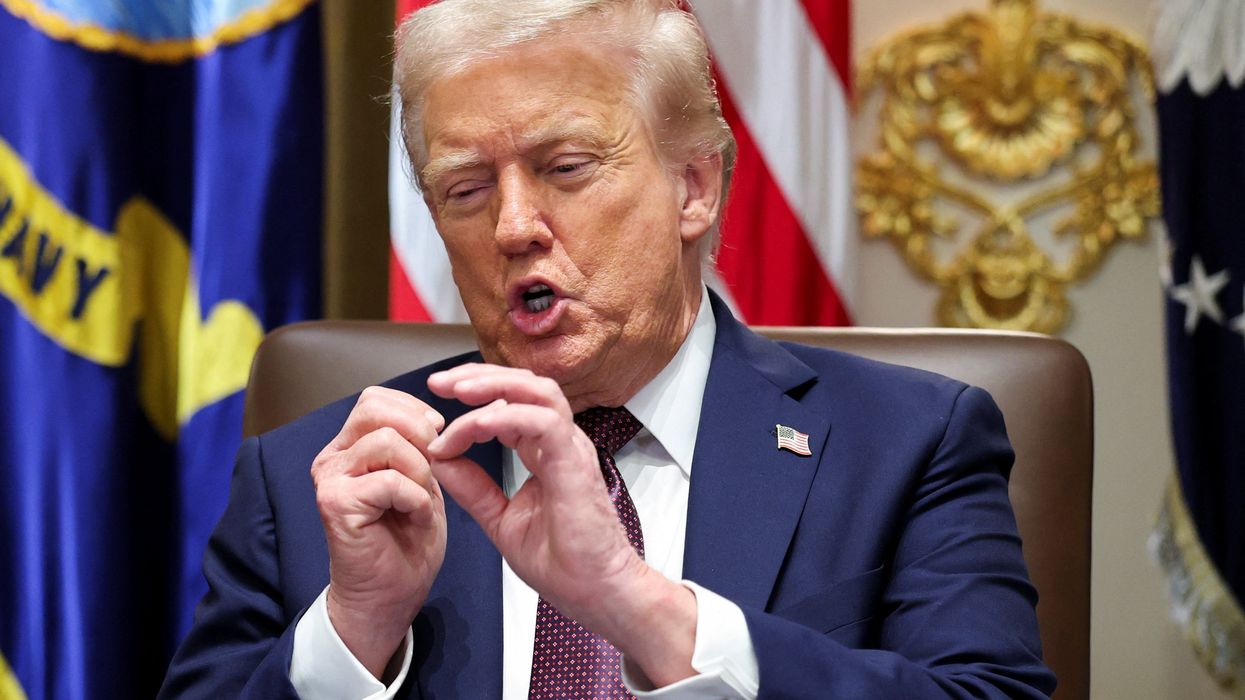
In October Americans learned that Trump regularly consumes a “hideous Franken-burger” (per The Daily Beast) which consists of “a Filet-O-Fish, a Quarter Pounder, and a Big Mac” before combining two of them (per Republican National Committee Chairman Joe Gruters). Slate’s Talib Visram elaborated that Trump regularly consumes “two Filet-O-Fishes, two Big Macs, and a chocolate shake (but no fries; everything in moderation).” He will add some lunchtime variety with an occasional “well-done steak with ketchup and a salad with blue cheese dressing.” One constant, though, is that he will drink “a dozen Diet Cokes” every day.
While Trump’s extreme enjoyment of McDonald’s stands out, other presidents have had idiosyncratic junk food fixations. President Joe Biden was well-known to consume large quantities of peanut-butter-and-jelly sandwiches with orange Gatorade, perhaps making him a culinary kin to President Ronald Reagan and the Gipper’s famous love of “Jelly Belly” jellybeans. President George W. Bush enjoyed not just any regular pizza but “cheeseburger pizzas, which his chef helpfully explained is ‘every ingredient of a cheeseburger on top of a margherita pizza.’”
Even more extreme than Trump, Biden, Reagan and Bush one can look at early 20th century Republicans like Presidents Theodore Roosevelt (who drank a gallon of coffee, or “bathtub,” per day, according to his son) and William H. Taft (who ate 8,000 calories per day and was America’s heaviest president at 350 pounds). Taft would start his day with a 12-ounce steak for breakfast, followed by eight other types of meat including “lamb chops, roast turkey, salmon filet, turtle soup, lobster stew, possum and sweet potatoes—all before dessert,” Visram wrote.
Perhaps the most eccentric junk food craze occurred in the 1970s, when presidents enjoyed mixing unhealthy condiments with cottage cheese. Presidents Richard Nixon (ketchup) and Gerald Ford (A.1. Sauce and sliced red onions, washed down with two lunchtime martinis) were both guilty of those impeachable gustatory offenses. Compared to these “treats,” one can view the normally-unhealthy cherry pies and almond cakes preferred respectively by Presidents George Washington and Abraham Lincoln as health foods.
This is not to say America has not had any presidents who were health-conscious. President Barack Obama’s “version of the fast-food banquet may have been his dinner of Vietnamese noodles in Hanoi with Anthony Bourdain” wrote Visram while his ideological antithesis, fellow Democratic President Andrew Jackson, “loved the Native American staple kanuche, or hickory-nut soup.” President Dwight Eisenhower kept himself literally regular with prune whip, and Visram wrote that President Woodrow Wilson foreshadowed the modern era’s “supplements and paleo diets” with his “special diet with elixirs and powders, and a breakfast of two raw eggs stirred into grape juice.”
On one occasion, Visram argued that a president may have been literally killed by a seemingly-healthy snack (iced milk and cherries), and then added he may have instead died by drinking the healthiest of all beverages (water).
“[President] Zachary Taylor’s binge of iced milk and cherries, after a long speech on a hot day, might have been what killed him,” Visram wrote. “For a century and a half, the meal was thought to have been poisoned—though after his body was exhumed, the prevailing theory became contaminated water.”
This refers to the theory that Taylor died from arsenic poisoning, but that would not have involved contaminated water. Writing about Taylor’s possible assassination for Salon in 2023, this author explained that Taylor became controversial in 1850 (one year into his first and only term) because he opposed aggressively expanding slavery into the Mexican territories the US had recently acquired in the Mexican-American War. He unexpectedly took sick after eating the normally-healthy snack of cherries and drinking iced milk at a 4th of July celebration, with doctors eventually deciding the fruit-and-dairy combination infected him with cholera morbus. His symptoms included “severe stomach pains, sharp pains on the side of his chest, vomiting, diarrhea, fevers, sweating, thirst, chills and fatigue.” Taylor eventually died and was replaced by his vice president, Millard Fillmore, who was well-known to sympathize with the Southern position on slavery.
Because Fillmore’s ascension seemed suspiciously-timed to benefit the pro-slavery faction, many conspiracy theorists speculated that Taylor may have actually been poisoned with arsenic. Taylor’s body was exhumed in 1991 and arsenic was discovered in his remains, although details remain controversial such as the quantity of arsenic in Taylor’s body, the study’s methodology and whether the arsenic itself was organic or inorganic. That last difference is critical because the type of arsenic which contaminated water in 1850 Washington DC (per Visram’s description) could have been either organic or inorganic — and except in very rare cases, organic arsenic does not lead to death. Inorganic arsenic, by contrast, is a commonly-used lethal poison.
"Arsenic is a metalloid that is present in all parts of the environment," Dr. Laura M. Labay, a forensic toxicologist and the Chair of the NAME Toxicology Committee, told this reporter for Salon in 2023. "For example it may be found in the water, soil and sediment." This reporter added at the time that “organic arsenic is naturally present in food like crustaceans and fish, and these forms are relatively non-toxic. ‘They will be rapidly excreted unchanged in the urine,’ Labay explained. In contrast, inorganic arsenic is highly toxic — and that is the one you want to avoid.”
While McDonald’s is not as unhealthy as arsenic, Trump nevertheless stands out among presidents because his penchant for McDonald’s is still dangerous, especially in a man turning 80 in July. Additionally, there is the irony that Trump’s economic policies may have made it harder for his supporters to share his love of McDonald’s. A Financial Times report in May found that McDonald's same-store sales in the U.S. dropped by 3.6 percent compared with the last analogous quarter because Trump’s tariffs dented consumer confidence.
"Soft data (sentiment) turning into hard data (sales) 'McDonald’s has posted the biggest drop in US sales since the height of the Covid-19 pandemic five years ago as uncertainty caused by Donald Trump’s tariffs weighs heavily on consumer sentiment,'" explained economic analyst Barry Ritholdz in a statement sharing the report.
Economic strategist Marko Kolanovic was more succinct on the social platform X, "In a recession, people prefer to eat at Microsoft."