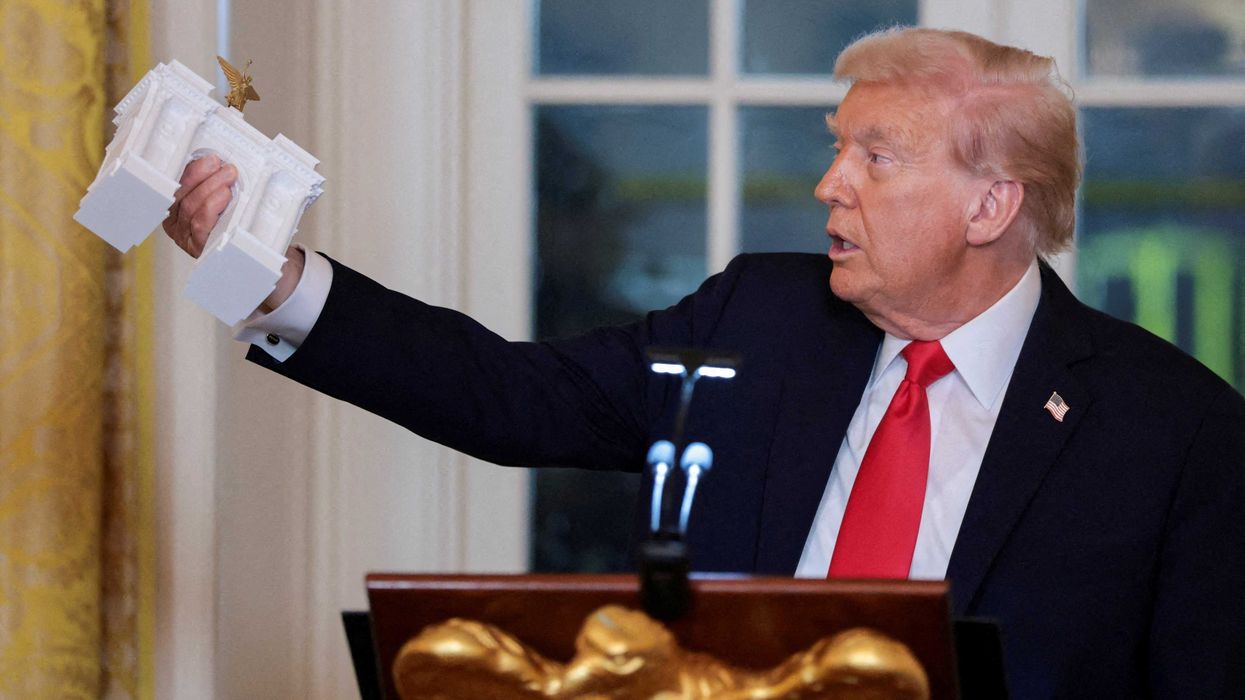
President Donald Trump plans on pardoning advisors who helped him engage in allegedly criminal activity as a way of consolidating power, according to the co-author of a book based on inside information about the White House.
"Trump is essentially beyond the reach of the law in terms of actions,” Jonathan Swan, who with Maggie Haberman co-authored the book “Regime Change,” told Peter Slen from C-SPAN on Monday. “Trump has told senior advisers in the Oval Office that he's going to pardon anyone who came within 250 feet of the Oval Office. I don't think they feel any real concern about illegality."
Trump has undertaken a number of actions that cause people to worry he plans on becoming a dictator. The Atlantic assistant editor Marc Novicoff explained in April that Trump has acted like a dictator in that he “prosecutes his political opponents; deports immigrants … to foreign prisons without due process; solicits tribute payments from corporations and foreign governments; deploys soldiers to American cities that are not, in fact, in civil-war-level chaos; and puts his name and image on government buildings that quite obviously don’t belong to him.”
Trump has renamed government buildings and institutions including the John F. Kennedy Center for the Performing Arts, the U.S. Institute of Peace, Trump Coin, Trump Accounts, TrumpRX, the Trump Gold Card and future U.S. paper currency. He has also unfurled banners with his image over the Department of Agriculture, the Department of Justice and the Department of Labor and urged lawmakers to pass a bill to carve his image onto Mount Rushmore.
"Dictators, once they've secured their grip on near-absolute power — and often once they start to get older — have a tendency to lose touch with reality, which often manifests in the form of grandiosity," UK-based i Paper journalist James Ball said in April. "Stalin was still relatively young when he renamed the city of Tsaritsyn as 'Stalingrad,' but building monuments and renaming things is very much the stereotypical out-of-control dictator move: Saddam Hussein had endless statues and monuments built in his image, while Saparmurat Niyazov of Turkmenistan renamed months, animal breeds, days of the weeks and cities…. The combination of endless flattery from courtiers, unbridled ego, lack of restraint from constitutional processes — and, quite often, the effects of an increasingly superannuated brain — drives many despots in this direction."
Ball added, "Democratically elected leaders are usually immune: they're not in office for long enough, they have to worry about what voters think — and as a result, they just don't get the chance to become so unmoored from reality. Donald Trump is spectacularly bucking that trend. Trump has only been back in office for 15 months, but he has managed to check off almost every item on the bucket list of the late-era autocrat."