
Congress explicitly said 'no' to this Trump order — and he's defying them anyway
(REUTERS)
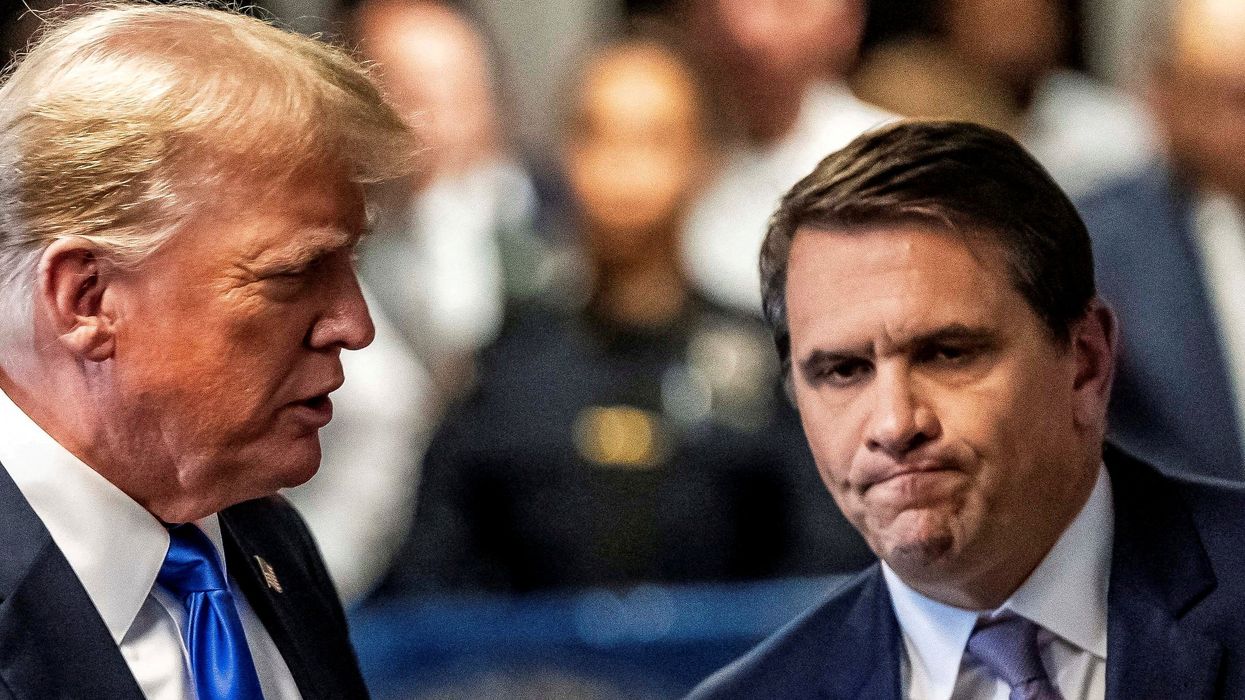
Donald Trump and Todd Blanche

Donald Trump and Todd Blanche
After the Trump administration upended the world’s largest foreign aid provider last year, terminating thousands of programs and firing nearly all of its staff, its plan for the agency was clear: Eliminate it entirely.
But because it is a congressionally created agency, President Donald Trump needed lawmakers’ permission to do so. So this year, Trump officials asked Congress for permission to shutter the U.S. Agency for International Development and dramatically reduce federal spending on food, medicine and lifesaving work around the world.
Congress said no. Lawmakers, who hold the government’s purse strings and have oversight of federal agencies, wanted USAID to remain, even in its diminished form. They detailed precisely how much the State Department should spend on foreign aid and for what, including $9.4 billion on global health to treat and prevent maladies like HIV, tuberculosis and malaria, and more than $5 billion on emergency humanitarian aid. They also insisted on regular, detailed reports about how the administration was spending the money.
Trump signed the bill, enshrining their orders into law.
Now, eight months into the fiscal year, Trump officials are failing to follow many of those orders, ProPublica has found. Officials have delayed spending on global health, have not issued funds for some projects and have labeled money destined for humanitarian aid as “unallocated” to control how it can be spent, according to a ProPublica review of government records and interviews with legal experts, current and former government employees, and members of Congress. And when lawmakers have asked about their actions, officials often have not responded.
The White House and Congress have been battling over federal spending since Day 1 of the Trump administration, setting up a constitutional crisis — a breakdown of the division of power among the three branches of the federal government, according to several legal scholars.
Nowhere has that crisis been more visible than with foreign aid. Last year, the administration took the unprecedented step of gutting USAID, terminating thousands of aid programs and letting funding expire, all without permission from Congress. Lawmakers did little to stop it.
Now, in defying Congress on foreign aid that Trump himself agreed to spend, the administration is quietly escalating the battle.
“It is a huge grab of power from the president, taking powers away from Congress,” said David Super, a professor of law and economics at Georgetown University and a leading scholar on administrative and constitutional law.
USAID was created by Congress decades ago as a means of promoting American diplomacy and soft power around the world. As ProPublica previously reported, when Trump officials dismantled the agency last year, stopping payments on thousands of lifesaving programs that provided food, medicine and other supplies to impoverished nations, many people died, including children.
Even with USAID in shambles, Congress has made clear that it expects the administration to continue providing foreign aid — in some cases, at nearly the level it did in previous years.
“It’s proof that there is still broad, bipartisan support for America showing up in the world, helping people and working with our allies and partners on shared challenges, not just because it’s the right thing to do, but because it directly benefits us,” said Sen. Brian Schatz, D-Hawaii, the ranking member of the Senate committee with oversight of foreign aid funds. Sen. Lindsey Graham, R-S.C., the committee’s chair, did not respond to multiple requests for comment.
But the administration has taken a variety of steps to thwart Congress’ directives. The Office of Management and Budget, run by Russell Vought, was instrumental in blocking the spending of aid money last year. This year, it has labeled both humanitarian aid and global health money as “unallocated,” meaning the OMB must approve how it is spent.
Legal scholars say such moves, and the delayed spending by the State Department, likely violate the law. Foreign aid is a prime example of why Congress made it illegal for administrations and agencies to slow-walk such funds, said Bobby Kogan, an OMB adviser under former President Joe Biden currently with the Center for American Progress. “If you spend no money for a year and all the clinics close, then those people die,” he said.
The State Department has made little effort to spend some foreign aid money that Congress earmarked for specific purposes, including family planning, neglected diseases and nutrition, according to government staff and budget documents.
And programs have been given fewer dollars, even when Congress has kept funding steady. That includes the President’s Emergency Plan for AIDS Relief, the hallmark HIV program credited with saving 26 million lives around the world.
Administration officials are also spending on foreign aid at a much slower rate than they had in recent years, according to an analysis of federal funding data shared with ProPublica by Aid on the Hill, an advocacy group created by former USAID employees, although the State Department disputes its conclusions. Another group published a similar analysis last week.
Where Trump officials have made plans to spend funds, it’s often spurred outrage. Under the new America First Global Health Strategy, Trump officials are signing bilateral deals with poor countries, asking for access to health data as a condition for receiving lifesaving medications the U.S. once donated.
Jeremy Lewin, a 29-year-old lawyer who came into government via Elon Musk’s Department of Government Efficiency with no prior humanitarian experience, is in charge of foreign aid. He has said that this new strategy will not only save countless lives, but also reform the aid sector and reduce dependence on U.S. funding.
Since last July, Lewin has been “performing the duties” of undersecretary for foreign assistance and humanitarian affairs, a position that must be approved by Congress, though the administration has yet to nominate him or anyone else to the job.
But he rarely, if ever, meets with career staff and doesn’t share information about his plans, even with the people who are expected to carry them out, according to six current and former career officials. Lewin insists that he approve even routine payments, creating a stranglehold on funding and information.
And all the while, Trump appointees have failed to answer basic questions from Congress about what they are doing. Letters from lawmakers have gone unanswered and required reports unfiled.
To understand the administration’s compliance with congressional mandates and federal law, ProPublica reviewed administration documents, including agreements, memos, and internal communications, and spoke with dozens of current and former government officials, congressional staff, and international experts in global health and humanitarian aid. Many people spoke on the condition of anonymity for fear of reprisal from the administration.
In response to a list of detailed questions about the concerns, a State Department spokesperson who declined to be named said they would continue to follow the president’s direction on foreign aid spending. “We are not withholding any funds appropriated to, or available to, State,” they said. “If additional funds are made available to State, we will work to obligate them consistent with legal requirements and Administration priorities.”
They said officials have regularly briefed Congress and that Lewin had recently spent four hours discussing foreign assistance. They also said they have “reduced by 80% the number of outstanding reports and letters” since Trump retook office.
“We are working with Congress to spend appropriated balances and find the right future-appropriated level for global health,” the spokesperson said.
In response to a series of detailed questions about this story, OMB spokesperson Rachel Cauley said, “This is patently false,” adding that “USAID was a weaponized government agency.” She did not respond to a follow-up question asking what was false.
After nearly all of USAID’s employees were fired and the majority of its programs closed down last summer, the agency’s remnants were transferred to the State Department. Despite repeated promises from Secretary of State Marco Rubio that lifesaving aid would continue, the State Department began winding down many of the remaining programs earlier this year.
And staff have been working with a severely constricted budget; officials gave them just half of the available money for PEPFAR, said Dr. Mike Reid, who was the program’s chief scientific officer until he left earlier this year over concerns about how the program is being run. Of the $9.4 billion for global health spending for the State Department that Trump signed into law earlier this year, Congress earmarked about $4.6 billion for PEPFAR. But staff say it’s unclear how much of that they will be allowed to spend.
Congress also explicitly directed the State Department to spend pots of money on family planning ($524 million), nutrition ($165 million) and neglected tropical diseases ($109 million), according to the bill. According to a review of government records and two people with knowledge of the department’s activities, State Department officials have made little or no effort to spend from those pots.
In response, a State Department spokesperson said it has “continued to obligate and spend every dollar appropriated for global HIV/AIDS programs” and “we continue to implement life-saving care in global health priority areas, including HIV/AIDS, tuberculosis, malaria, and maternal and child health.”
They added: “The State Department has been in the process of slowly replacing old carry-over USAID grants with new State Department grants and contracts which have fresh funds, new terms and conditions, and better align with the new America First foreign assistance strategy.”
Global health programming in general is moving at a much slower rate than it did previously, according to the Aid on the Hill analysis of federal funding data. Of the more than $9 billion that Congress told the Trump administration to spend on global health last year, the administration had by the end of this March obligated just $190 million, 5% of what was spent on average in that period in the five years before Trump returned to office. Typically, officials would have obligated about half of the money by then. Another advocacy organization, Health Security Policy Academy, published an analysis last week that drew a similar conclusion.
The State Department said it “cannot and will not” verify any independent analysis, but disagreed with the figures, saying that it has “approved and implemented spending” for more than $7.5 billion to align with the bilateral agreements and disaster response. “You either have vastly outdated numbers or are simply mistaken,” it said, but would not elaborate.
The agreements signed with nations around the world, a centerpiece of the State Department’s foreign aid policy, will in many cases involve sending funds directly to those governments, some of which have been mired in corruption scandals. But the specifics of the programs are still being determined, and the funding has yet to flow.
Meanwhile, Lewin has been increasingly leaning on large international organizations to deliver aid once managed by USAID employees.
Earlier this year, Lewin funneled $3.8 billion to a small arm of the United Nations, the Office for the Coordination of Humanitarian Affairs, quadrupling the budget of the agency.
Trump has frequently criticized the U.N. as ineffective. But after nearly all of USAID’s staff was fired, the skeleton crew at the State Department doesn’t have the capacity or expertise to manage so much humanitarian aid themselves, according to a dozen people familiar with the new system.
The agreement with OCHA, a copy of which was reviewed by ProPublica, also does not allow the U.S. to independently audit the funds, though the U.N. agreed to run a pilot project for greater internal oversight.
Eri Kaneko, OCHA’s spokesperson, said the agency has worked quickly since December to disburse funds for “the most urgent and life-threatening needs” and that U.N. entities are “fully committed to the highest standards of accountability and oversight.”
The U.S. has been the largest donor to the Global Fund to Fight AIDS, Tuberculosis and Malaria, a multilateral organization that provides medicines and prevention measures to millions of people around the world, since its inception. Lewin recently announced an expanded partnership with the fund to provide HIV prevention across Africa. But the Trump administration last year withheld payments pledged under the Biden administration, forcing the fund to reduce the amounts it gave to nations.
So in this year’s spending bill, Congress directed the State Department to make good on its pledges, issuing specific instructions to Rubio on what to pay and when, and telling him to make those contributions “in a timely manner.”
That hasn’t happened.
A State Department spokesperson told ProPublica that “all current funding obligations have been met.” But according to a board member for the Global Fund, congressional staff and Friends of the Global Fight, an organization that advocates for the fund in the U.S., the administration should contribute another $661 million.
“The State Department is underfunding the Global Fund,” Schatz said. “It’s out of compliance with congressional appropriations.”
When the senator asked about the funding during Rubio’s recent testimony to Congress, Rubio said, “I think that will move shortly, very quickly.”
During previous administrations, once Congress passed laws to approve federal spending, the money flowed through the OMB, which in turn parceled out the funds to designated agencies, making sure they didn’t spend the funds too quickly or too slowly.
Under Trump, the OMB, led by Vought, has repeatedly blocked funds approved by Congress from going to agencies using legally dubious maneuvers, experts in federal spending and constitutional law told ProPublica.
As ProPublica has chronicled, Vought takes an expansive view of presidential power and has moved to give the executive branch dramatically greater authority to not spend legally appropriated money. Foreign aid has been a clear focus; after USAID was razed last year, Vought was made acting administrator and tasked with overseeing the closeout of the agency. Eric Ueland, a Vought deputy at the OMB, is currently performing those duties.
The OMB currently has labeled more than $500 million in global health money as “unallocated,” according to its own data, which makes it impossible for the State Department to spend without first going through the OMB. It had also labeled most of the humanitarian aid money this way, but began releasing some of those funds in May. By June 11, the OMB had released all of that money to the State Department.
Several people inside and outside the government told ProPublica they fear that the administration is withholding the funds because it is planning not to spend them at all. They have good reason to be concerned: That’s exactly what Trump did last year.
In 2025, the administration clawed back some $13 billion in foreign aid that Congress had passed into law, some of it by using a maneuver widely understood by legal experts to be illegal.
That maneuver, which Vought calls a “pocket rescission,” essentially asks Congress to cancel funds so late in the fiscal year that there isn’t enough time for them to be spent if Congress says no. The Government Accountability Office, Congress’ watchdog, has said pocket rescissions are illegal, and several constitutional scholars told ProPublica the move violates the Impoundment Control Act. That law, passed in 1974 in the wake of disputes with President Richard Nixon, restricts the president’s authority to withhold, or impound, funds approved by Congress.
A federal court initially blocked the maneuver as part of ongoing lawsuits related to the dismantling of USAID. But the administration appealed to the Supreme Court, which issued an emergency ruling split along ideological lines that allowed the clawback to continue, though it did not rule on the merits.
The GAO has standing to take legal action on a pocket rescission. Edda Emmanuelli Perez, GAO’s general counsel, told ProPublica that her office was continuing to review potential impoundments and monitoring ongoing litigation, and that it has not made a decision to file any lawsuits at this time.
While there are still nearly four months left in this fiscal year, career officials and legal experts say another rescission — legal or not — would further erode Congress’ power of the purse, threatening the U.S. democracy.
“If that’s going to be a regular occurrence, then we have a real fundamental threat to the rule of law,” said Cerin Lindgrensavage, a former Justice Department lawyer who works for Protect Democracy, a nonprofit that fights against authoritarianism. “Congress has said spend the money, and the president doesn’t want to. The question is, who wins? Under the law, Congress is supposed to win. Right now, the president is.”
Budget watchers say there are concerning signs that the administration plans to withhold more funds.
In April, the OMB announced to Congress that it was withholding funds earmarked for global health to pay the hefty bills for severance fees and other costs for the thousands of USAID programs Trump officials terminated last year.
OMB officials told lawmakers they were setting aside $19 billion to cover those costs, though they anticipated the total would be “substantially” less. (Internal documents reviewed by ProPublica say the figure doesn’t include the cost of the litany of lawsuits associated with the closures — or the dozens of new hires and other agency operations needed to process them.)
The bulk of that money came from unspent funds for the canceled programs and other unobligated dollars from previous years. But $3.2 billion came from funds earmarked by Congress for global health and development programs that Trump signed into law in 2025. If it’s not obligated by the end of September, that money will expire and can no longer be spent.
Democratic lawmakers were incensed by the OMB’s decision. In a letter to Trump officials, senators called it an “appalling admission of waste of U.S. taxpayer dollars” and demanded that the administration use the $3.2 billion as directed, “consistent with the law.” They asked for a response by May 8. As of June 16, lawmakers had not received one.
Asked about the funds during the recent Senate hearing, Rubio claimed they were under the purview of the OMB. Schatz pointed out that Rubio had moved all foreign aid under the State Department and had just wrestled some of that money away from the OMB to respond to an Ebola outbreak. “It also demonstrates you are perfectly capable of getting money released from those closeout funds if you wish,” he told the secretary. “Ebola is an urgent priority, but so is malaria, so is TB and so is HIV/AIDS.”
“Proposing a rescission is a Presidential authority, and we will follow President Trump’s direction as to any future rescissions,” the State Department spokesperson told ProPublica. “We are currently planning to obligate all appropriated balances, consistent with law.”

