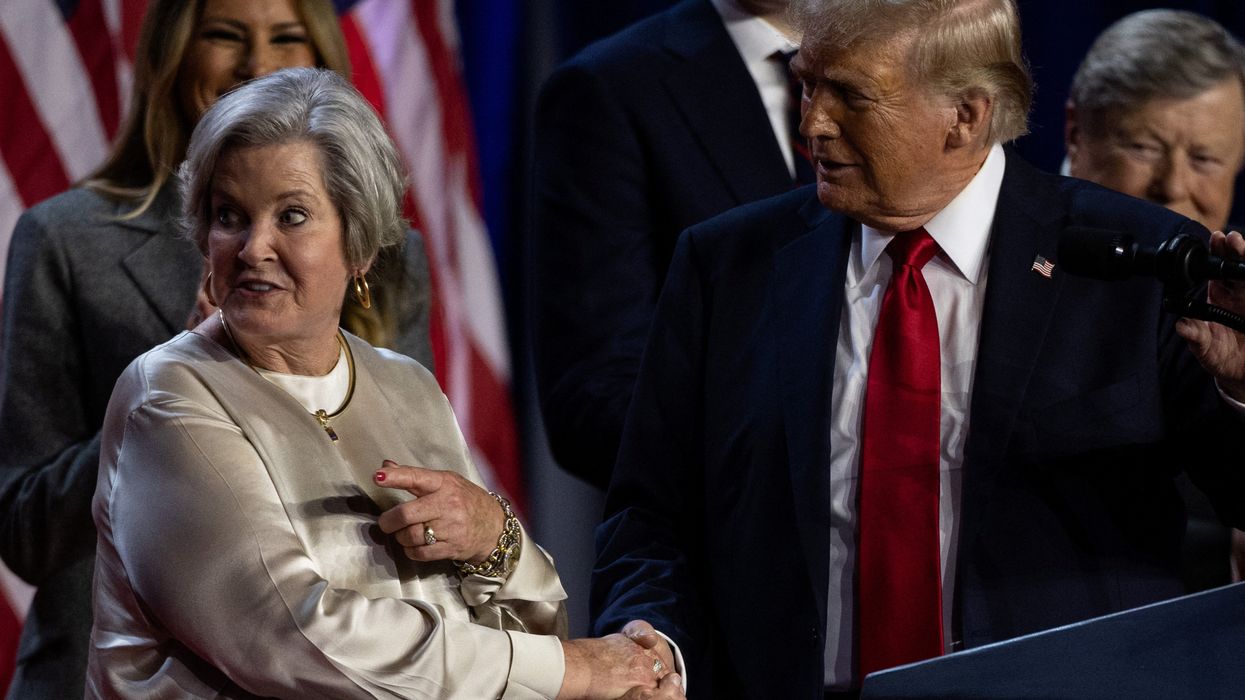
White House chief of staff Susie Wiles' bombshell Vanity Fair interview showed that she had quite a bit to say about top figures in President Donald Trump's administration. But according to a new analysis from a former Clinton advisor, she also had some telling things to say about herself, painting herself as an "enabler" also trying "distance herself" from Trump's actions.
The interviews between Wiles and Vanity Fair's Chris Whipple were conducted over the first year of Trump's second term and produced many notably candid comments. She refers to Trump as having an "alcoholic's personality" and operating with "a view that there’s nothing he can’t do." She said Vice President JD Vance has "been a conspiracy theorist for a decade" and changed his stance from Trump critic to supporter out of a political calculation, rather than a change in principles. She also described businessman and one-time Trump advisor Elon Musk as "an avowed ketamine" user and "an odd, odd duck" whose behavior left her "aghast."
Writing for The Guardian on Tuesday, Sidney Blumenthal — a former senior advisor to both former President Bill Clinton and former First Lady, U.S. Senator and Secretary of State Hillary Clinton — dug into the ways in which Wiles' relationship with her alcoholic father (the late NFL broadcaster Pat Summerall) seems to inform her approach to handling Trump. In particular, he highlighted one of her concluding comments, in which she claimed not to be an "enabler," a claim at odds with her overall handling of the Trump White House.
"So no, I’m not an enabler," Wiles told Vanity Fair's Chris Whipple. "I’m also not a b——. I try to be thoughtful about what I even engage in. I guess time will tell whether I’ve been effective."
According to Blumenthal, this excerpt showed Wiles was "concerned with distancing herself" from Trump while operating "as the chief of staff to the worst president in American history."
"Wiles herself introduces the therapeutic notion of the 'enabler,'" Blumenthal wrote. "The role is that of someone who does not intervene to curb an 'alcoholic’s personality,' unlike as she ultimately did to stop her father’s self-destructive spiral. She still thinks of herself as the alcoholic’s daughter, who has the choices of acquiescing, enabling or intervening.
"As chief of staff, she has stifled her temptation to intervene," he continued. "She knows it would be in vain and endanger her. In her interviews with Whipple, she presents herself as a manifestation of learned helplessness. But she may know instinctively that Trump, humiliated by her disclosures, might find a way slowly to humiliate her until she resigns. Or were the interviews themselves her retribution for the ineffectiveness he imposes on her?"