
Supreme Court 'boiling over' into malfunction as conservatives choose 'sides'
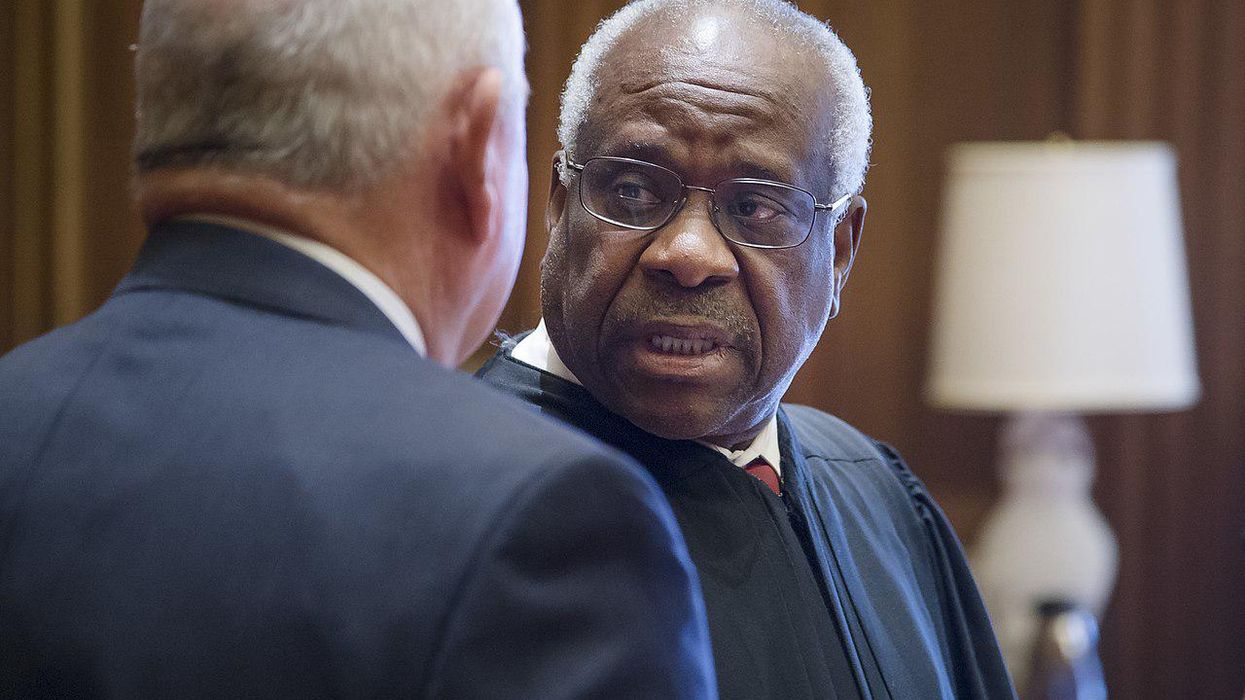
Justice Clarence Thomas with Sonny Perdue on April 25, 2017, Wikimedia Commons
Justice Clarence Thomas with Sonny Perdue on April 25, 2017, Wikimedia Commons

Justice Clarence Thomas with Sonny Perdue on April 25, 2017, Wikimedia Commons
There has been a “deterioration of morale” at the U.S. Supreme Court, Yale Law School professor Justin Driver told Bloomberg News, as he predicted “there will be major fireworks” by the time the high court’s term comes to a close around the end of June.
Other legal scholars share that concern.
“It appears from the outside that there has been an erosion of comity and trust,” William & Mary Law School constitutional and administrative law Professor Jonathan Adler told Bloomberg. “This raises the concern that it could affect how the court operates and inhibit deliberation.”
The court already appears to be operating at an unusual level of enmity.
“Tensions are starting to boil over,” Bloomberg reports. “Back-and-forth sniping between Justices Ketanji Brown Jackson and Samuel Alito Monday night marked the latest sign of strain at a court that has become a prominent symbol of the polarization besetting the country.”
During last week’s landmark ruling all but gutting what remains of the six-decade-old Voting Rights Act, liberal Justice Ketanji Brown Jackson accused the court’s conservative majority of taking political sides. Justice Samuel Alito, a conservative, called her claims “insulting” and “utterly irresponsible.”
More high-profile — and possibly highly-contested — decisions are to be handed down over the next eight weeks, and with them, more contentious opinions.
Justices are set to rule on President Donald Trump’s effort to eliminate birthright citizenship, they are to hand down opinions on transgender girls in women’s sports, and on Trump’s attempt to fire Federal Reserve Governor Lisa Cook.
On Monday, as the court cleared the way for Louisiana to eliminate a majority-minority district, Justice Jackson “accused the court of betraying its principles, including its past pronouncements that judges shouldn’t change the voting rules on the eve of an election.”
“Just like that, those principles give way to power,” Jackson warned.
Jackson’s remarks “drew a fiery response” from Justice Alito, who said that her dissent “levels charges that cannot go unanswered.” Bloomberg reports that “Alito took particular umbrage at Jackson’s claim that the court was engaging in an unprincipled power play,” which he called “a groundless and utterly irresponsible charge.”
At the time, Justice Amy Coney Barrett in an appearance said that “collegiality is a decision you make,” as she shared that she and other justices spend time together at lunches and even dinners at each other’s homes.
“You have to make decisions to spend time with people, and particularly people with whom you might disagree, in order to forge those bonds,” Barrett said.
Pointing to what it calls the “Jackson Factor,” Bloomberg reports that Jackson, the nation’s newest justice, “has been at the center of much of the sparring,” and much of that seems to be with Justice Alito.

