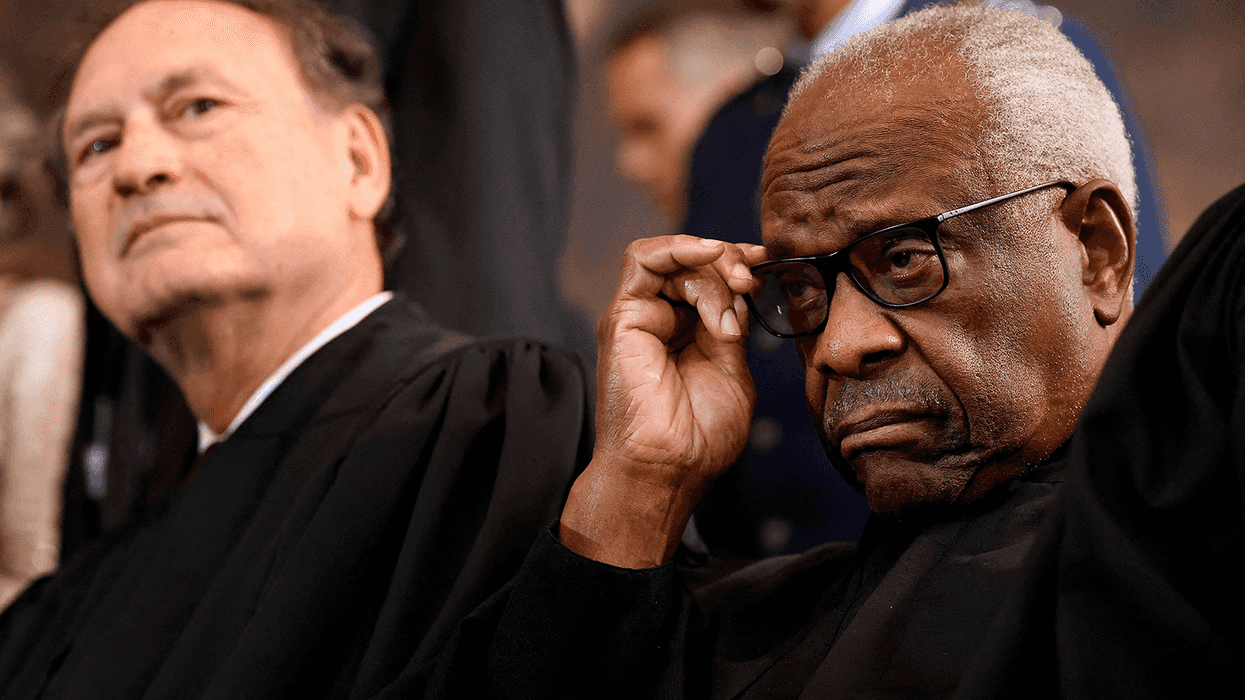
In late April, the Supreme Court handed down a decision that critics say “demolishes” the Voting Rights Act by ending a provision that prevents racial discrimination. Now, according to experts, it appears that arguments made by Justice Samuel Alito were based on “misleading data analysis.”
According to the Guardian, “In his opinion gutting section 2 of the Voting Rights Act last week, Alito said that Black voter turnout had exceeded white voter turnout in two of the five most recent presidential elections, both nationally and in Louisiana. Alito’s claim was copied almost verbatim from a friend-of-the-court brief filed by the justice department. It was a critical data point Alito used to make the argument that the kind of discrimination that once made the Voting Rights Act necessary no longer exists.”
But a review of this assertion revealed that an “unusual methodology” was used to come to such a conclusion.
The brief provided by the Trump-led Justice Department calculated Black and white voter turnout in direct proportion to the total adult population of each racial group. But as the Guardian explained, “Such an approach is not preferred by experts in calculating statewide turnout because the general over-18 population may include non-citizens, people with felony convictions and others who cannot legally vote. But it does yield Alito’s conclusion that Black voter turnout exceeded white voter turnout in the 2012 and 2016 presidential elections in Louisiana.”
If calculated using the accepted method, however, the numbers offer a different conclusion: “that Black voter turnout in Louisiana only exceeded white voter turnout in the 2012 presidential election.” What’s more, “The Guardian also reviewed data from the Louisiana secretary of state’s office, which calculates voter turnout a third way, as a percentage of registered voters. Using that methodology, Black turnout has not exceeded white turnout in any of the last five presidential elections in Louisiana.”
Experts suggest that this was no mere mistake, but an intentional attempt to manipulate the outcome.
“[The DOJ approach] is misleading because they’re including ineligible voters in the denominator,” said University of Florida political science professor Michael McDonald. One of the nation’s leading experts on voter turnout, he noted that if he wanted to reach Alito’s conclusion, McDonald would “manipulate” the numbers in the exact same way. “They had to fudge how they’re calculating the turnout rate to get there, and they’re not even taking into account margin of error, and all these other methodology issues about the current population survey to arrive at that number. Someone knew what they were doing.”