
Another Army leader resigns after months of tension with top Trump brass
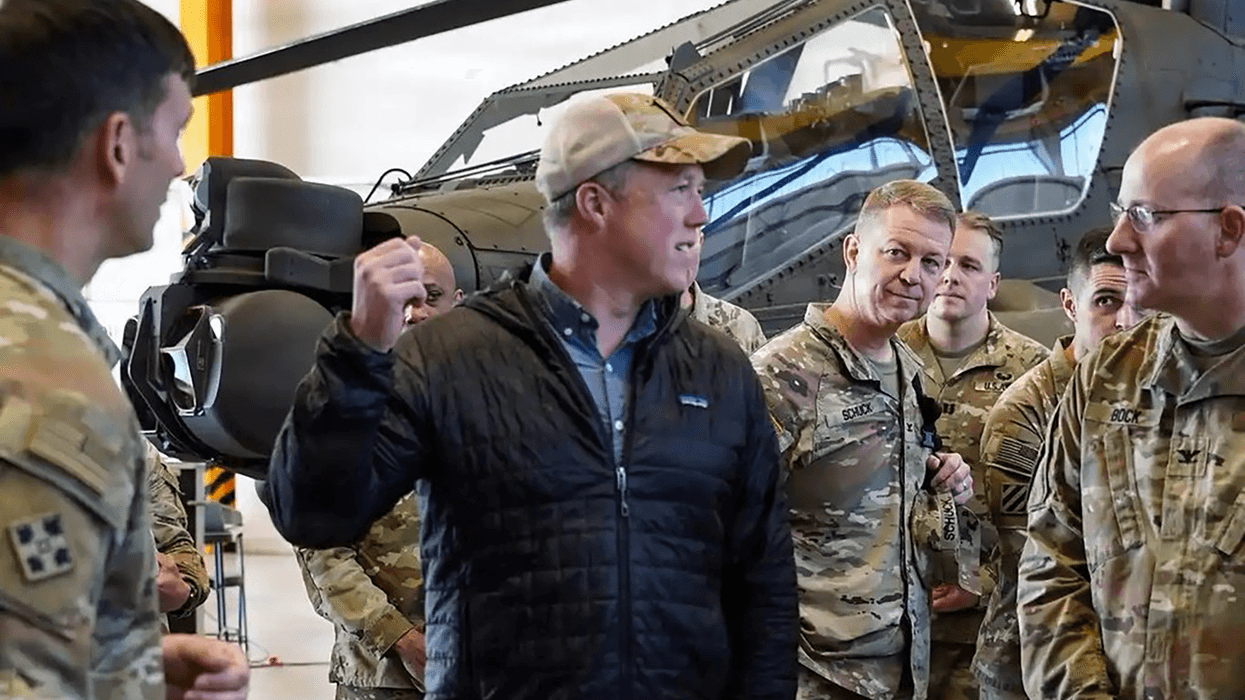
SECArmy Dan Driscoll visits USAG Ansbach
SECArmy Dan Driscoll visits USAG Ansbach

SECArmy Dan Driscoll visits USAG Ansbach
President Donald Trump's Army Secretary just resigned, allegedly due to his ongoing feuds with Defense Secretary Pete Hegseth — and as a result, there are no Senate-confirmed Army leaders remaining in power.
"Army Secretary Dan Driscoll has submitted his resignation to President Trump following months of tension with Defense Secretary Pete Hegseth over the direction of the service and the ouster of numerous senior Army officers," reported The Wall Street Journal's Michael R. Gordon and Marcus Weisgerber on Monday. "He is expected to leave the Pentagon in coming days."
The Journal added, "With Driscoll’s departure, the Army will lack any Senate-confirmed civilian or military leaders. Gen. Christopher LaNeve has served as acting chief of the service since Hegseth fired his predecessor, Gen. Randy George."
Trump has received repeated criticisms for purging the military, which is supposed to be apolitical, of generals and other officials who do not profess loyalty to him.
Writing for Just Security in June, Writing for Just Security, legal scholar Michael N. Schmitt (a law professor at New York University) argued that "he question regarding these departures is not whether the president and secretary of defense have broad lawful authority to reshape the senior officer corps. They unequivocally do. Nor is it a question of whether personnel decisions of this kind are ever warranted. Sometimes, they certainly are. Instead, at its core, a central question is their impact on the combat effectiveness, indeed the lethality, of our armed forces."
In his article, Schmitt listed 25 U.S. military leaders who Trump had forced out, adding that they collectively had 901 and one-half years of experience. He added that Trump appears to be replacing military advisers who are apolitical with those who will be loyal to the Republican Party for reasons reminiscent of the actions of Soviet dictator Joseph Stalin.
"Between 1937 and 1938," Schmitt wrote, "Joseph Stalin systematically purged the Red Army's officer corps. His motivations were political, for he wanted to eliminate perceived rivals and consolidate absolute personal authority. Of the five marshals of the Soviet Union, three were executed. Of the 15 army commanders, 13 were removed…. Launched in November 1939, the Winter War against Finland revealed the costs. Despite massive numerical superiority, Soviet forces performed disastrously, with the Red Army sustaining casualties at least several times higher than those of the Finns."
Additionally, given Trump's repeated efforts to meddle in the 2026 midterms to make sure Republicans don't lose, there are concerns he will use the military to seize voting machines or otherwise alter the vote, although Trump's Chairman of the Joint Chiefs of Staff Dan Caine denied this on Monday.
When this journalist quoted two historians in 2024 who compared Trump to both Stalin and Nazi dictator Adolf Hitler, Trump's then-spokeswoman Karoline Leavitt specifically singled out the Hitler comparison as "disgusting."

