NYT columnist exposes grim warning behind a wild new political betrayal
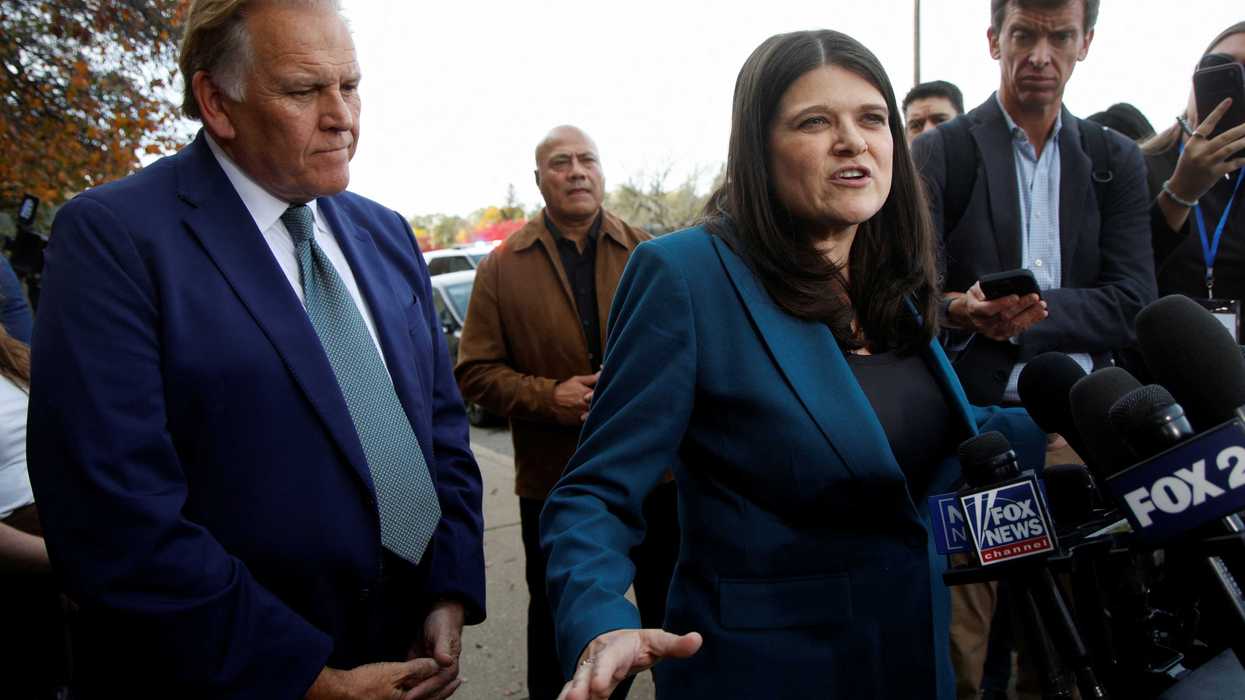
Rep. Haley Stevens, a Michigan Democrat, speaks with the media next to GOP Senate candidate Mike Rogers after attending the Perfecting Church in Detroit, Michigan, November 1, 2026. REUTERS/Rebecca Cook
Rep. Haley Stevens, a Michigan Democrat, speaks with the media next to GOP Senate candidate Mike Rogers after attending the Perfecting Church in Detroit, Michigan, November 1, 2026. REUTERS/Rebecca Cook
The midterm political landscape was rocked this weekend after failed Democratic Senate candidate Haley Stevens broke rank to endorse the race's Republican nominee, and as one prominent New York Times columnist explained, exposed a dire warning about self-serving political aspirants in the process.
Stevens, the Democratic U.S. Representative for Michigan's 11th District, lost the Democratic nomination for her state's Senate seat earlier this year to Abdul El-Sayed, who polling now suggests has a slight edge over Republican nominee Mike Rogers. Despite previously claiming that she would support El-Sayed's candidacy, Stevens had, in recent days, seemed to have become less committed to the idea, before ultimately announcing her endorsement of Rogers on Sunday, just two days out from election day.
Stevens dispute with El-Sayed largely seemed to stem from his critical posture towards Israel, and her break from supporting him appeared to come in response to a controversial ad for his candidacy released by a third-party outfit, which El-Sayed has since disavowed.
Discussing the messy incident on his official YouTube channel, liberal Times columnist Jamelle Bouie offered his take on the psychology underpinning Stevens' decision, arguing that she had exposed how little she truly stands for anything besides her own political advancement.
"Stevens doesn't really seem like she believes anything," Bouie said. "It just seems like she felt that she was entitled to the seat, entitled to the nomination, felt that that was the obvious next step for her and really took it hard; could not reconcile her defeat with her image of where she thought she would be. I think also there's a bit of just bigotry: she can't believe that she lost to a Muslim man, to an Arab Muslim man, and is still full of pique about that."
Returning to that idea later in the video, Bouie argued further that Stevens was now a "cautionary tale" to voters about the dangers of political actors who are not truly devoted to anything but themselves.
"To my mind this is a great example of the problem with candidates who don't seem to really believe anything, who seem only to be running to advance their careers, and who are unable to make themselves subordinate to a larger cause," Bouie said. "Stevens clearly thought that this whole story was about her, and now that it isn't, she is lashing out in a way to make it about her. The story may end up being about her, but in as much as it becomes a cautionary tale about people like Haley Stevens, and I think at a time when Democrats were trying to make their final push, trying to build unity, this actually might be the thing that did it, because now everyone is united in a simple message, which is that Haley Stevens sucks."