
Unsealed court doc reveals a key factor in high food prices
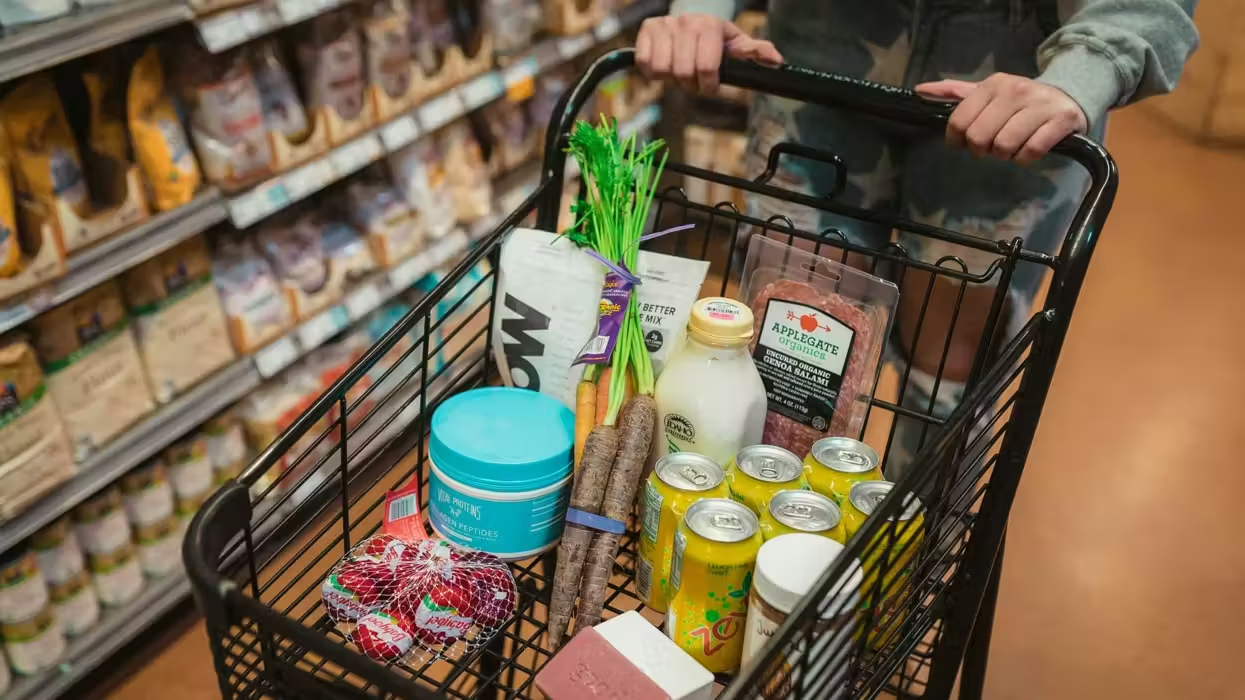
Photo by Karsten Winegeart on Unsplash
a person pushing a shopping cart full of food
December 18, 2025 | 07:54AM ETFrontpage news and politics
With high grocery prices continuing to squeeze Minnesotans, a newly unsealed antitrust complaint provides a path towards relief.
The complaint is a revealing look at the way big retailers can wield their power over food manufacturers to drive up prices — while crushing competitors. The lawsuit also underscores that if Minnesota legislators are going to effectively address sticker shock at the grocery store, they must address the consolidation that has a stranglehold over the industry.
A judge recently ordered that an antitrust complaint against PepsiCo that was brought by the Federal Trade Commission under the Biden administration, but dropped earlier this year by the Trump Administration, be unsealed and made available to the public.
The complaint provides a unique look at price discrimination in practice, which involves charging retailers different prices for the same good, often at the behest of powerful retailers. That practice is a violation of an antitrust law known as the Robinson-Patman Act.
For the past decade, according to the unsealed complaint, Walmart has used its immense power to demand promotional payments and allowances from Pepsi that have kept prices of soft drinks lower than other retailers. Walmart has also used Pepsi to help it monitor prices of soft drinks at competing retailers. When the gap between Walmart and others is too low, Pepsi limits allowances and raises wholesale prices for those companies. “Rather than simply working with Walmart to reduce prices, Pepsi’s actions have had the effect of raising prices for customers of competing retailers,” the complaint says.
While Pepsi revealed to investors it could not risk angering Walmart, they did benefit from preferential promotion and in-store placement.
“Walmart’s promise is: Keep us the king of our domain and we’ll make you the king of yours,” wrote Stacy Mitchell of the Institute for Local Self Reliance, the organization — with a strong Minnesota presence — that sued to unseal the FTC’s complaint.
While the FTC lawsuit targeted soft drinks, this is just a glimpse at a more pervasive practice.
A small food cooperative in New London told legislators this year about the disparity in wholesale prices they face.
Meanwhile, a study from the Federal Reserve Bank of Atlanta last month found market consolidation has driven food inflation higher.
From the 1950s until the early 80s (a time of aggressive Robinson-Patman Act enforcement) independent grocery stores captured over half of America’s grocery dollar.
Today, the four largest grocery chains capture over half of America’s grocery dollar while the market share of independents has dropped to 22%. Walmart alone commands a fifth of the grocery market nationally, 19% in the Twin Cities, and over half of the market in some parts of rural Minnesota. Meanwhile, according to the Federal Reserve Bank of Minneapolis, 1.6 million Minnesotans have low retail access and 16% of the state’s census tracts are food deserts. This transformation of the grocery industry over the past four decades follows a decision by presidents of both parties to let the law collect dust.
While Minnesota cannot revive enforcement of the Robinson-Patman Act, it can create its own standards.
The bipartisan Consumer Grocery Price Fairness Act would do just that.
The legislation would give Minnesota clearer and stronger tools for policing price discrimination in the grocery industry. Building off the principles of the Robinson-Patman Act, the law would require suppliers to offer goods to retailers on equivalent terms and prohibit retailers from extracting unfair concessions from suppliers.
The legislation also addresses key loopholes in the Robinson-Patman Act. This includes the ability of suppliers to engage in price discrimination if retailers are in different “channels” such as giving a preferential price to a dollar store chain compared to a traditional grocery store. The legislation would also ban the kind of access discrimination experienced during the pandemic, i.e., Walmart threatening to fine suppliers that did not give them preferential access to goods.
The Robinson-Patman Act was passed in 1936 when Minnesota stood at the forefront of a nationwide movement to address the harms of chain stores.
Gov. Floyd B. Olson of the Farmer-Labor Party secured passage of a tax on chains.
His predecessor, Republican Gov. Theodore Christianson, advocated for a national version of the tax. “Selling the goods is far more important than manufacturing them,” Christianson told Congress in 1940. While the taxes Olson and Christianson fought for were eventually tossed out by the U.S. Supreme Court, the Robinson-Patman Act became the enduring legacy of that movement.
Today, Minnesota can create a new legacy that helps reign in the power of big box stores and provides relief to consumers.

