
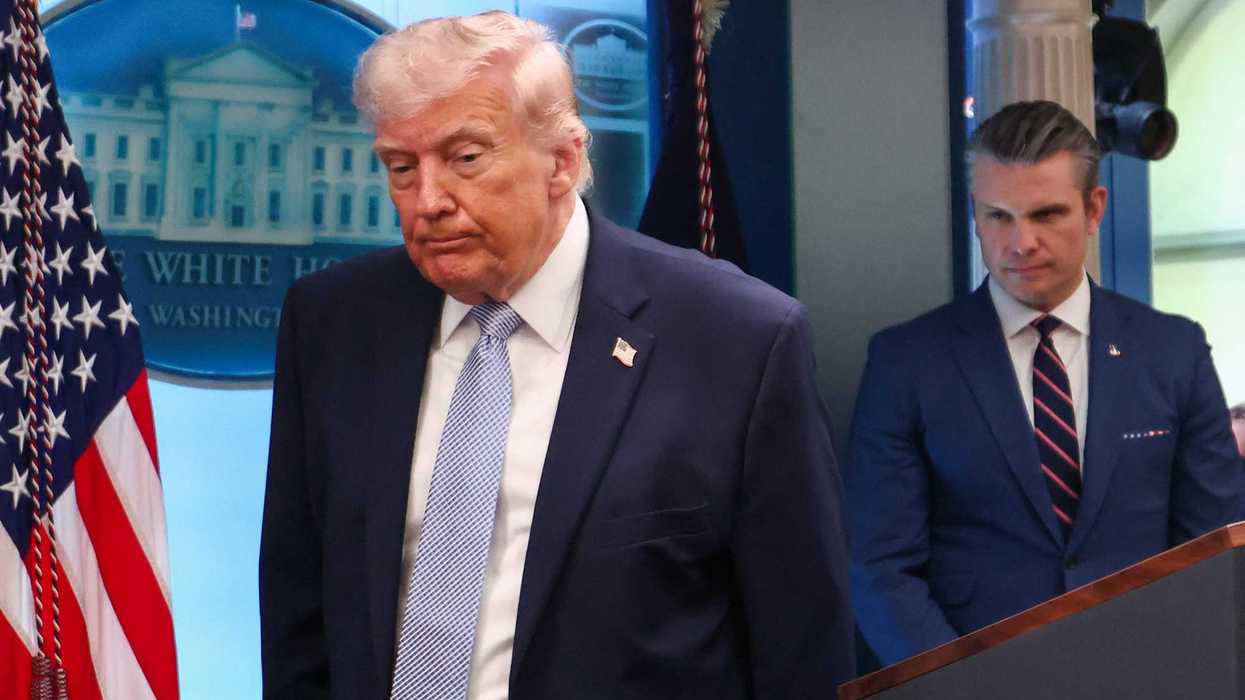


Republican lawmakers are turning on President Donald Trump's controversial Pentagon chief, Pete Hegseth, as his strained relationship with Congress threatens to derail the administration's $1.5 trillion military spending plan, according to a new report.
The Washington Post reported Thursday that growing frustration with Hegseth and his lack of communication has contributed to a breakdown in the bipartisan cooperation traditionally needed to fund the Pentagon, with lawmakers running out of time to pass major defense legislation.
The newspaper interviewed 30 people involved in congressional national security matters, including 20 lawmakers serving on committees overseeing the military. Many blamed the impasse on Hegseth's confrontational approach.
"The way Hegseth treats people is a problem," Rep. Austin Scott, a senior member of the House Armed Services Committee, told the Post.
The difficulty they find dealing with Hegseth is so high that some Republicans have asked the Pentagon to send uniformed military officers, rather than deal with him, to brief lawmakers.
Sen. Lisa Murkowski (R-Alaska), who opposed Hegseth's confirmation, described his tone as "as shockingly unprofessional as anything I see."
The meeting Murkowski referred to was classified, but three sources familiar with the discussion said the defense secretary said he didn’t trust everyone in the room and would watch what he said.
The administration wants to increase defense spending by roughly 40 percent, fund new weapons systems, replenish ammunition depleted during the war with Iran and advance Trump's proposed Golden Dome missile shield.
But the proposal has become tangled in a dispute over how to secure congressional approval. The White House divided the $1.5 trillion package, with $1.15 trillion requiring Democratic support and $350 billion that it hopes Republicans can approve independently.
Republicans have yet to agree on a strategy for passing their portion, while Democrats have resisted additional funding for a war they say Trump launched without congressional authorization.
The annual defense authorization bill, which has passed for 65 consecutive years, has also encountered obstacles, failing to advance in the Senate while narrowly passing the House.
Some Republicans are also unhappy with the administration's decision to exclude Democrats from briefings on parts of the proposal. Sen. Kevin Cramer (R-N.D.) said lawmakers should have access to information before making consequential military funding decisions.
The standoff comes as the Pentagon faces mounting financial pressure. The Iran conflict had already cost more than $47 billion by mid-October, according to U.S. Central Command, forcing delays to military training and maintenance.
Pentagon spokesman Joel Valdez defended Hegseth, saying he remains willing to engage with lawmakers who raise concerns in good faith. Other Republicans blamed Democrats for obstructing military funding.
But Hegseth's troubles extend beyond the budget. Republicans have challenged his preferred Army leadership appointments, while Rep. Thomas Massie (R-Ky.) is leading an impeachment push over the Iran war.
With the November 3 midterm elections approaching, lawmakers told the Post that securing the administration's full spending request appears increasingly unlikely.
Report typos and corrections to:
feedback@alternet.org.

#story_page_sidebar
MOST POPULAR
{{ post.roar_specific_data.api_data.analytics }}
MOST POPULAR
ContactAdvertise with AlterNetPrivacy PolicyWriter GuidelinesPress InformationAbout AlterNetMeet the AlterNet StaffDebug Logs
@2026 - AlterNet Media Inc. All Rights Reserved. - "Poynter" fonts provided by fontsempire.com.