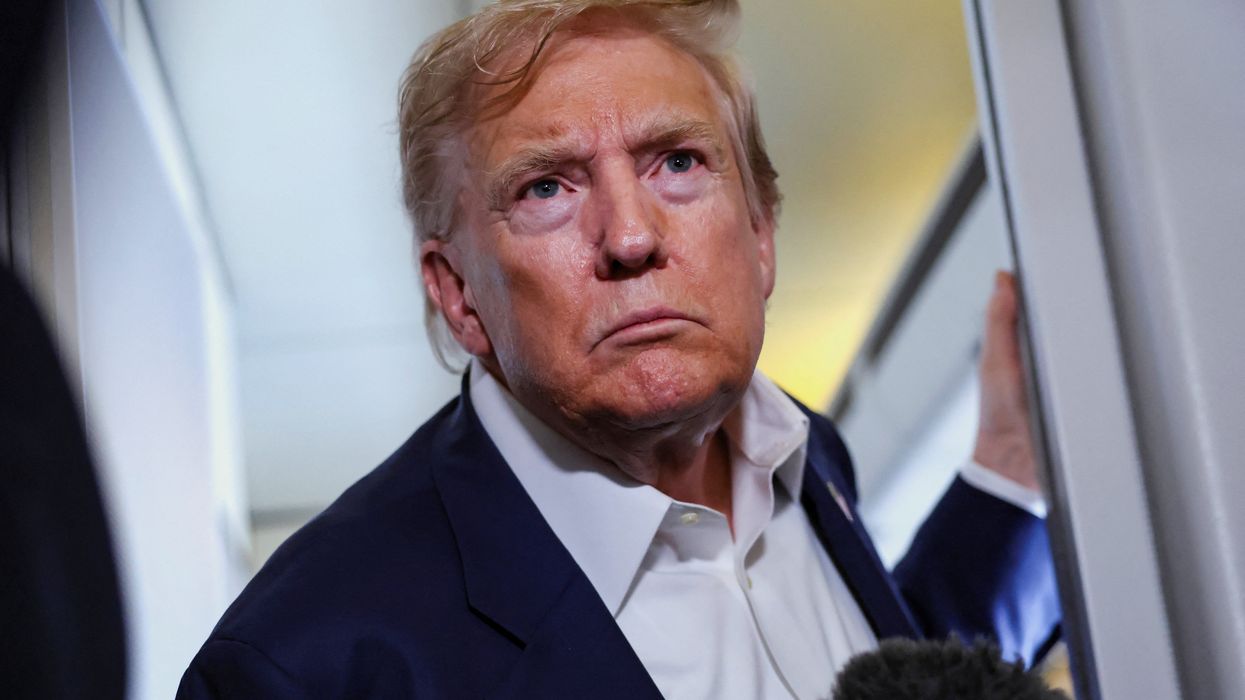
President Donald Trump made historic inroads among young voters during the 2024 presidential election, but a conservative commentator and polling expert believes his second term has erased those gains — and for more than one reason.
Speaking with Here & Now's Indira Lakshmanan about a recent focus group session, The Bulwark’s Sarah Longwell analyzed her hundreds of hours of analysis and why it bodes so poorly for Trump.
“Nothing has shifted more in the Republican Party over the last decade than its views on foreign policy,” Longwell told Lakshmanan on Tuesday. “The Republican Party has just become very isolationist, especially among younger voters. And I think you can see this in polling, but we certainly hear it in focus groups with younger voters across the political spectrum.” Longwell described Republicans as not wanting American foreign policy to be entangled with Israel and, in general, to not get entangled in “foreign adventurism.” By invading Venezuela and Iran, and threatening invasions against Cuba, Denmark and Mexico, Trump has violated those ideals.
“I think for those voters, they're watching what Trump is doing right now and they're feeling duped and disappointed, because not only has he not lowered prices as they wanted, but he has of course launched a number of preemptive strikes and appears to be getting us into a new war right now,” Longwell said. She also pointed out that Trump has not lowered prices, even though he frequently promised to do so during his campaign, and supports building AI facilities. Both of these policies — one a failure to deliver, the other a controversial job-gobbling agenda — imperil Generation Z’s economic future.
“They talk about their fears around AI, they talk about just the price of everything, the fact that they can't pay rent or they'll never get into a house,” Longwell said. “And so when Trump talks about America First, it's not just a slogan for them. They read it as a statement of prioritization — Trump is saying he's going to focus on Americans and cost of living, and not on these other sorts of unnecessary things that they think politicians often focus on. And so right now, I've heard nothing from voters who are more disappointed with Trump than it is about the fact that he is not focusing on prices and is instead focusing on a variety of other things —
whether it is covering up the Epstein files, whether it's the ballroom that he's building, and now I think getting into a war.”
In addition to feeling frustrated with Trump on a policy level, young people find that he has so polarized American politics that it even trickles into their personal lives.
“There's also, among young men and young women, a level of political divergence — the gap is greater than it's ever been,” Longwell explained. “So you have the vast majority of young women who are more progressive, or who vote for Democrats, and do not support JD Vance and Donald Trump. And young men, on the other hand — not overwhelmingly, but you have a lot more young men who like Donald Trump, who listen to and kind of live in the manosphere podcasting world. And that actually puts a strain on their social relationships, because if a young woman thinks that a young man who votes for Donald Trump is somebody they just don't share values with — that that vote is an indication of not having shared values — that makes dating very hard.”
She added, “And so you hear a lot of young Trump-voting men complaining that it's hard to find a conservative woman. And you hear a lot of progressive young women saying that under no circumstances would they date somebody who voted for Donald Trump.”
An April 2025 survey by the Yale Youth Poll found that a disproportionate number of Generation Z-ers who were aged 13 to 16 during the COVID-19 lockdowns are Republican, especially men. This is because they gravitated towards the Republicans’ anti-lockdown rhetoric and had so much free time devoid of socialization that they were easy prey for manosphere influencers.
"Turns out, they weren’t too happy about it. Perhaps it’s not surprising, then, that this group has gravitated to the GOP, the political party that ultimately opposed pandemic lockdowns and belittled precautions like vaccines and masks," the report said. Jack Dozier, deputy director of the Yale Youth Poll, told Bloomberg, "These kids are students who have grown up in a different media environment, in a different world — basically — than their peers.”
He concluded, “They’re significantly more conservative and while they still have some tendencies to lean towards progressive social issues, their economic issues and, at the end of the day, their party choice is significantly more conservative.”
By early 2026, however, the signs already emerged that this conservatism was cracking. Last month Vox interviewed Rachel Janfaza, the founder of The Up and Up, a research firm dedicated to Gen Z.
"In my work as a researcher, this is something I heard in focus groups and on campus quads at the time," Janfaza explained. "Yes, economic issues mattered the most, but a surprising number volunteered that they were worried about the US being dragged into conflicts — and what it would mean for the generation that would be tasked with fighting them."