
Election deniers are running for governor across America —and they could steal 2028
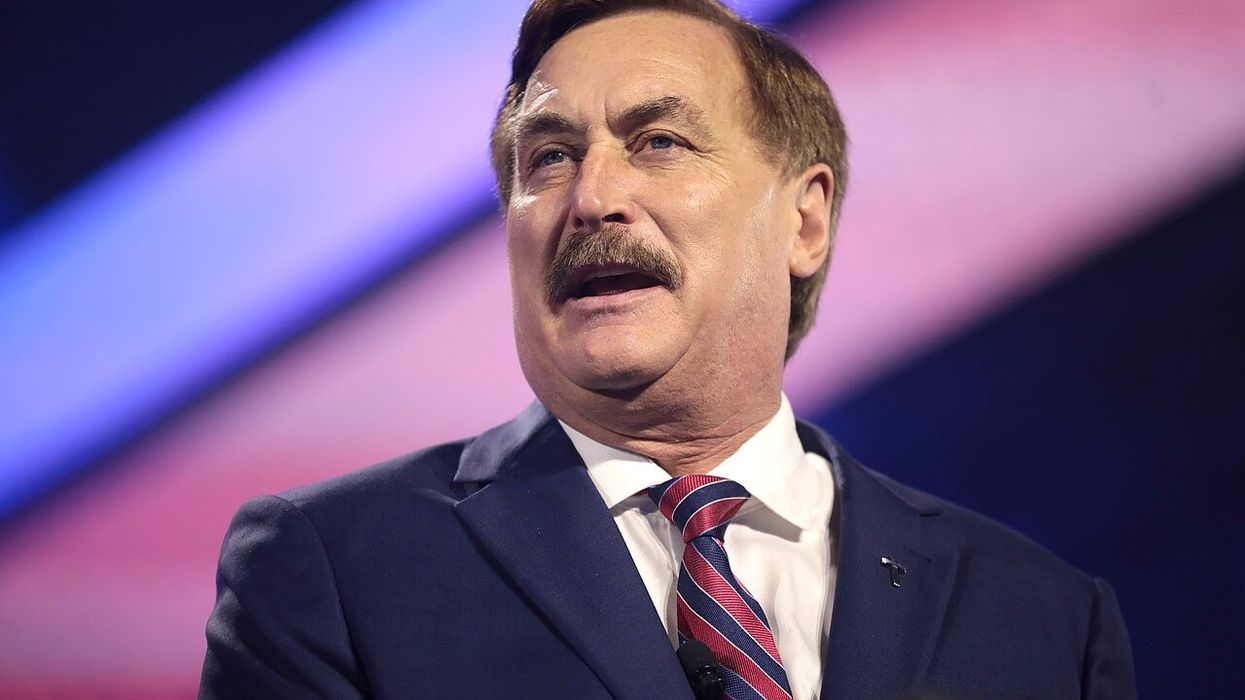
MyPillow CEO Mike Lindell in Phoenix in December 2022 (Gage Skidmore)
MyPillow CEO Mike Lindell in Phoenix in December 2022 (Gage Skidmore)

MyPillow CEO Mike Lindell in Phoenix in December 2022 (Gage Skidmore)
President Donald Trump continues to falsely claim that he won the 2020 presidential election — and now that fabrication is fueling the agendas for a new generation of potential Republican governors.
Michigan Republican strategist Jason Cabel Roe argued that the emphasis on supporting Trump’s election denial is “silly because they know better,” wrote The Washington Post's Dan Merica, Patrick Marley and Clara Ence Morse. The former executive director of the Michigan Republican Party then added “but, you know, it’s still what the base wants to hear.” Despite this obsession, however, Roe added that voters are far more concerned about the economy and the price of gas.
“There’s enough muddying of what everybody’s feelings are about election integrity at this point — and maybe even a little exhaustion with relitigating an election that was six years ago — that I just don’t know that it really matters to voters,” Roe explained. His position was supported by a March NBC News poll which determined voters are mostly concerned with inflation and the cost of living, followed by threats to democracy.
The Republicans running for governor in their respective states on election denier platforms include Minnesota's Mike Lindell, who founded MyPillow; Arizona's Rep. Andy Biggs; Georgia's Lt. Gov. Burt Jones; Pennsylvania’s Republican treasurer's Stacy Garrity; Wisconsin's Rep. Tom Tiffany; Michigan's state Senate Minority Leader Aric Nesbitt and Rep. John James; and California's Riverside County Sheriff Chad Bianco.
In addition to demonstrating their fealty to Trump, election denying also means these candidates could try throwing out valid vote counting efforts in the 2028 presidential election if urged by the White House.
“This is an important issue,” Kentucky Gov. Andy Beshear, chair of the Democratic Governors Association, a group preparing to make Republicans’ history of election denialism a key issue in 2026, said at a speech. “But it’s not the only issue, and it shouldn’t necessarily be the lead thing. Almost everyone in this economy is struggling because of [Trump] and these folks that are running, these election deniers, were willing to do anything for this president. So, their past attempts to steal an election were to steal it for a guy that’s made life tougher. They’re certainly not going to stand up to him to try to make life easier.”
As conservative columnist George F. Will wrote in February, Trump has thoroughly litigated his claims of election fraud, and they have all been found wanting.
“Someone should read to him ‘Lost, Not Stolen,’ a 2022 report by eight conservatives (two former Republican senators, three former federal appellate judges, a former Republican solicitor general, and two Republican election law specialists),” Will explained in The Washington Post. “They examined all 187 counts in the 64 court challenges filed in multiple states by Trump and his supporters. Twenty cases were dismissed before hearings on their merits, 14 were voluntarily dismissed by Trump and his supporters before hearings. Of the 30 that reached hearings on the merits, Trump’s side prevailed in only one, Pennsylvania, involving far too few votes to change the state’s result.”
Will added, “Trump’s batting average? .016. In Arizona, the most exhaustively scrutinized state, a private firm selected by Trump’s advocates confirmed Trump’s loss, finding 99 additional Biden votes and 261 fewer Trump votes.” Therefore he wrote of Trump, “The man who never alters his opinion is like standing water, and breeds reptiles of the mind.”

