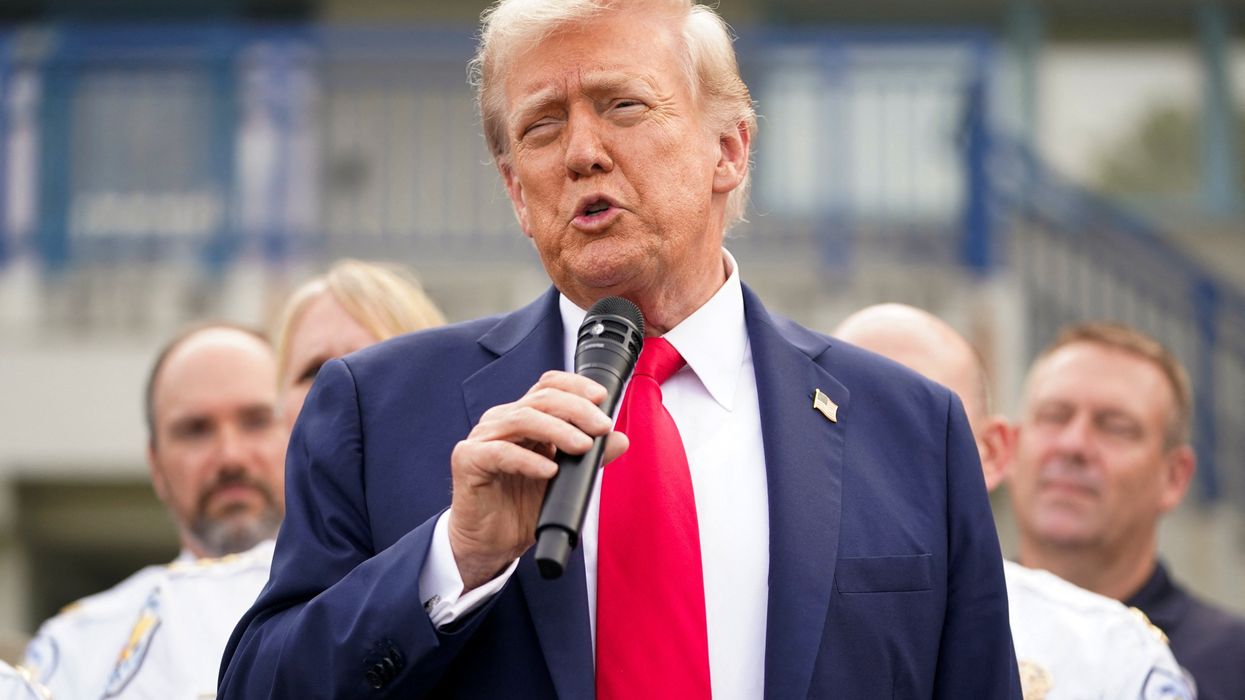
President Donald Trump claimed credit for America’s record low murder rate — but top crime experts say the actual sources of the crime drop precede Trump’s recent second term.
“The answer is, we don’t know,” said Jeff Asher, a crime statistician behind the Real-Time Crime Index, at a recent panel covered in a report by the gun violence magazine The Trace. The Real-Time Crime Index compiles data from hundreds of police reports all over America to accurately monitor crime patterns. Using his research, Asher concluded that the crime drop preceded Trump’s second term.
“We saw a record drop in murder in 2023, 2024, and then again in 2025,” Asher explained. “So the roots of it are probably stuff that happened in the 2021-2022 time frame.”
This does not mean that Trump is entirely incorrect in stating, as he did during his 2026 State of the Union message, that “last year the murder rate saw its single largest decline in recorded history.” A January study from the nonpartisan think tank the Council on Criminal Justice found that 2025’s homicide rate may have been the lowest on record since 1900. Yet as Trace reported, “the vast majority of those homicides — around 75 percent — were gun homicides, which spiked in 2020 during Trump’s first term and continued to increase into 2021, before beginning a gradual and consistent decline through the remaining Biden years.”
Indeed, Asher pointed out at the aforementioned panel that Trump’s biggest boast in terms of reducing crime can be clearly contextualized in terms of the years preceding his second term.
“I deployed our National Guard and federal law enforcement to restore law and order to our most dangerous cities, including Memphis, Tennessee, big success; New Orleans, Louisiana, big success; and our nation’s capital itself, Washington, D.C., where we have almost no crime anymore,” Trump said during the State of the Union. “How did that happen?”
Asher pointed out during the panel that “in D.C., you’ve seen a massive drop in crime from the middle of 2023 through the summer of 2025 that just continued at the same level. Maybe there were a couple of weeks of lower gun violence” as a result of Trump’s National Guard deployments, “but again, that’s hard to tease out when you’ve had two straight years of large declines in gun violence.”
Trump himself has in the past acknowledged that, in order to reduce crime, he needs to focus on gun violence — but when he openly states this, he faces pushback from the pro-gun factions of his Republican Party base.
For example, Trump was harshly criticized when Judge Jeanine Pirro told Fox News earlier this month that if “you bring a gun into the District, you mark my words, you’re going to jail. I don’t care if you have a license in another district, and I don’t care if you’re a law-abiding gun owner somewhere else. You bring a gun into this District, count on going to jail, and hope you get the gun back, and that makes all the difference.” A pro-Trump congressman, U.S. Rep. Greg Steube (R-FL), told Pirro “Come and Take It.” He later added, “I bring a gun into the district every week. I have a license in Florida and DC to carry. And I will continue to carry to protect myself and others.”
Trump himself has at times indicated a support for stricter gun control laws. After Minnesota intensive care nurse Alex Pretti was shot to death by border patrol agents during a protest, Trump argued “you can’t have guns. You can’t walk in with guns” when protesting around federal agents. Trump faced significant MAGA pushback for these remarks, but America’s main pro-gun advocacy group, the National Rifle Association (NRA), has lost power since a fifth of its membership left between 2019 and 2022 after former leader Wayne LaPierre was accused of siphoning off NRA funds.
Some speculate that the pro-gun movement is losing clout because of the NRA’s diminished standing. Yet in January, when Trump-appointed US Attorney Bill Essayli said federal agents would be “legally justified in shooting” a person who approached them while armed, certified firearms instructor Stephen Gutowski argued in an MS NOW op-ed that the Trump administration’s “coordinated messages” have “already sparked backlash from some of Trump’s closest allies: gun-rights activists.” The NRA itself wrote on social media that Essayli’s statements were “dangerous and wrong,” adding that “responsible public voices should be awaiting a full investigation, not making generalizations and demonizing law-abiding citizens.”
During his first term, Trump backed down when confronted by the NRA, although on those occasions LaPierre was still in charge of the organization. In 2018 Trump told a White House gathering of America’s governors that he supported “getting rid” of bump stocks and strengthening background checks.
“It doesn’t seem to make sense that you have to wait until you’re 21 years old to get a pistol, but to get a gun like this maniac used in the school, you get that at 18,” Trump told Fox News at the time. “I mean that doesn’t make sense, and, frankly, I explained that to the NRA.”
Trump later walked back these statements and never pushed for these regulations. Scientific studies on gun control (as aggregated by the RAND Corporation, a nonprofit global policy think tank) found a correlation between lowered crime rates and laws like mandatory waiting periods, child-access prevention laws, forcibly confiscating firearms from those prohibited from owning them and banning those convicted of domestic violence from owning firearms. Mandatory waiting periods, minimum age requirements and child-access prevention laws were also correlated with drops in suicide rates.