

Wile E. Coyote vs. Trumpism —and the movie Hollywood didn't want you to see
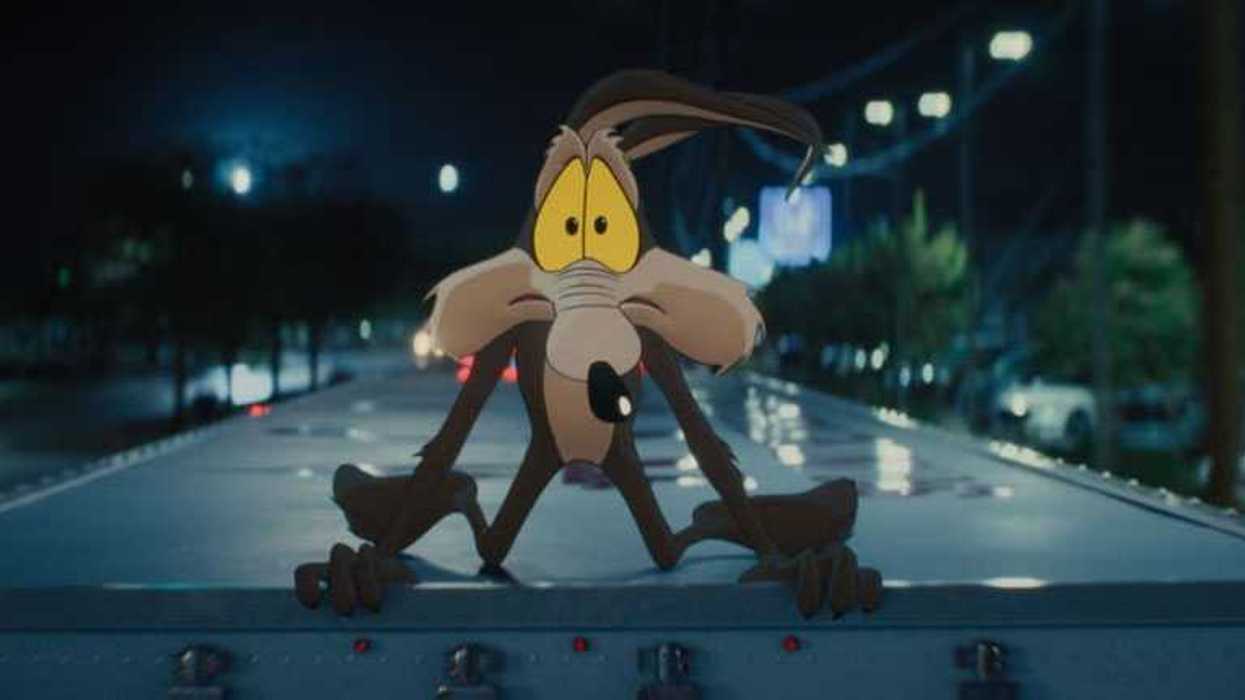
Screenshot from "Coyote vs Acme"
In the age of President Donald Trump, the Consumer Finance Protection Bureau has been gutted and the Food and Drug Administration is being run by quacks. Because the government no longer protects the public from predatory financial institutions or irresponsible purveyors of food and medicine, Americans are being exploited by banks and credit unions, as well as consuming dangerous foods from glass-riddled bread to diarrhea-inducing lettuce.
If this is an unusually serious way to introduce the review of a Looney Tunes movie, that's because "Coyote vs. Acme" has a surprisingly somber story. Starring Will Forte, Lana Condor, PJ Byrne and John Cena and directed by Dave Green off a script by Samy Burch, "Coyote vs. Acme" tells the story of the Warner Bros. cartoon Wile E. Coyote (who never speaks here, although he occasionally piped up in the cartoons) as he sues the Acme Corporation for selling him defective products in his ongoing quest to capture the Road Runner (Eric Bauza). The coyote and road runner have been engaged in slapstick antics over dozens of short cartoons since 1949, but they have never been the subject of their own feature-length motion picture. Here, though, the titular coyote recruits the services of lawyers Kevin and Paige Avery (Forte and Condor) to prove that Acme should be held accountable for his pain and suffering... or, at least, that is how it seems at first.
A work of genius
The genius of "Coyote vs. Acme" — and I do not use the term "genius" lightly here — is that beneath the characteristically hilarious cartoon antics, this is a film filled with surprises and subtext. It explicitly references the myth of Sisyphus, an ancient Corinthian king condemned to an afterlife of forever rolling a boulder up a hill only to have it roll back down whenever it nears the top. The modern French philosopher Albert Camus argued that Sisyphus' punishment, instead of being torture, was actually a form of paradise, writing in his 1942 essay "The Myth of Sisyphus" that "Sisyphus teaches the higher fidelity that negates the gods and raises rocks. He too concludes that all is well. This universe henceforth without a master seems to him neither sterile nor futile. Each atom of that stone, each mineral flake of that night filled mountain, in itself forms a world. The struggle itself toward the heights is enough to fill a man's heart."
Camus concluded, "One must imagine Sisyphus happy." The beauty of "Coyote vs. Acme" is that it reimagines its hapless hero, the coyote, as an aspirational rather than tragic figure, his perpetual failures reminding us that the journey as well as the destination are both worth savoring, even when they do not wind up being exactly what we expect. On top of this existential meditation, "Coyote vs. Acme" is also a scathing commentary on corporate America, with the Acme Corporation serving as a stand-in for the corrupt mega-businesses that dominate our real world. Even though life is meant to be a struggle, that doesn't mean those who live it should be subject to the whims of those with great power and no ethics, a point that "Coyote vs. Acme" makes through the villainous lawyers Buddy Crane (Cena) and Bill Pellicano (Byrne), who are led by a CEO and cartoon rooster Foghorn Leghorn (Bauza). In the context of "Coyote vs. Acme," Wile E. Coyote is simultaneously hilarious punchline and heartbreaking punching bag. His plight reminds us of another intellectual, American humorist Mark Twain, whose description of coyotes in the 1872 book "Roughing It" inspired his animated counterpart.
The coyote, Twain wrote, is "a long, slim, sick and sorry-looking skeleton, with a gray wolfskin stretched over it, a tolerably bushy tail that forever sags down with a despairing expression of forsakenness and misery, a furtive and evil eye, and a long, sharp face, with slightly lifted lip and exposed teeth. He has a general slinking expression all over. The coyote is a living, breathing allegory of Want. He is always hungry. He is always poor, out of luck, and friendless. The meanest creatures despise him, and even the fleas would desert him for a velocipede. He is so spiritless and cowardly that even while his exposed teeth are pretending a threat, the rest of his face is apologizing for it.”
A great kiddie flick
If this seems too heady for little ones, no worries. At the packed screening I attended on an early Friday afternoon, the children hooted and hollered at the wall-to-wall gags with such glee that I would have smiled with nostalgia (I, too, was raised on Looney Tunes) even if I wasn't often chuckling myself (which I was). Like all great family movies, "Coyote vs. Acme" works on two levels — it has deep philosophical and social commentary for the adults, juvenile jokes for the kids and a fast-paced, funny story that works for both groups. If there is any justice in the world, "Coyote vs. Acme" will be the first Looney Tunes movie to win an Academy Award for Best Animated Feature (six have won Best Animated Short Film, all between 1947 and 1958 and none starring Wile E. Coyote and the Road Runner). Even if other great animated features are released in 2026, it will be impossible for any of them to match "Coyote vs. Acme" in combining top notch writing, comedy and animation with a historical pedigree going back decades.
Additionally, an Oscar win would be the ultimate triumphant note for a movie that Warner Bros. didn't even want you to see. For context there, I refer to a recent summary from Decider.
"Unlike those more grown-up movies we mentioned, it’s not the content of 'Coyote vs. Acme' that caused Warner Bros. to drop the movie," explained Decider's Jesse Hassenger. "(It’s a solid PG, a rarity these days.) It’s not the quality, either. (We’ll get to that shortly.) It was part of a cost-saving measure that also claimed the not-yet-finished Batgirl and a Scooby-Doo animated feature. Executives decided it would be more worthwhile to claim these movies as tax write-offs than actually attempt to make money by releasing them. To claim said write-off, the movies would have to be, essentially, locked in a corporate vault and never shown."
Given the plot and historical context of "Coyote vs. Acme," that backstory resonates more profoundly than it otherwise would.
At the time I write this, Warner Bros. is being greedily eyed by David Ellison, the billionaire nepo baby who seems determined to purchase major media companies and turn them into bastions of pro-Trump bootlicking (see his alleged firing of comedian Stephen Colbert and confirmed terminations of principled journalists at "60 Minutes"). While "Coyote vs. Acme"'s suppression had nothing directly to do with Trump, indirectly that act of censorship is quite consistent with Trump-era values. Instead of sharing a great work of art with the public, Warner Bros. wanted to bury it just so they could make a few extra bucks. (Ultimately, after widespread public outcry, they sold it to distributor Ketchup Entertainment.) More to the point, at a time when Trump is destroying institutions that protect the public from oligarchical avarice, "Coyote vs. Acme" launches a missile directly into the "might makes right" ethos promulgated by Trump and his supporters.
Closing with Chris Dodd
As I watched "Coyote vs. Acme," I thought of my 2025 Democracy at Work interview with former Sen. Chris Dodd (D-CT), who co-authored the 2010 Dodd-Frank Act. When I asked him about Trump's destruction of the Consumer Finance Protection Bureau, which Dodd-Frank created, the erstwhile lawmaker had a profound observation about Trump's larger agenda.
“That is, of course, just to destroy the ability of consumers, individually and generally, to have the kind of protections that they deserve to have, particularly people who live paycheck to paycheck trying to survive,” Dodd pointed out. It is very much by design that, in Trump's America, everyone who isn't in cahoots with Acme is Wile E. Coyote, living in want, "always hungry" and "always poor, out of luck, and friendless," always one greedy and cruel business decision away from humiliation and physical hardship.
Unlike the coyote, though, there is nothing noble in America's ongoing fanatical refusal to quit Trump. I'm reminded of the Spanish American philosopher George Santayana, whose definition of "fanatic" inspired one of Chuck Jones' rules governing Wile E. Coyote's behavior: "A fanatic is one who redoubles his effort when he has forgotten his aim."
Because it captures all of these themes, albeit in its own looney way, "Coyote vs. Acme" is a literal work of genius, the very description that Wile E. Coyote perennially uses to describe himself. It is both timeless and very much a product of our own time, a light-hearted comedy romp and a genuine contemplative look at the meaning of life.
There is not a single person to whom I would not recommend "Coyote vs. Acme."

