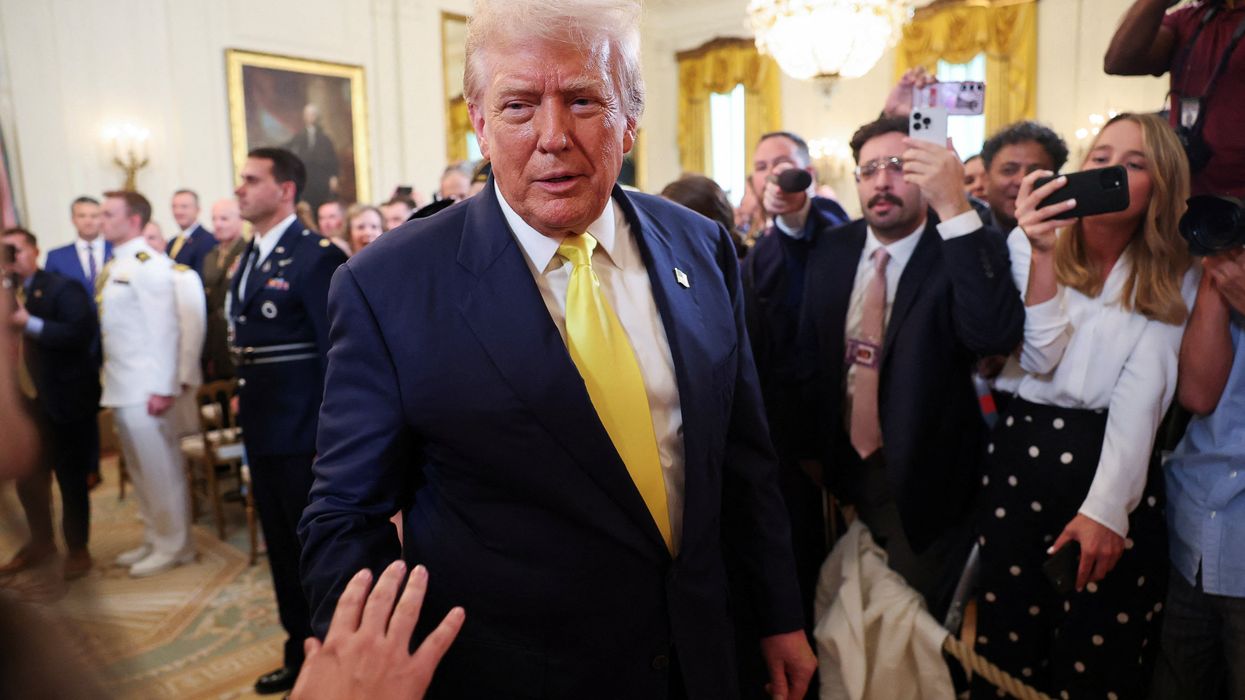
President Donald Trump is closely aligned with Silicon Valley oligarchs, from directly receiving their largesse in campaign donations to aggressively pushing their AI technology on Americans. Yet a recent report in The Hill reveals that, despite these ties, some of those same oligarchs feel awkward about their relationship with the president.
“While several tech leaders are making their relations — both good and bad — with the president public, [OpenAI CEO Sam] Altman has largely kept quiet about the president and the extent of his relationship with him,” reported The Hill's Miranda Nazzaro on Sunday. “It comes as OpenAI prepares an initial public offering, and Altman faces his own blowback from the anti-AI movement.”
Similarly X CEO Elon Musk, despite relying on Trump for government contracts, had a public falling out with the president after clashing over spending bills and blame for political failures. Eventually the two reconciled, with each walking back their negative statements about the other, and Nazzaro noted that “in the largest and latest sign of reconciliation, Musk was one of two executives aboard Air Force One with Trump for the China state visit earlier this month."
Dario Amodei, a founder of Anthropic, wound up on Trump’s bad side when he refused to allow his AI to break ethical codes in its work with Secretary of Defense Pete Hegseth and his Pentagon. Amodei even later said, in a memo leaked by the Trump administration, that he believed Trump had targeted him because Anthropic neither donated to his campaign nor engaged in “dictator-style” praise of Trump, as did many of his competitors. Amodei later apologized to investors for his split with Trump and has since reconciled with the president, remaining in the loop on AI policy.
Amazon founder Jeff Bezos started out as anti-Trump, particularly through his leadership of The Washington Post during his first term, but later revealed himself as pro-Trump when he killed an op-ed supporting Democratic presidential nominee Kamala Harris in the 2024 presidential election. Bezos has subsequently gone out of his way to praise Trump, earlier this month describing Trump’s second term as “more mature, more disciplined version of himself than he was in his first term.”
He later told CNBC’s “Squawk Box” that “Trump has lots of good ideas. He’s been right about a lot of things. You have to give him credit where credit is due.”
Nazzaro also talks about Meta CEO Mark Zuckerberg and Nvidia CEO Jensen Huang, both of whom have also cultivated ties with Trump to advance their business interests. By contrast venture capitalist David Sacks is one of Trump's closest AI advisers, and is widely regarded as pushing Trump to support the AI CEOs agenda.
Indeed, as protests against AI have surged, Trump has worked toward making it illegal to protest the development of AI.
“In the wake of attacks on CEOs, a nationwide protest movement targeting data centers, and increasing concerns about AI job replacement, federal intelligence agencies and domestic law enforcement are circulating reports with a new domestic target in mind: anti-technology extremists,” wrote Wired's Daniel Boguslaw on Sunday. “More than 1,000 pages of unpublished reports from the Department of Homeland Security, FBI, and fusion centers obtained by WIRED show a national shift taking place to surveil this new and worryingly broad category of people and activities deemed an emerging threat.”
Despite the attempts to suppress anti-AI sentiment, AI proponents like former Google CEO Eric Schmidt, real estate executive Gloria Caulfield and music executive Scott Borchetta were roundly booed when they promoted AI during college commencement speeches. Semafor recently reported that anti-AI sentiment in America is overwhelming, suggesting that the college students’ hostility mirrors that of the American public at large.
“Polls show that 70% of Americans think AI is moving too fast, over 50% have negative views of it, and just 18% of young people say they feel hopeful about it,” Semafor reported. “Partly, they are turned off by AI’s upending of the job market. ‘Every other day, a new AI agent is being released in the market,’ said Vaishali Hireraddi, 23, a University of California, Davis, graduate student who’s applied to 500 jobs so far. ‘What am I doing with my life?’”